Categories
Beyond

RBI targets early FY28 for plastic notes rollout

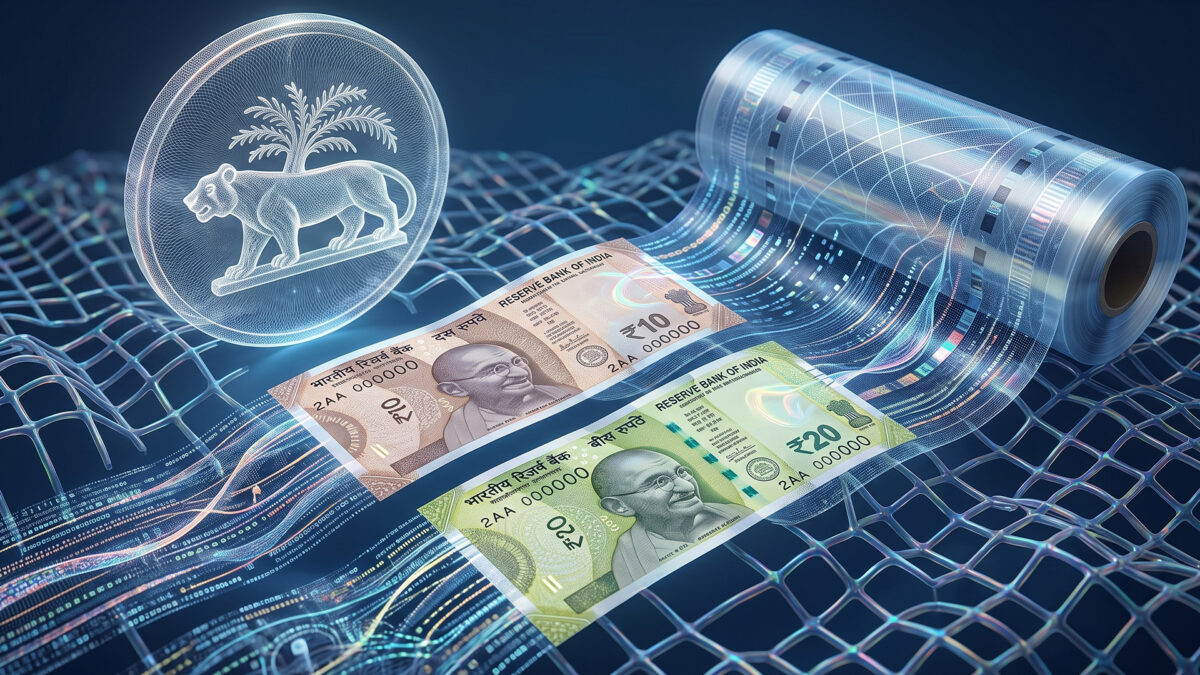
India is moving closer to introducing plastic currency, with Reserve Bank of India (RBI) Governor Sanjay Malhotra saying the central bank is targeting the circulation of polymer banknotes from the beginning of the next financial year. If the ongoing field trials and operational preparations go as planned, Indians could start seeing polymer ₹10 and ₹20 notes from early FY28, which begins in April 2027.

The announcement marks a significant step in India’s long-running plan to introduce polymer currency. The RBI has been examining the possibility of using plastic-based notes for years, but the latest update suggests that the proposal has now moved beyond an initial assessment and into a structured testing phase.

Speaking to reporters after the RBI’s monetary policy announcement on Wednesday, Malhotra said the central bank would first evaluate the results of the ongoing pilot before making a final decision on wider circulation. The RBI does not want to rush the transition and will test how the new banknotes perform in real-world Indian conditions.

The initial trial will focus on the ₹10 and ₹20 denominations. The government has approved the RBI’s proposal to conduct field trials involving one billion polymer notes of each denomination, taking the total to two billion notes. The exercise will allow the central bank to examine durability, performance, printing efficiency, security and how easily the notes can be handled in everyday transactions.

The choice of ₹10 and ₹20 notes is deliberate. These are among the most frequently handled denominations in the Indian currency system and tend to wear out faster because they change hands repeatedly. According to the latest information, the two denominations together account for nearly 25% of the total volume of banknotes in circulation, while representing only around 1.4% of the total value. This gives the RBI an opportunity to conduct a large-scale test without exposing the currency system to significant financial risk.

Polymer banknotes are made from a thin, flexible plastic material instead of traditional cotton-based paper. Their biggest advantage is durability. They are more resistant to moisture, dirt and tearing and can remain usable for much longer than conventional paper currency. This could be particularly useful for low-value notes, which are frequently damaged and withdrawn from circulation.

For the RBI, longer-lasting currency could also mean fewer notes needing to be replaced. That could eventually reduce the cost and logistical burden associated with printing, transporting and withdrawing worn-out banknotes. However, the central bank will have to establish whether those advantages hold up under India’s varied climate and heavy cash usage before deciding on a wider rollout.

Security is another important part of the experiment. Polymer currency can accommodate features such as transparent windows and other anti-counterfeiting elements that are difficult to reproduce. The RBI will therefore examine whether polymer notes can provide stronger protection against counterfeit currency while remaining easy for the public and banks to authenticate.

The initial introduction is also designed to minimise disruption to India’s cash infrastructure. ₹10 and ₹20 notes are mainly distributed through bank branches rather than ATMs, allowing the RBI to test the new currency without immediately requiring major changes to ATM networks. A move to polymer notes in higher denominations could be more complicated because existing machines may need software upgrades, recalibration or other modifications to recognise and process the new notes.

Importantly, the arrival of polymer currency will not mean that India’s existing paper notes suddenly become invalid. The government has clarified that there is currently no proposal to completely replace paper banknotes. If the pilot succeeds, polymer notes are expected to circulate alongside conventional currency.

India’s move towards plastic money is not entirely new. The RBI has explored polymer currency for more than a decade. Earlier trials and proposals were considered in select cities, including Mysore and Cochin, while a separate proposal discussed in 2009 was eventually shelved because of technical challenges. The latest programme therefore represents another attempt to determine whether polymer banknotes can work effectively on a much larger scale in India.

The current approach is cautious. Rather than immediately replacing paper currency, the RBI will first put millions of polymer notes through real-world use. Their durability, security, public acceptance, printing process and overall performance will be closely assessed. The experience will then help determine whether polymer banknotes should be introduced in other denominations.

If the ₹10 and ₹20 trials are successful, the RBI could eventually consider extending polymer currency to higher-value denominations such as ₹100 and ₹500. But that decision is still some distance away and will depend on the results of the pilot.

For ordinary Indians, the change may initially seem small — a ₹10 or ₹20 note that feels different in the hand. But behind that simple change is a larger attempt to modernise India’s currency management system, make banknotes last longer and reduce the constant cycle of replacing worn-out cash.

For now, the key date to watch is April 2027, when the RBI is targeting the beginning of circulation of polymer notes, provided the trials and preparations remain on track.

Categories
1 Minute-Read

Centre clears polymer ₹10, ₹20 notes rollout

The Centre has authorised the Reserve Bank of India (RBI) to issue up to two billion polymer banknotes in the ₹10 and ₹20 denominations, paving the way for a pilot rollout of more durable currency.

The approval allows the RBI to issue one billion notes of each denomination. Unlike paper notes, polymer banknotes are made from flexible plastic, making them more resistant to wear, moisture and dirt while improving security features.

Existing paper notes will continue as legal tender, with polymer notes introduced gradually to reduce replacement costs and improve the lifespan of India’s most frequently used currency. For more quick updates on policy and economic developments, explore our 1-Minute Read section.

Read More..

Categories
Beyond

RBI cleared to issue polymer ₹10, ₹20 notes

The Centre has approved the Reserve Bank of India (RBI) to issue up to two billion polymer banknotes in the ₹10 and ₹20 denominations, marking a significant step in the country’s efforts to modernise currency and improve the durability of frequently used notes. The move is expected to reduce the cost of replacing worn-out notes while making everyday cash transactions more efficient.

According to a government notification, the RBI has been authorised to issue one billion ₹10 polymer notes and one billion ₹20 polymer notes under the provisions of the RBI Act. The approval clears the way for the central bank to introduce polymer currency on a pilot scale before considering wider adoption in the future.

Unlike traditional paper currency, polymer banknotes are made from a thin, flexible plastic film. They are more resistant to moisture, dirt and tearing, allowing them to remain in circulation much longer than conventional paper notes. This makes them particularly suitable for lower-denomination currency, which changes hands frequently and tends to wear out quickly.

Officials believe the new polymer banknotes will help reduce the recurring cost of printing replacement notes. Since ₹10 and ₹20 notes are among the most commonly used denominations in India, extending their lifespan could result in significant savings over time while improving the quality of currency in circulation.

The decision does not mean India is replacing all paper currency with plastic notes. Instead, the government and the RBI are adopting a gradual approach by introducing polymer notes only in selected denominations. Existing paper notes will continue to remain legal tender and circulate alongside the new polymer currency.

The RBI has been studying the use of polymer notes for several years. Many countries, including Australia, Canada, the United Kingdom, New Zealand and Singapore, have already switched to polymer currency for most or all of their banknotes. Their experience has shown that polymer notes generally last much longer, remain cleaner and offer better protection against counterfeiting.

Another key advantage of polymer banknotes is enhanced security. The material allows advanced security features such as transparent windows, complex holograms and improved printing techniques that are difficult to replicate. These features make counterfeit currency harder to produce and easier for the public to identify.

The notes are also expected to be more hygienic. Because polymer surfaces absorb less moisture and dirt than paper, they remain cleaner even after prolonged use. This is especially relevant in a country where currency notes pass through millions of hands every day.

The RBI is expected to finalise the design and production process before the new notes enter circulation. While the appearance may be similar to the existing ₹10 and ₹20 notes, the polymer versions are likely to incorporate updated security features and improved durability. The central bank has not yet announced a launch date.

Experts say introducing polymer currency is a practical step rather than a dramatic overhaul of India’s monetary system. By focusing first on low-value denominations, the RBI can assess how the notes perform under Indian climatic conditions, including high temperatures, humidity and heavy daily usage.

The move also aligns with India’s broader efforts to modernise its currency management system. Even though digital payments have grown rapidly in recent years, cash continues to play an important role in the economy, particularly in rural areas and small retail transactions. Ensuring that physical currency remains durable and secure is therefore still a priority.

Industry observers believe polymer notes could also reduce the environmental impact associated with frequent reprinting and disposal of damaged paper currency. Although polymer notes require specialised manufacturing, their longer lifespan means fewer notes need to be produced over time, potentially lowering overall resource consumption.

The approval comes as the RBI continues to strengthen currency security and improve cash management across the country. Alongside technological upgrades in banknote printing and counterfeit detection, the introduction of polymer notes reflects a long-term strategy to make India’s currency more resilient and cost-effective.

For the public, the transition is expected to be seamless. The new polymer ₹10 and ₹20 notes will be used just like existing banknotes and will remain interchangeable with paper currency. There will be no need to exchange existing notes, and all valid paper notes will continue to be accepted for transactions.

As the RBI prepares for the rollout, the initiative is being viewed as an important milestone in India’s currency evolution. If the pilot proves successful, polymer banknotes could gradually become a familiar part of everyday life, offering longer-lasting, cleaner and more secure currency while helping reduce the cost of managing cash across the country.