
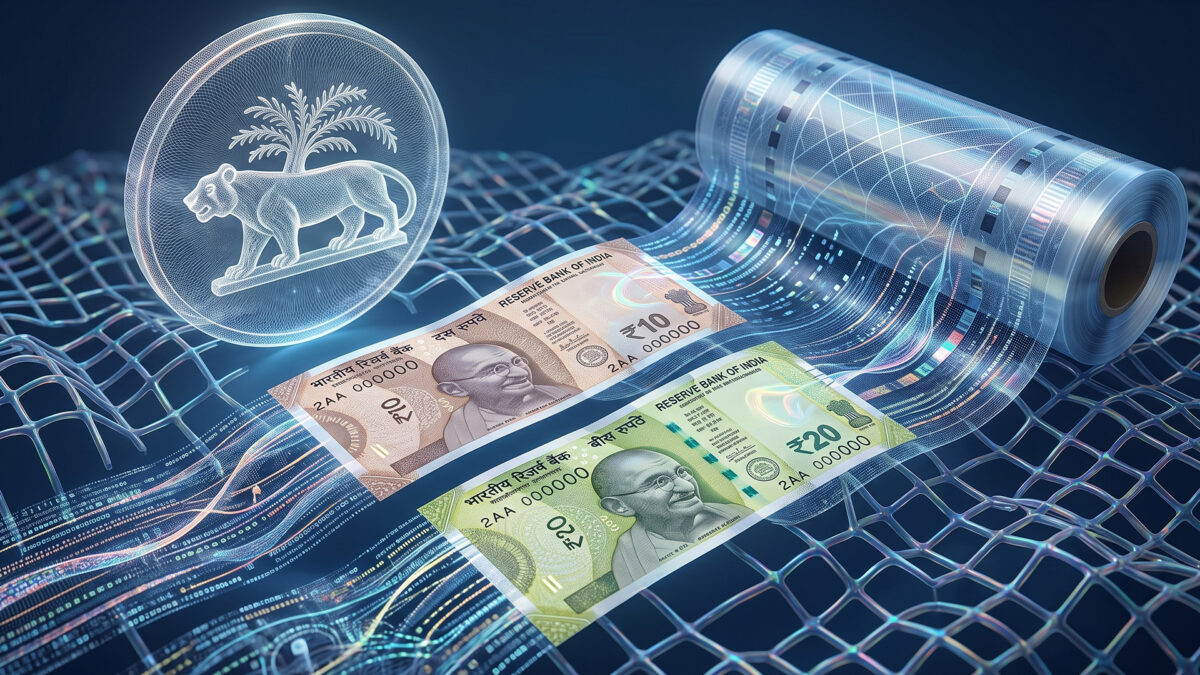
The Centre has approved the Reserve Bank of India (RBI) to issue up to two billion polymer banknotes in the ₹10 and ₹20 denominations, marking a significant step in the country’s efforts to modernise currency and improve the durability of frequently used notes. The move is expected to reduce the cost of replacing worn-out notes while making everyday cash transactions more efficient.
According to a government notification, the RBI has been authorised to issue one billion ₹10 polymer notes and one billion ₹20 polymer notes under the provisions of the RBI Act. The approval clears the way for the central bank to introduce polymer currency on a pilot scale before considering wider adoption in the future.
Unlike traditional paper currency, polymer banknotes are made from a thin, flexible plastic film. They are more resistant to moisture, dirt and tearing, allowing them to remain in circulation much longer than conventional paper notes. This makes them particularly suitable for lower-denomination currency, which changes hands frequently and tends to wear out quickly.
Officials believe the new polymer banknotes will help reduce the recurring cost of printing replacement notes. Since ₹10 and ₹20 notes are among the most commonly used denominations in India, extending their lifespan could result in significant savings over time while improving the quality of currency in circulation.
The decision does not mean India is replacing all paper currency with plastic notes. Instead, the government and the RBI are adopting a gradual approach by introducing polymer notes only in selected denominations. Existing paper notes will continue to remain legal tender and circulate alongside the new polymer currency.
The RBI has been studying the use of polymer notes for several years. Many countries, including Australia, Canada, the United Kingdom, New Zealand and Singapore, have already switched to polymer currency for most or all of their banknotes. Their experience has shown that polymer notes generally last much longer, remain cleaner and offer better protection against counterfeiting.
Another key advantage of polymer banknotes is enhanced security. The material allows advanced security features such as transparent windows, complex holograms and improved printing techniques that are difficult to replicate. These features make counterfeit currency harder to produce and easier for the public to identify.
The notes are also expected to be more hygienic. Because polymer surfaces absorb less moisture and dirt than paper, they remain cleaner even after prolonged use. This is especially relevant in a country where currency notes pass through millions of hands every day.
The RBI is expected to finalise the design and production process before the new notes enter circulation. While the appearance may be similar to the existing ₹10 and ₹20 notes, the polymer versions are likely to incorporate updated security features and improved durability. The central bank has not yet announced a launch date.
Experts say introducing polymer currency is a practical step rather than a dramatic overhaul of India’s monetary system. By focusing first on low-value denominations, the RBI can assess how the notes perform under Indian climatic conditions, including high temperatures, humidity and heavy daily usage.
The move also aligns with India’s broader efforts to modernise its currency management system. Even though digital payments have grown rapidly in recent years, cash continues to play an important role in the economy, particularly in rural areas and small retail transactions. Ensuring that physical currency remains durable and secure is therefore still a priority.
Industry observers believe polymer notes could also reduce the environmental impact associated with frequent reprinting and disposal of damaged paper currency. Although polymer notes require specialised manufacturing, their longer lifespan means fewer notes need to be produced over time, potentially lowering overall resource consumption.
The approval comes as the RBI continues to strengthen currency security and improve cash management across the country. Alongside technological upgrades in banknote printing and counterfeit detection, the introduction of polymer notes reflects a long-term strategy to make India’s currency more resilient and cost-effective.
For the public, the transition is expected to be seamless. The new polymer ₹10 and ₹20 notes will be used just like existing banknotes and will remain interchangeable with paper currency. There will be no need to exchange existing notes, and all valid paper notes will continue to be accepted for transactions.
As the RBI prepares for the rollout, the initiative is being viewed as an important milestone in India’s currency evolution. If the pilot proves successful, polymer banknotes could gradually become a familiar part of everyday life, offering longer-lasting, cleaner and more secure currency while helping reduce the cost of managing cash across the country.