
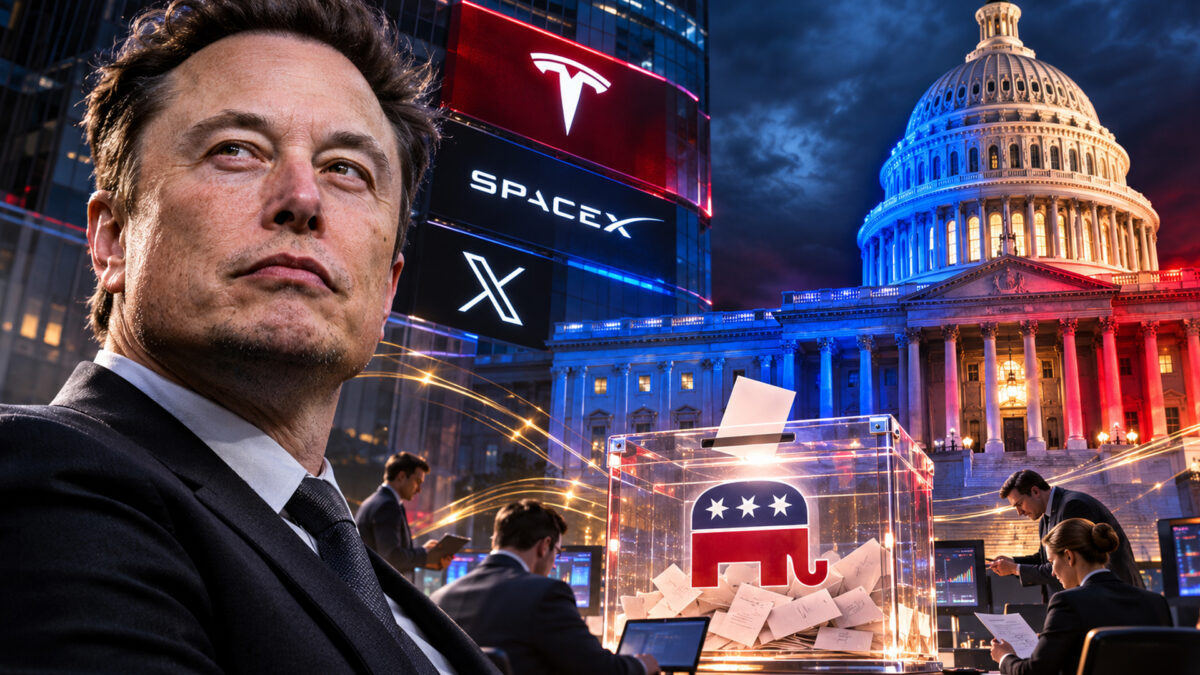
Elon Musk has deleted several pro-Republican social media posts following the party’s setbacks in the 2026 US midterm elections, drawing fresh attention to the billionaire’s political involvement and the impact of his campaign spending. Musk reportedly spent around $458 million supporting Republican candidates and political groups during the election cycle, making him one of the biggest financial backers of the party.
The developments come after Democrats made significant gains in the midterm elections, challenging Republican control and raising questions about the political influence of wealthy donors. The results also triggered a negative reaction in the stock market, with shares of Tesla and SpaceX-linked investment instruments coming under pressure.
Musk had been among the most prominent supporters of Republican candidates and President Donald Trump’s political agenda. His involvement extended beyond financial contributions, with the billionaire using his social media platform, X, to promote Republican messages and encourage voters to support the party.
His post-election decision to remove some of those messages has attracted attention, particularly given the scale of his financial commitment and his public role in the campaign.
Musk Deletes Republican Posts After $458 Million Bet
Strap: Democratic midterm victories rattle Musk-backed campaigns and send Tesla, SpaceX shares lower.
Elon Musk has deleted several social media posts urging Americans to vote for Republican candidates after the party suffered major setbacks in the 2026 US midterm elections. The move comes despite the billionaire spending at least $458 million backing Republican candidates and political organisations during the election campaign.
Democrats made significant gains, securing control of both the Senate and the House of Representatives, dealing a major blow to President Donald Trump and his Republican allies. Several candidates who received financial support from Musk also lost important races, raising questions about the effectiveness of his massive political investment.
Musk’s deleted posts included an October 29 message urging Americans to elect Republican senators and an Election Day appeal carrying the words “Vote red today!”. The October 29 message had been pinned to the top of his profile on X before it was removed following the election results.
The deletion attracted attention after users questioned the disappearance of the posts. Musk’s artificial intelligence chatbot Grok reportedly confirmed that he had removed the Election Day message following the Republican losses.
The development has brought renewed attention to Musk’s political influence, his relationship with Trump and the potential consequences for his business interests.
Musk was among the biggest financial supporters of Republican candidates during the 2026 US midterm election cycle. He reportedly contributed at least $458 million to Republican-aligned political campaigns and organisations, making him one of the largest individual political donors in recent American election history.
A significant portion of the money went through America PAC, Musk’s political action committee, which supported Republican candidates through campaign advertising, voter outreach and mobilisation activities.
His contributions also supported the Republican Senate Leadership Fund and other organisations working to retain Republican control of Congress.
Campaign finance disclosures and other estimates have placed his total spending at around $474 million, although the reported figures vary depending on the donations and political groups included.
Musk’s financial backing was particularly concentrated in Texas, where several of his businesses are headquartered. He reportedly spent nearly $230 million on the Texas Senate contest, supporting Republican candidate Ken Paxton against Democrat James Talarico.
However, Talarico defeated Paxton, delivering a significant setback to Musk’s political campaign.
The defeat was particularly notable because Texas has traditionally been a Republican stronghold. Democrat Gina Hinojosa also defeated incumbent Republican Governor Greg Abbott, adding to the party’s losses in the state.
Following the election results, Musk returned to X with several comments about the Republican setbacks.
In one post, he sarcastically wrote, “Guess my election-interfering space lasers didn’t work this time,” apparently referring to criticism of his political involvement.
He also posted that “Data centers in space looking pretty appealing right now”, a remark that attracted attention because of the growing political debate surrounding large AI infrastructure projects.
Musk subsequently shared comments about the election results and returned to discussing his technology ventures, including Starlink and Grok.
His decision to remove the earlier pro-Republican messages has nevertheless become a talking point, particularly because he had used his platform to encourage voters to support Republican candidates.
The Republican losses also affected investor sentiment towards Musk’s businesses. Tesla and SpaceX shares came under pressure following the election, as investors assessed the possible implications of a Democrat-controlled Congress for the billionaire’s companies.
Tesla shares fell around 3.3% on Wednesday, while SpaceX shares declined approximately 3.9%. The selling pressure continued into Thursday, with Tesla falling more than 11% and SpaceX losing nearly 9% in trading reports.
The combined market value of the two companies was on track to decline by more than $380 billion during the week, according to market reports.
Investors are particularly concerned about the possibility of increased regulatory scrutiny of Musk’s business operations and proposed projects.
Democratic lawmakers have indicated that they want closer oversight of Musk’s companies, including their government contracts, political contributions and business dealings.
One of the major concerns involves Musk’s expanding interest in artificial intelligence and data centre infrastructure.
SpaceX has increasingly been investing in AI computing, while Tesla’s energy business supplies battery storage systems used by data centre operators.
Both companies could face challenges if Democratic lawmakers push for stricter regulations on large data centre projects.
In Texas, concerns over electricity consumption, water availability and pressure on local power grids have become important political issues. Democratic candidates Talarico and Hinojosa had called for tighter regulations on AI data centres.
Goldman Sachs estimated that Democratic gains could lead to short-term data centre construction moratoriums affecting around 45% of planned US capacity expansion.
Musk’s proposed Terafab chip manufacturing complex in Texas, which could involve investments of up to $119 billion, may also face a more complicated approval process.
The election outcome could further complicate discussions surrounding a possible Tesla-SpaceX merger. Analysts believe increased regulatory scrutiny could make such a transaction more difficult.
The Democratic victories have created a new political environment for Musk, whose companies have significant commercial interests involving the US government.
SpaceX has important contracts with NASA and the Department of Defense, while Starlink plays a role in satellite communications and international operations.
Democratic lawmakers have already raised questions about several aspects of Musk’s business activities, including government contracts, his previous involvement in the Department of Government Efficiency and the use of Starlink.
With Democrats gaining control of Congress, these issues could receive greater attention through investigations and legislative proposals.
For Musk, the election results represent more than a political disappointment. They could influence the regulatory environment in which his businesses operate, particularly in AI, energy, space technology and government contracting.
The billionaire’s substantial financial backing failed to prevent major Republican losses. The coming months will show whether the change in congressional power translates into tougher oversight of his business empire.