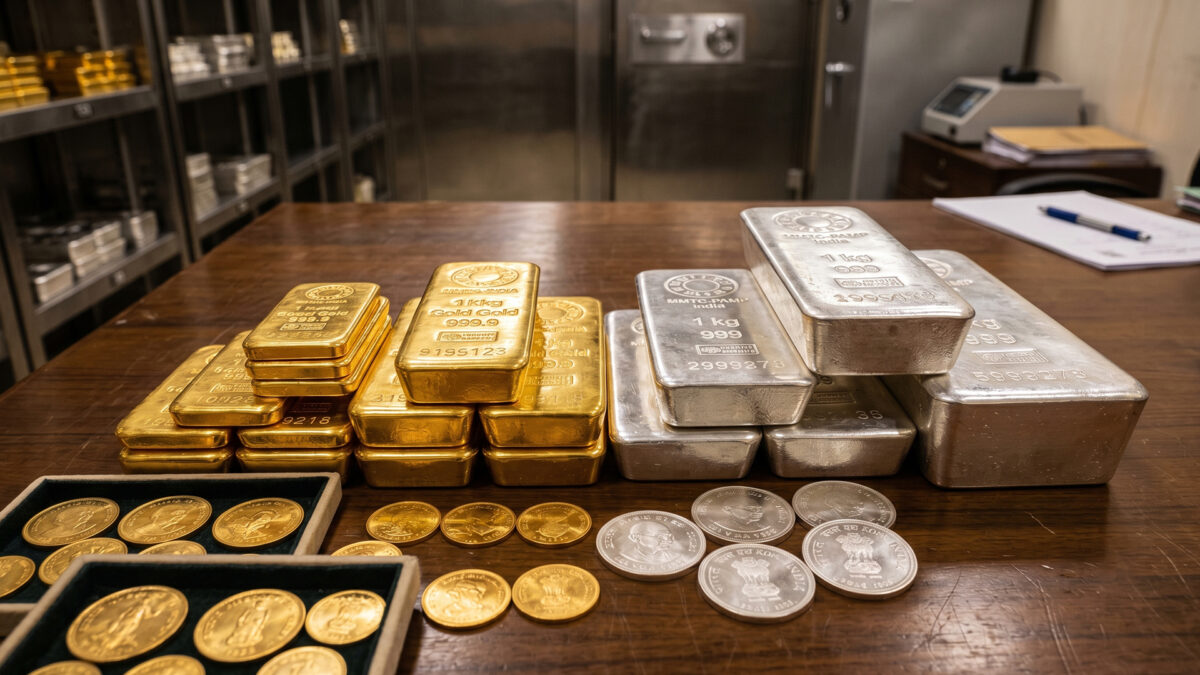
Gold prices recovered on Wednesday, September 16, after falling sharply in the previous session, while silver extended its gains in the domestic futures market. Investors continued to watch developments in West Asia, crude oil prices and the US Federal Reserve’s interest-rate decision, keeping precious metals in focus.
On the Multi Commodity Exchange (MCX), gold futures for October delivery were trading at around ₹1,51,785 per 10 grams in early trade, up nearly 0.65%. Silver futures for December delivery gained 1.33% to ₹2,35,200 per kg around 9.04 am. The recovery came after gold fell nearly 2% on Tuesday.
The latest movement in the gold price today reflects the continued volatility in the bullion market. Gold has been moving sharply in both directions as investors balance safe-haven demand against expectations of US interest-rate changes.
International gold prices also recovered on Wednesday. Spot gold rose about 0.8% to $4,328.39 an ounce, while spot silver climbed 1.5% to $64.60 an ounce. Investors were waiting for the US Federal Reserve’s policy announcement later in the day, which could influence the direction of global bullion prices.
Gold tends to attract buying when investors are worried about geopolitical or economic uncertainty. At the same time, expectations of higher interest rates can weigh on the metal because gold does not generate interest income. This has created a tug-of-war in the market, with safe-haven demand providing support while rate expectations limit the upside.
The continuing tensions in West Asia have also kept investors cautious. Developments affecting crude oil supplies are particularly important because any prolonged disruption could push energy prices higher and add to inflation concerns across major economies. Recent damage to Saudi Arabia’s East-West pipeline and the suspension of crude loadings at Yanbu have added to supply concerns.
Domestic retail prices remained elevated despite the recent correction. According to Indian Bullion Association data, 24-carat gold was priced at ₹1,52,330 per 10 grams on Wednesday, while 22-carat gold stood at ₹1,39,636 per 10 grams. Silver of 999 purity was quoted at ₹2,34,900 per kg.
Retail rates vary across cities because of local market conditions and other costs. In New Delhi, 24-carat gold was priced at ₹1,51,790 per 10 grams and 22-carat gold at ₹1,39,141. Silver 999 was quoted at ₹2,34,070 per kg.
Mumbai recorded a 24-carat gold rate of ₹1,52,050 per 10 grams, while 22-carat gold was priced at ₹1,39,379. Silver stood at ₹2,34,480 per kg.
In Bengaluru, 24-carat gold was quoted at ₹1,52,170 per 10 grams and 22-carat gold at ₹1,39,489. Silver was priced at ₹2,34,660 per kg.
The difference between MCX prices and retail jewellery rates is normal. Consumers also need to account for making charges, GST and other applicable costs when buying jewellery. The final amount paid at a jewellery store can therefore be higher than the quoted market rate.
Silver has been attracting particular attention in recent weeks. Its price is influenced not only by investment demand but also by its use in industries such as electronics, solar energy and manufacturing. That industrial demand gives silver a different price dynamic from gold and can lead to sharper movements.
The silver price today was showing strong momentum in the domestic futures market, with the December contract up 1.33% in early trade. The move followed a period of volatility in which silver, like gold, was affected by currency movements, crude oil prices and changing expectations around US monetary policy.
The US Federal Reserve’s decision remains the immediate global trigger for both metals. Investors are looking for signals on the future path of interest rates rather than focusing only on the decision itself. A more hawkish stance could put pressure on gold, while softer signals could support demand for precious metals.
The dollar is another important factor. A stronger US currency generally makes dollar-denominated gold more expensive for overseas buyers and can weigh on international demand. Movements in the rupee can also influence domestic gold rates in India, making the local price different from the international trend.
Wednesday’s recovery therefore comes at an important point for the bullion market. Gold remains close to historically high levels despite the recent correction, while silver continues to see strong buying interest.
Investors and retail buyers will be watching the Federal Reserve’s policy signals, crude oil movements, the rupee-dollar exchange rate and developments in West Asia. These factors are likely to determine the next major move in gold and silver prices as markets remain highly sensitive to global economic and geopolitical developments.