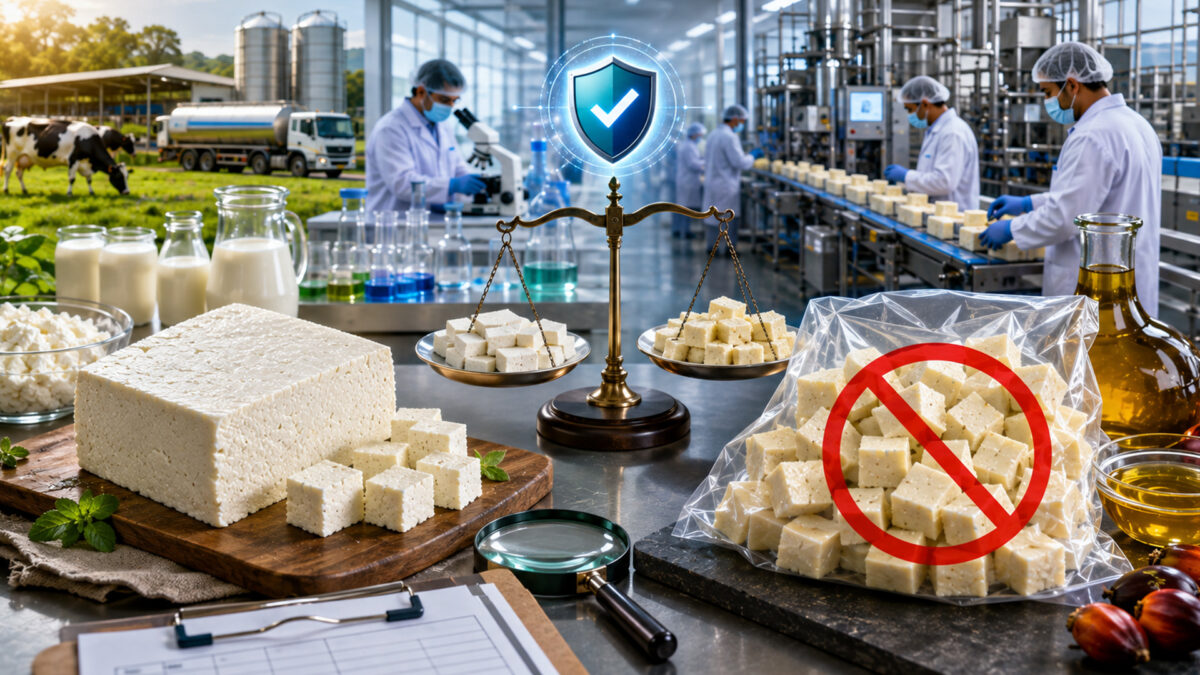
Gujarat has imposed a statewide ban on the manufacture, storage, transportation, distribution and sale of non-standard analogue paneer, cheese and butter, citing concerns over food safety, consumer protection and misleading products being sold as dairy items.
The decision was announced by Gujarat Health Minister Praful Pansheriya as the state steps up its crackdown on products that imitate traditional dairy foods without meeting prescribed standards. The prohibition has been introduced under the Food Safety and Standards Act, 2006.
The move is aimed at ensuring that consumers receive genuine and safe dairy products and are not misled into buying cheaper substitutes as if they were made from milk. Authorities have warned that individuals and food business operators found violating the order could face legal action under the food safety law.
Analogue dairy products are designed to look and behave much like conventional paneer, cheese or butter but are not necessarily made entirely from milk. Depending on the product, manufacturers may use ingredients such as vegetable fats, starches, milk proteins, emulsifiers and other additives to achieve a similar texture, appearance or taste.
The concern for regulators is not simply that these products are cheaper alternatives. The bigger issue is whether they are being properly identified and sold to consumers. A customer buying what they believe is dairy paneer, for instance, may not realise that the product is an analogue or non-dairy substitute.
This distinction is particularly important because genuine paneer is a milk-based food and is valued for its protein and other nutrients. Analogue products can have a different nutritional profile, depending on the ingredients used. Authorities are therefore focusing on product standards, labelling and consumer awareness alongside enforcement.
Gujarat’s decision comes just days after Maharashtra announced a statewide ban on analogue paneer. The Maharashtra Food and Drug Administration imposed a one-year prohibition on the manufacture, storage, transportation, distribution and sale of analogue paneer, citing food safety violations and consumer protection concerns.
Maharashtra’s action followed concerns raised through food testing. Reports said more than 35% of recent paneer samples tested in the state failed quality tests, with vegetable fat adulteration emerging as a concern. The state subsequently moved to prevent the production and sale of the non-dairy imitation product.
Chhattisgarh has also taken similar action. The state imposed a one-year ban on non-standard dairy analogue products, including paneer, cream and butter. The restrictions cover their manufacture, processing, storage, transportation, distribution and sale.
With Gujarat now joining Maharashtra and Chhattisgarh, the issue of analogue dairy products has moved into sharper national focus. The developments indicate growing attention from state authorities towards food adulteration, misleading labelling and the quality of products sold to consumers.
For Gujarat, the decision also has significance because of the state’s strong dairy industry. Authorities have said the move is intended not only to protect consumers but also to safeguard the legitimate dairy sector from products that may imitate traditional dairy foods without following the same standards.
The ban is likely to affect food businesses, restaurants, caterers, manufacturers and distributors that use or sell paneer, cheese and butter. Businesses will now need to ensure that their products meet the applicable food safety requirements and that customers are not misled about their composition.
For consumers, the move could mean greater scrutiny of paneer and other dairy products available in the market. Experts and food authorities have repeatedly advised buyers to check packaging, ingredient lists, manufacturer details and quality certifications rather than relying only on appearance or price.
Analogue paneer can look remarkably similar to regular paneer, which makes it difficult for consumers to identify the difference simply by looking at it. That is why proper labelling and enforcement remain important parts of the food safety system.
The Gujarat government has made it clear that public health is the primary reason behind the prohibition. The state wants food businesses to follow prescribed standards and prevent consumers from being unknowingly exposed to products that do not meet those requirements.
The action also puts the spotlight on the wider challenge of food adulteration in India. As demand for affordable food products rises, manufacturers can be tempted to use lower-cost ingredients to replicate popular products. Regulators, meanwhile, face the challenge of ensuring that innovation and cost reduction do not come at the expense of food quality or consumer safety.
The latest bans could also encourage greater awareness among consumers about the difference between dairy and non-dairy products. While an analogue product is not automatically unsafe simply because it is not made entirely from milk, selling it without clear disclosure or allowing it to fall below prescribed safety standards can create serious consumer concerns.
For now, Gujarat’s statewide prohibition sends a clear message to food manufacturers and sellers: products marketed as paneer, cheese or butter must comply with the applicable food safety requirements, and consumers must not be misled.
With Maharashtra, Chhattisgarh and Gujarat taking similar measures, scrutiny of analogue dairy products is likely to increase across other states as well. The focus will now be on enforcement, food testing and ensuring that the products reaching consumers are both accurately labelled and safe to eat.