India’s biggest listed companies delivered a strong performance on the stock market during the past week, with five of the country’s 10 most-valued firms together adding nearly ₹1.54 lakh crore to their combined market capitalisation. The rally was driven by robust investor interest in blue-chip stocks, with Tata Consultancy Services (TCS) emerging as the biggest wealth creator during the week.
The rise in market value reflects improving investor confidence in fundamentally strong companies despite continued global uncertainties. Healthy corporate earnings, sustained domestic investment and optimism around India’s economic outlook encouraged investors to increase their exposure to leading stocks across information technology, banking and energy sectors.
Among all the companies, TCS recorded the highest jump in market capitalisation. The IT giant added more than ₹72,000 crore to its valuation during the week, making it the biggest contributor to the overall gains. Investor sentiment towards the company improved after its quarterly earnings met market expectations and the management expressed confidence about stronger business momentum in the coming months. The company’s positive outlook reassured investors that demand for technology services is expected to remain resilient despite global economic challenges.
Private sector lender ICICI Bank also witnessed a significant rise in market value, adding more than ₹29,000 crore during the week. Strong financial performance, consistent loan growth and healthy asset quality continued to attract investor interest in the banking major. Financial stocks remained among the preferred choices for investors as expectations of sustained credit growth and stable profitability supported buying activity.
Reliance Industries, India’s most-valued listed company, also contributed to the rally by adding nearly ₹24,000 crore to its market capitalisation. The conglomerate continued to receive support from investors due to its diversified business portfolio spanning energy, retail and digital services. The company’s long-term growth prospects and continued investments in expanding businesses helped maintain positive market sentiment.
Other major gainers included Infosys and HDFC Bank, both of which registered healthy increases in their market valuations during the week. The gains in these companies reflected renewed confidence in India’s leading technology and financial services firms, which continue to remain favourites among both domestic and foreign institutional investors.
Together, these five companies added approximately ₹1.54 lakh crore to their combined market capitalisation, highlighting the strength of India’s large-cap stocks. Market experts believe that investors continue to favour companies with stable earnings, strong balance sheets and proven business models, especially at a time when global markets remain volatile.
However, the week was not positive for every company among India’s top-10 most-valued firms. Five other companies witnessed a decline in their market capitalisation as investors booked profits after recent gains. Despite these losses, the combined increase recorded by the top performers comfortably outweighed the decline, allowing the overall valuation of India’s leading listed companies to move higher.
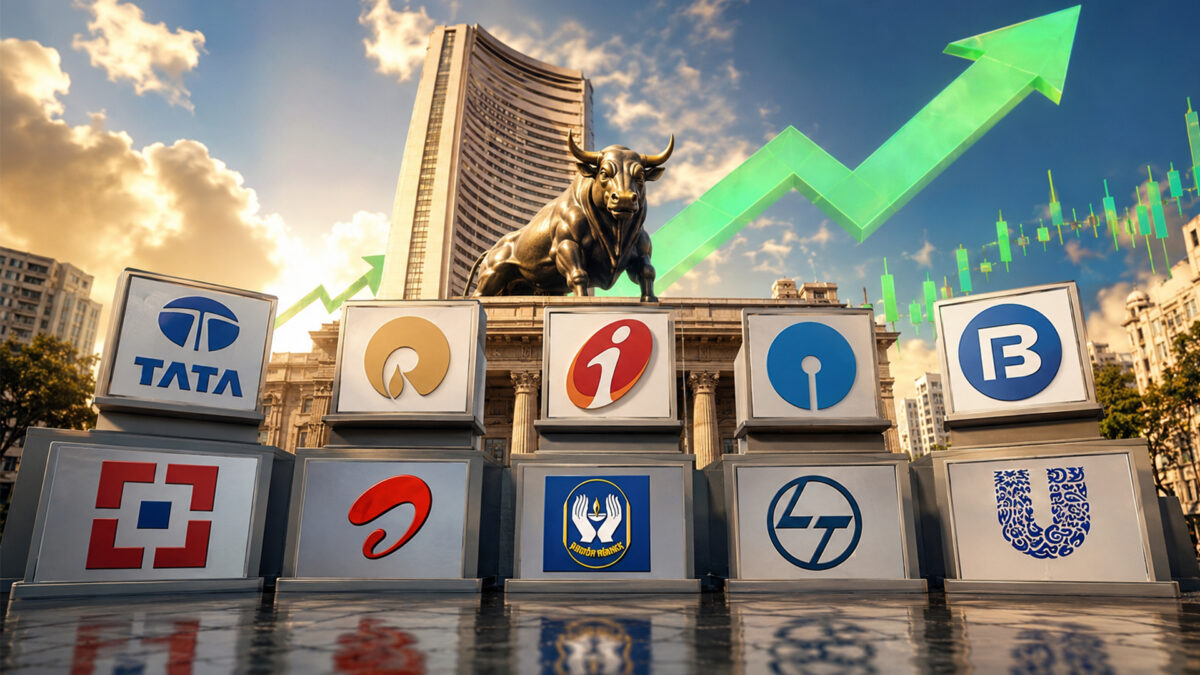
The latest changes did not significantly alter the hierarchy of India’s biggest listed firms. Reliance Industries retained its position as the country’s most-valued company by market capitalisation. It continued to be followed by HDFC Bank, Bharti Airtel, ICICI Bank, State Bank of India, TCS, Bajaj Finance, Life Insurance Corporation of India (LIC), Larsen & Toubro (L&T) and Hindustan Unilever Ltd (HUL). These companies collectively account for a substantial share of India’s total stock market value and often influence the movement of benchmark indices.
Market capitalisation, commonly referred to as market cap, represents the total value of a company’s outstanding shares. It is calculated by multiplying the current share price by the total number of shares in circulation. A rise in market capitalisation generally indicates growing investor confidence and an increase in shareholder wealth, while a decline reflects weaker market sentiment or profit booking.
Analysts say the latest rally underlines the resilience of India’s equity markets, supported by strong domestic participation, steady inflows from institutional investors and optimism surrounding corporate earnings. Large-cap companies continue to attract investors because they are generally considered more stable during periods of market volatility.
The performance of TCS has been particularly encouraging for the information technology sector, which has faced pressure over the past year due to slower global technology spending. The company’s strong quarterly performance and optimistic guidance have renewed hopes that demand for digital transformation projects could improve in the coming quarters.
With the earnings season gathering pace and investors closely monitoring quarterly results, market participants expect stock-specific movements to remain high in the coming weeks. If corporate earnings continue to meet expectations and macroeconomic conditions remain supportive, India’s leading companies could continue to witness healthy investor interest, strengthening the country’s equity markets further.
Also Read: Sensex slides 440 points, Nifty ends below 24,250