
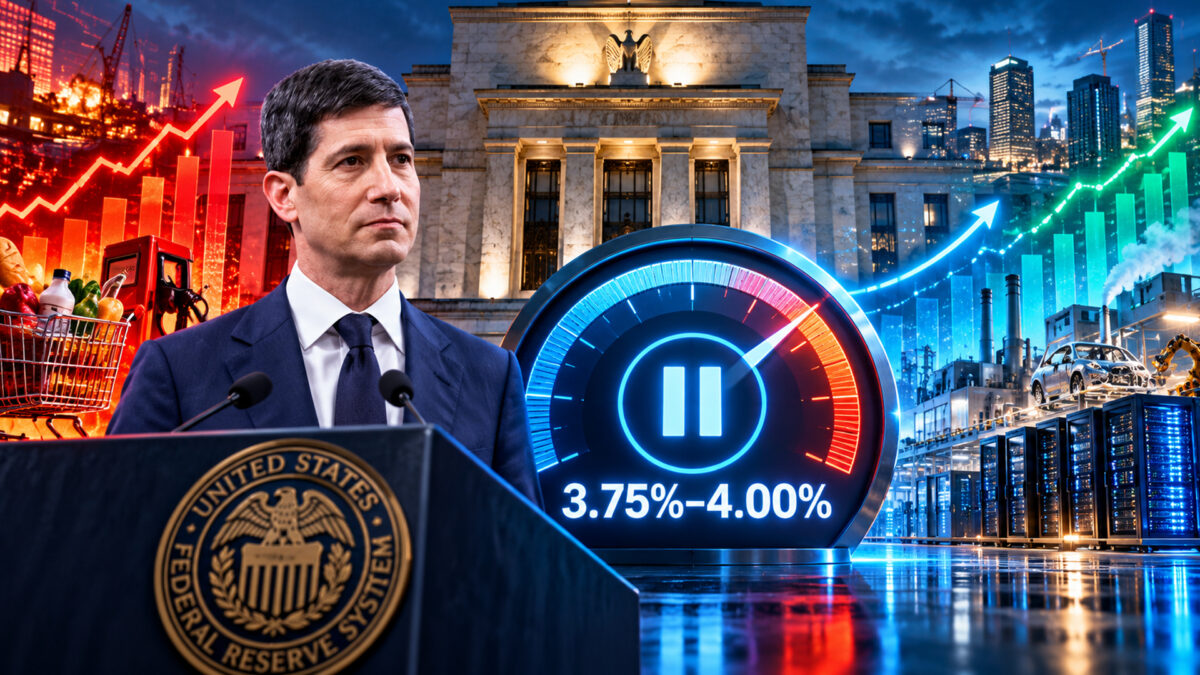
The US Federal Reserve has kept its benchmark interest rate unchanged at 3.75% to 4%, as persistent inflation continues to complicate the central bank’s monetary policy decisions. The decision, announced on October 28 after a two-day meeting, reflects the Fed’s cautious approach as policymakers assess whether price pressures are easing sufficiently to bring inflation towards its 2% target.
The Federal Open Market Committee (FOMC), which determines US monetary policy, voted to maintain the existing interest rate range. However, the decision was not unanimous. Federal Reserve Governor Lisa Cook and Cleveland Fed President Beth Hammack supported a quarter-percentage-point rate increase, highlighting concerns that inflation could remain elevated for longer than expected.
Fed Chair Kevin Warsh reiterated that inflation remains too high, signalling that policymakers are not yet satisfied with progress towards price stability. His comments reinforced the central bank’s message that it will continue to assess incoming economic data before deciding whether borrowing costs need to rise further.
The decision comes as the US economy continues to demonstrate resilience despite elevated interest rates. Economic activity has remained strong, supported by consumer spending and business investment. However, sustained demand can make it harder to bring inflation under control, particularly when businesses retain the ability to pass higher costs on to consumers.
The Fed faces a delicate balancing act. Increasing interest rates could help moderate demand and reduce inflationary pressures, but it could also raise borrowing costs for households and businesses. Holding rates steady gives policymakers more time to evaluate economic conditions without immediately tightening financial conditions further.
Inflation continues to be a central concern for the Federal Reserve, which aims to bring annual price increases down to 2%. Although policymakers have been working towards this goal, persistent price pressures have complicated decisions about when to ease or tighten monetary policy.
Higher prices affect household budgets through everyday expenses such as food, housing, transport and energy. When inflation remains elevated, consumers lose purchasing power, while businesses face uncertainty over operating costs, wages and investment plans.
The central bank uses interest rates as one of its main tools to control inflation. Higher borrowing costs generally discourage spending and investment, helping reduce demand across the economy. However, monetary policy operates with a lag, meaning the full effects of previous rate changes may take months to become visible.
This makes the timing of the Fed’s next move particularly important. Raising rates too aggressively could weaken economic growth and employment, while delaying action could allow inflation to remain above target for longer.
The dissenting votes from Cook and Hammack underline the differences within the committee over how quickly policymakers should respond to inflation risks. While the two officials favoured an immediate increase, the majority preferred to maintain rates and wait for further evidence.
The Federal Reserve’s decisions have a significant influence on global financial markets, affecting US Treasury yields, the dollar, equities and commodities. Investors closely monitor the central bank’s statements and officials’ comments for clues about the future direction of interest rates.
Following the latest announcement, US stocks recorded modest gains, while the dollar weakened slightly. Treasury yields moved in different directions across maturities as investors assessed the implications of the decision. The relatively limited market reaction reflected expectations that the Fed would leave rates unchanged.
Attention has now shifted to whether the central bank could increase rates again before the end of the year. Persistent inflation and the divided vote have kept the possibility of further tightening in focus. However, the Fed has not committed to a specific rate path, and future decisions will depend on incoming economic information.
US monetary policy also matters for emerging markets, including India. When American interest rates remain high, US assets can become more attractive to international investors. This may influence capital flows, currency movements and equity-market sentiment in emerging economies.
For American consumers, prolonged high interest rates could keep mortgages, credit cards and other loans expensive. Businesses may also face higher financing costs, potentially affecting expansion, hiring and investment decisions.
The next phase of the Fed’s policy decisions will depend on inflation readings, employment figures and broader economic indicators. Policymakers will need to determine whether price pressures are easing sufficiently or whether stronger action is necessary to restore price stability.
The December meeting is expected to draw close attention from investors and economists. Expectations about another rate increase could change as new data becomes available, making the coming weeks important for financial markets.
The Federal Reserve has chosen to hold rates steady rather than tighten policy immediately. The decision highlights the difficulty of balancing inflation control with economic growth. While the US economy continues to show resilience, policymakers remain concerned about the persistence of high prices.
The central bank’s next move will depend on whether incoming evidence shows convincing progress towards its 2% inflation target. Until then, investors, businesses and consumers will have to navigate an environment in which borrowing costs remain elevated and the outlook for future interest rate changes remains uncertain.