Categories
Beyond

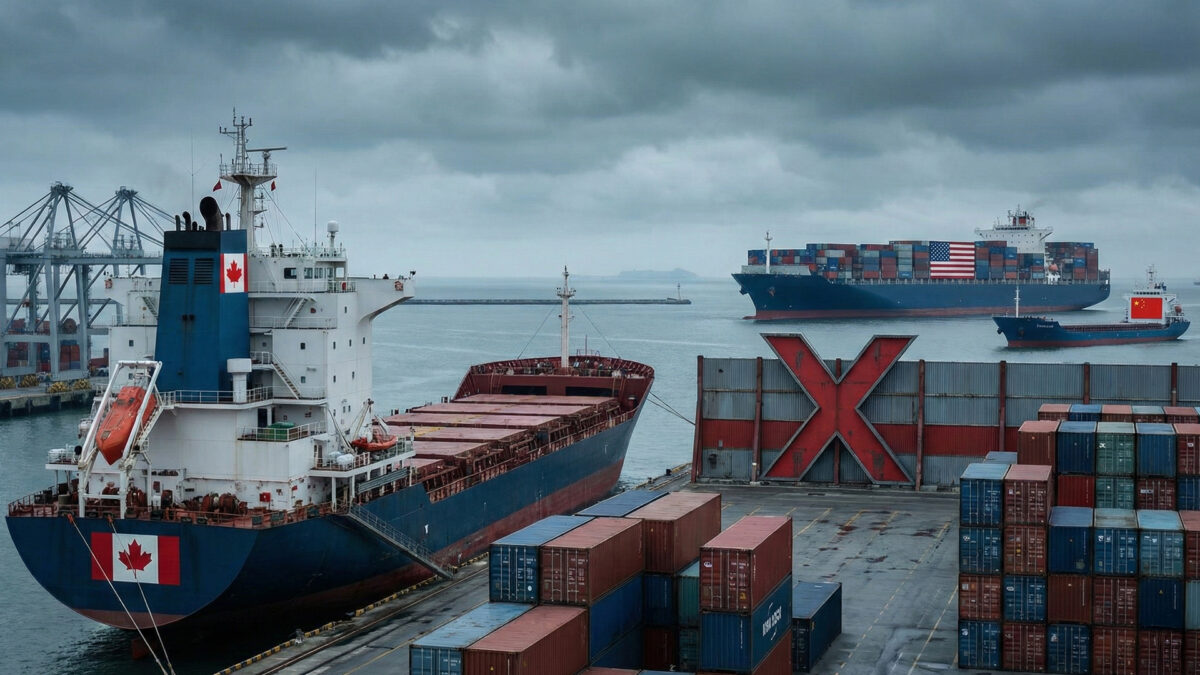
Canada rejects China deal after 100% tariff threat

Canada has ruled out any free trade agreement with China, after US President Donald Trump threatened to impose 100 per cent tariffs on Canadian goods if Ottawa went ahead. Prime Minister Mark Carney clarified that Canada remains committed to its North American trade agreements and has no intention of pursuing a broad pact with Beijing.

Speaking on Sunday, January 25, Carney emphasised that Canada’s limited engagement with China has focused only on resolving specific tariff disputes, not on negotiating a full-fledged trade deal. “We respect our commitments under the USMCA. We are not planning any free trade agreements with China or other non-market economies,” he said.

The remarks follow a week of tense exchanges between Washington and Ottawa. Trump’s warnings came after reports that Canada was exploring closer trade ties with China, prompting fears in the US that Chinese goods could gain easier access to North American markets through Canada.

Recent agreements with China have been narrow and targeted. Canada reduced tariffs on a small number of Chinese electric vehicles, while Beijing agreed to ease duties on some Canadian exports, including canola and seafood. These measures, Carney stressed, are far from a comprehensive trade deal.

The US threat has added strain to Canada-US trade relations, but Carney’s firm stance sends a clear message: Ottawa seeks to balance global economic ties while honouring obligations to its North American partners. Analysts say the move highlights Canada’s careful approach to diplomacy, ensuring it can engage with global markets without triggering conflicts with the US.

Also Read: India to cut EU car import duties

Categories
Corporate

Deloitte report in Canada faces AI citation controversy

Deloitte, the global consulting firm, is under scrutiny after a $1.6 million healthcare report it prepared for the Newfoundland and Labrador government was found to contain questionable references.

The 526-page Health Human Resources Plan, released in May 2025, was meant to guide government policy on healthcare staffing, virtual care, retention, and the pandemic’s impact on workers.

Investigations revealed multiple citations that appear to be fabricated, including references to academic papers that don’t exist. Some real researchers were incorrectly credited, and in some cases, fictitious co-authors were listed. One researcher, Gail Tomblin Murphy, called the mention of her work “false” and possibly AI-generated.

The provincial Department of Health has asked Deloitte to review and confirm all citations. Deloitte responded that while some citation corrections are needed, the overall recommendations and conclusions remain valid.

This is not the first time Deloitte has faced such issues. Earlier reports for other governments were also found to have fabricated references, raising concerns about relying on AI for research without proper human checks.

Also Read: Ravelcare SME IPO ₹24 crore, shares ₹123–₹130

Categories
Leaders

India, Canada partner on critical minerals, green energy

India and Canada are working to deepen their economic partnership, focusing on critical minerals, clean energy, and aerospace trade. The 7th Ministerial Dialogue on Trade and Investment in New Delhi brought together India’s Piyush Goyal and Canada’s Maninder Sidhu to discuss stronger cooperation.

Bilateral trade reached US$23.66 billion in 2024, with goods trade up 10% from last year. Both countries also plan to expand investments, creating jobs in each nation.

The ministers agreed to develop long-term supply chains for critical minerals, boost green energy projects, and collaborate in aerospace technologies. They also emphasized resilient supply chains in agriculture and stronger people-to-people ties.

Further discussions with business leaders are planned next year to keep the momentum going.

Also Read: Maruti recalls nearly 40,000 Grand Vitaras for fix

Categories
Beyond

Canada updates temporary visa rules

Canada’s Immigration, Refugees and Citizenship Canada (IRCC) has introduced new rules detailing when visitor visas, study permits, work permits, and electronic travel authorizations (eTAs) can be cancelled.

The update to the Immigration and Refugee Protection Regulations (IRPR), announced on November 4, 2025, gives officers authority to revoke documents if holders become ineligible, inadmissible or fail to comply with visa terms.

Under the new provisions, visitor visas and eTAs can be cancelled for reasons such as administrative errors, criminal inadmissibility, loss of passport, or failure to depart Canada on time. Study and work permits may also be revoked if issued by mistake or if the holder no longer meets eligibility conditions.

All temporary resident documents are automatically void if the holder becomes a permanent resident or dies. The move is aimed at tightening compliance and closing gaps in existing immigration procedures.

Also Read: India’s Forex reserves drop $5.6 billion to $689.73 billion

Categories
Beyond

Canada Opens Fast-Track for H-1B Holders

In a bid to attract skilled workers hit by recent US visa policy and fee changes, the Canadian government has announced a new accelerated immigration pathway for professionals holding US H-1B visa holders.

As part of a broader plan to strengthen its innovation-driven economy and fill key labour shortages outlined in the 2025 Federal Budget, the program will offer opportunities to transition expertise to Canada’s fast-growing sectors, including healthcare, technology and scientific research.

As part of its International Talent Attraction Strategy, Canada will roll out a special initiative to hire more than 1,000 global researchers, backed by CA $1.7 billion in funding.

The investment aims to help Canadian universities and research institutions bring in top international talent and accelerate advancements in innovation and discovery.

The budget also proposes setting up a Foreign Credential Recognition Action Fund, with CA $97 million allocated over five years starting 2026–27. Managed by Employment and Social Development Canada, the fund will help streamline and modernize the recognition process for foreign-trained professionals, with a focus on healthcare and construction, where demand for qualified workers remains high.

Prime Minister Mark Carney emphasized that attracting and retaining top global talent is essential for maintaining Canada’s competitive edge. The new measures reflect a shift toward strategic immigration policies that align with regional and sectoral needs.

These steps also complement ongoing efforts to improve Canada’s Temporary Foreign Worker Program and create smoother pathways to permanent residency for skilled professionals.

With the new fast-track visa route and expanded research funding, Ottawa aims to position Canada as a global hub for innovation, talent, and opportunity, strengthening its role in the evolving international labour and technology landscape.

Also Read: Maharashtra Becomes First State to Partner with Starlink