
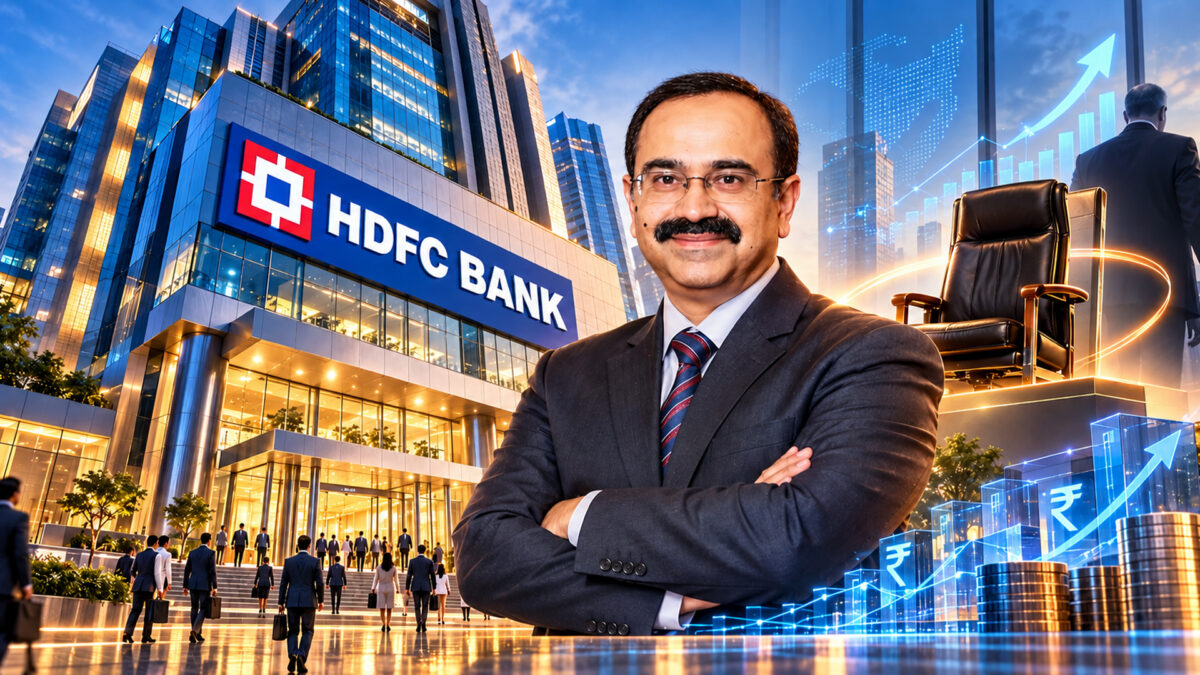
Anup Bagchi’s appointment as HDFC Bank’s next managing director and chief executive officer has ended months of uncertainty around the lender’s top job. The bigger question now is how the new chief will reshape the bank’s leadership team and business priorities.
The Reserve Bank of India has approved Bagchi’s appointment for a three-year term beginning October 27. He will succeed Sashidhar Jagdishan, whose tenure ends on October 26. Bagchi will become the first outsider to lead HDFC Bank since its establishment, bringing more than three decades of experience across the ICICI Group.
The leadership change has already attracted a positive response from investors. HDFC Bank shares opened 1.67% higher at ₹733.25 on October 5 after the appointment was announced, although the stock later gave up much of the early gain. Brokerages have largely retained their positive view, saying the appointment removes an important leadership overhang.
The focus is now shifting from who will lead the bank to how Bagchi will run it.
Analysts expect the new CEO to review the existing senior management structure. Some churn at the senior and mid-senior levels is possible, although the extent of any reshuffle will depend on Bagchi’s assessment of the current team and his long-term strategy. Emkay Research has highlighted management stability as one of his immediate priorities, while PL Capital has warned that changes brought by an external leader could create some short-term disruption.
That makes continuity an important issue. HDFC Bank currently has experienced executives in key positions, including Deputy Managing Director Kaizad Bharucha and Executive Director V Srinivasa Rangan. Bagchi will have to balance the advantages of an existing leadership team with the need to bring his own operating approach to the bank.
The timing is significant because HDFC Bank is already going through a broader management transition. Puneet Sharma is set to take over as chief financial officer from December 1, while Rangan has been reappointed as executive director for another year. Jimmy Tata has also been appointed whole-time director for three years.
The bank could see further changes in the coming years. Nine senior executives could potentially reach the age-based retirement benchmark between 2027 and 2030, with five of those possible transitions concentrated in 2027 and 2028. The actual timing will depend on individual terms and decisions, but the potential changes add another layer to Bagchi’s succession challenge.
Behind the management story is an equally important business challenge.
HDFC Bank’s latest second-quarter business update showed strong growth in both loans and deposits. Gross advances rose 16.3% year-on-year and 5.2% sequentially to ₹32.19 lakh crore. Assets under management increased 15.3% year-on-year to ₹33.07 lakh crore.
Deposits grew 18.8% year-on-year to ₹33.27 lakh crore, while CASA deposits increased 10.8% to ₹10.52 lakh crore. The numbers provide Bagchi with a stronger operating base as he prepares to take charge, but analysts say maintaining this momentum will be critical.
Deposit mobilisation remains a key priority. HDFC Bank’s CASA ratio had fallen to 32.3% as of June 2026, highlighting the challenge of increasing low-cost deposits. A stronger CASA mix is important because it can help control funding costs and support margins.
Net interest margins are another concern. The bank has faced pressure on profitability following the post-merger transition, making margin recovery an important test for the new leadership.
Bagchi’s background could prove useful here. He has worked across retail and wholesale banking, treasury, capital markets, wealth management, digital financial services and insurance during his long career with the ICICI Group. He was also managing director and CEO of ICICI Securities before leading ICICI Prudential Life Insurance.
His experience gives him a broad view of financial services, but moving from an external position into HDFC Bank will require careful handling of the bank’s culture and existing systems.
Analysts are also watching whether the leadership change can improve investor confidence. HDFC Bank’s shares have underperformed the broader banking sector in recent years, while concerns around governance, management departures and slower profitability have weighed on sentiment. Bagchi’s appointment has therefore been viewed as an opportunity for a strategic reset.
Brokerages have responded positively. Motilal Oswal retained a ‘Buy’ rating with a target price of ₹925, while PL Capital maintained its ‘Buy’ call with a ₹950 target. Analysts pointed to the removal of succession uncertainty but stressed that execution will determine whether the stock can sustain a rerating.
Technology, digital banking and customer service are also expected to remain important areas for the new leadership. Improving productivity, strengthening the balance sheet and extracting greater value from HDFC Bank’s large customer base will be central to the next phase.
Bagchi therefore enters HDFC Bank with both an advantage and a demanding task. The immediate uncertainty over the CEO position is gone, and the latest business numbers offer signs of stronger growth. But rebuilding margins, improving the deposit mix, maintaining loan growth and managing a changing leadership bench will require sustained execution.
His first months at HDFC Bank could determine whether the leadership transition becomes simply a change at the top or the beginning of a broader reset for India’s largest private-sector lender.