
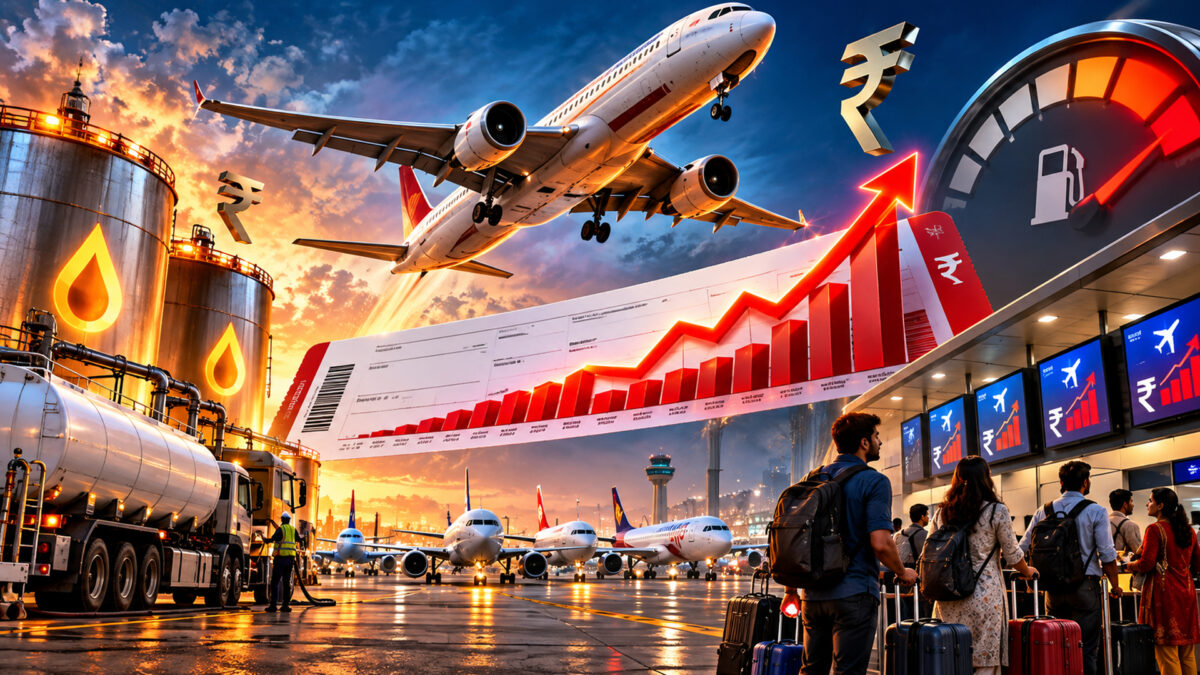
Air travel is becoming more expensive as major Indian airlines increase fuel surcharges to offset rising aviation turbine fuel (ATF) costs. Air India, Air India Express and Akasa Air have revised their surcharges from October 9, while IndiGo introduced higher levies earlier, from October 6.
The increases come amid a sharp rise in aviation fuel prices, adding pressure on airlines already dealing with high operating costs. Since fuel is one of the biggest expenses for carriers, the additional charges are intended to help them manage the impact without relying entirely on higher base fares.
The revised surcharges vary according to the distance travelled and, on international routes, the destination. Passengers booking flights should therefore check the final fare carefully, as the additional amount can differ significantly between short-haul and long-haul journeys.
Air India and Air India Express have introduced a distance-based fuel surcharge for domestic flights. Passengers travelling up to 500 km will pay ₹400 per sector. The surcharge rises to ₹600 for journeys between 501 km and 1,000 km, ₹850 for distances between 1,001 km and 1,500 km, and ₹1,200 for flights covering 1,501 km or more.
The airlines have also revised surcharges on international routes. The additional charge for flights to West Asia and the Middle East is $55 per sector. Passengers travelling to Europe, including the United Kingdom, will pay $135, while the surcharge for Australia is $210. Flights to North America will carry an additional charge of $215 per sector.
The revised charges apply to new bookings from the specified implementation times on October 9. Air India Express implemented the changes from midnight, while Air India introduced them from 11 am. Travellers who have already purchased tickets should check the terms applicable to their bookings rather than assume that the revised charges will automatically apply.
Akasa Air has also increased its fuel surcharge on domestic routes. Passengers travelling up to 500 km will pay ₹375 per sector. The charge is ₹600 for journeys between 501 km and 1,000 km, ₹900 for distances between 1,001 km and 1,500 km, and ₹1,150 for flights covering 1,501 km or more.
On selected international routes, Akasa has introduced a surcharge of ₹2,500 per sector for flights from India to destinations including Kuwait, Qatar, Saudi Arabia, the United Arab Emirates, Thailand and Vietnam.
IndiGo, which revised its fuel charges from October 6, has also adopted a distance-based structure for domestic travel. Its surcharge is ₹375 for flights up to 500 km, ₹600 for journeys between 501 km and 1,000 km, and ₹900 for distances between 1,001 km and 1,500 km. Passengers travelling between 1,501 km and 2,000 km will pay ₹1,150, while flights exceeding 2,000 km carry a surcharge of ₹1,300.
The airline’s international fuel surcharge varies by region and distance. For routes within the South Asian Association for Regional Cooperation (SAARC), the charge is ₹1,000 for flights up to 500 km and ₹3,000 for longer journeys. Flights to Southeast Asia, the Gulf Cooperation Council region and the Middle East, as well as North and East Asia, carry a surcharge of ₹5,500. The charge is ₹6,000 for Africa and ₹10,000 for Europe.
The increases follow a significant rise in domestic ATF prices from October 1. The price climbed to around ₹137 per litre after an increase of approximately ₹16 per litre, raising costs for airlines at a time when international jet fuel prices have also been under pressure.
Fuel expenses can account for as much as 40% of an airline’s operating costs, making sudden price increases particularly difficult to absorb. Global energy market volatility, tensions in West Asia and the weakness of the Indian rupee have added to the pressure. Since fuel is traded internationally, currency movements can further increase the cost for Indian carriers.
Fuel surcharges allow airlines to recover part of these expenses through a separate charge rather than adjusting the base fare alone. However, the higher levies could make air travel more expensive for families, business travellers and passengers planning trips during the festive and holiday season.
The price increases also come as the domestic aviation market faces changes in passenger demand. Data from the Directorate General of Civil Aviation showed that domestic passenger traffic fell 6.34% month-on-month in August to 121.26 lakh, compared with 129.47 lakh in July.
The latest revisions underline how changes in fuel prices can quickly affect the cost of flying. With airlines reviewing surcharges in response to operating expenses, passengers may need to compare the total ticket price, including taxes and additional levies, before making a booking.