
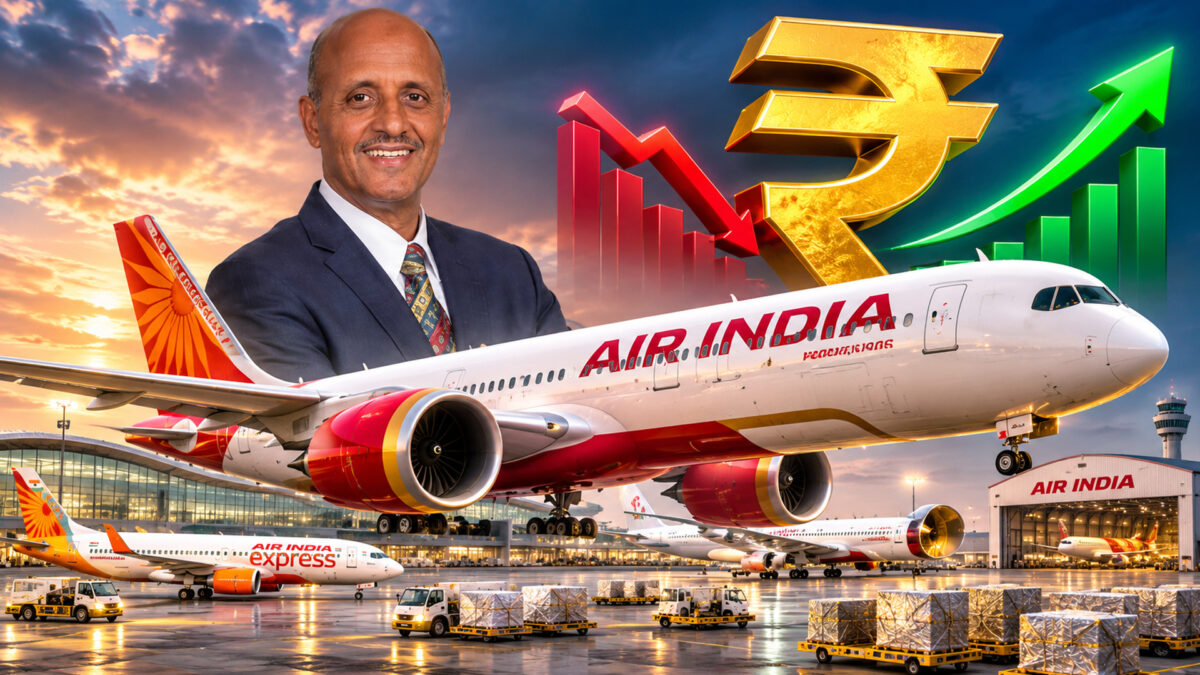
Air India has set an ambitious target of saving ₹6,000 crore as its new chief executive, Tewolde Gebremariam, steps up efforts to revive the airline and improve its financial performance. The strategy focuses on cutting operational costs, increasing revenue, strengthening coordination with Air India Express and exploring new business opportunities.
Gebremariam outlined the priorities at an internal town hall meeting on Wednesday, November 25. He said the airline group had already achieved savings of around ₹1,500 crore and identified another ₹3,500 crore worth of potential cost-reduction opportunities. The overall target stands at ₹6,000 crore, although the management has not specified a firm deadline for achieving it.
The new CEO, who took charge in October, wants Air India and its low-cost subsidiary, Air India Express, to function as one integrated group while retaining their separate identities. He believes closer coordination will help eliminate duplication, reduce expenses and prevent unnecessary competition between the two airlines.
The plan marks an important step in Air India’s broader turnaround strategy under the Tata Group, which has been working to restore the airline’s position in the highly competitive aviation market.
A key part of the restructuring will involve bringing support functions such as finance, human resources and information technology under a common group structure. Both airlines will continue to have dedicated teams where necessary, but employees may also report to shared group-level departments. Network planning and marketing are among the functions that already operate with some degree of coordination.
However, the plan does not involve a merger. Air India and Air India Express will retain separate Air Operator Certificates, which govern their regulatory and operational responsibilities. Flight operations, safety, regulatory compliance and customer-facing services will remain independent.
The two airlines will also continue to serve different market segments. Air India will concentrate on the international full-service market, while Air India Express will compete with low-cost carriers. Gebremariam believes this structure will allow the group to benefit from shared resources without losing the distinct positioning of its two brands.
He has also raised concerns about duplication and internal competition between the airlines. According to him, overlapping responsibilities have increased costs and created unnecessary friction. The new approach aims to replace this rivalry with greater cooperation and a common business strategy.
The management restructuring will support this transition. Air India’s existing management committee will be reorganised as the Air India Management Team. Deepak Rajawat, who currently serves as Air India Express’s chief financial officer, will join the group leadership team and take over as the low-cost airline’s chief executive on December 1.
The group also plans to appoint a Group Strategy Officer. The position will oversee long-term business planning, network development, airline partnerships and diversification. An 11-member senior management team will separately focus on identifying and implementing cost-saving measures.
Gebremariam has set a target of reducing non-fuel expenses by around 20% and fuel costs by 5%. The airline has also invited employees to suggest ways to improve efficiency. The initiative has received approximately 1,500 ideas, reflecting the management’s effort to make cost consciousness part of everyday operations rather than restrict it to major spending decisions.
Fuel expenses have nearly doubled compared with the previous year, adding to the airline’s financial pressure. The management wants to bring down the cost per available seat kilometre (CASK), which measures the cost of operating an airline seat over a kilometre, below revenue per available seat kilometre (RASK), which measures the income generated from that capacity.
Alongside cost reduction, the airline is exploring new sources of revenue. One proposal involves entering the dedicated cargo freighter business to tap opportunities in domestic and international air freight. Gebremariam believes the group can make better use of its existing cargo capacity, particularly as more wide-body aircraft join its fleet.
Air India is also considering an in-house holiday and tour operations business. The proposed venture could offer packaged holidays to Indian travellers and international tourists. The airline may explore partnerships with the tourism ministry and hotel groups, including the Taj brand, to develop these offerings.
Another initiative involves bringing the group’s various training activities under one umbrella, called the Air India Aviation Academy. The proposed academy will consolidate pilot training, aircraft type-rating programmes, recurrent training, simulator facilities and maintenance-related training across locations such as Amravati, Gurugram and Bengaluru. The airline eventually wants to develop it into a profit-making business by offering training services to other aviation companies.
The airline is also reviewing its international network to respond to geopolitical developments and airspace restrictions. It plans to shift some westbound connecting traffic from Delhi to Mumbai, while retaining Delhi as a key hub for eastbound connections to destinations in Japan, South Korea, Australia and Southeast Asia. Bengaluru is also being considered as an additional hub.