
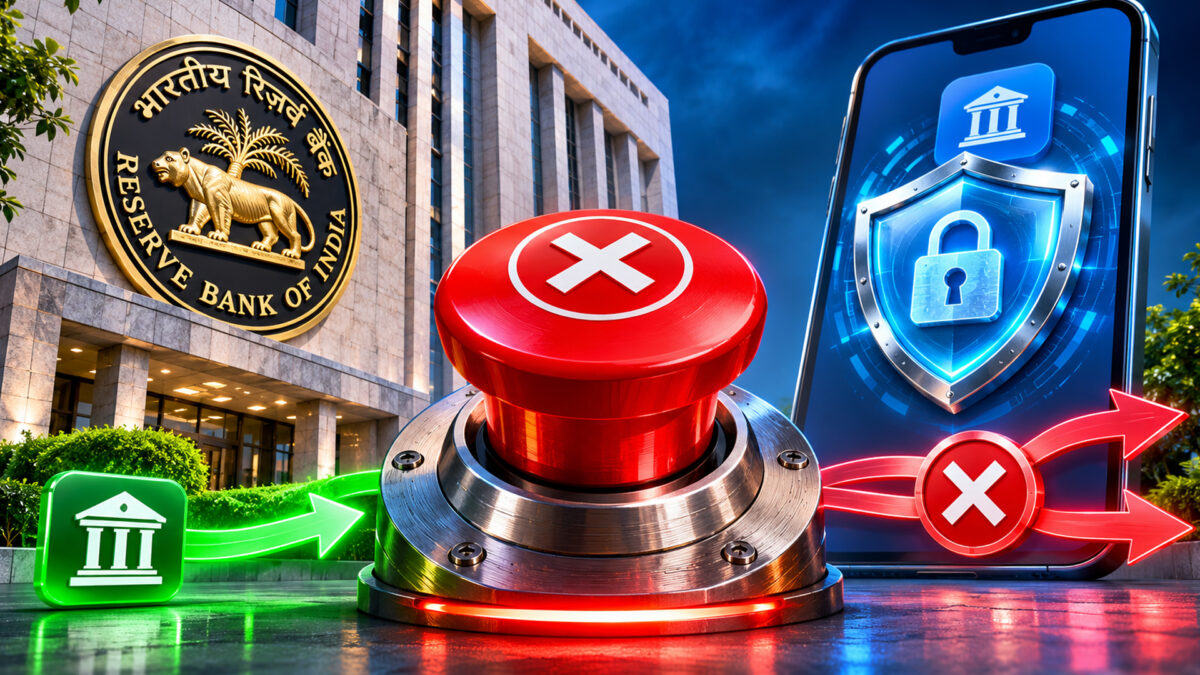
The Reserve Bank of India (RBI) has proposed a new set of safeguards to help customers protect their bank accounts from digital payment fraud. The measures will give account holders greater control over electronic transactions and allow them to block outgoing payments when they suspect suspicious activity.
The proposals include an emergency facility called the ‘Stop Switch’, customer-controlled transaction limits and an option to nominate a trusted person to approve high-value transfers. The RBI has also proposed stricter accountability for banks that fail to prevent fraud because of security lapses or negligence.
The central bank issued the draft directions on November 23. It has invited comments from banks, customers and other stakeholders until December 14, 2026. The proposals are not yet in force.
The Stop Switch is one of the key features of the proposed framework. It will allow customers to block future outgoing payments initiated by them. Customers can activate it if they lose their phone, suspect that someone has accessed their banking details or notice an unauthorised attempt to use their account.
Once activated, the facility will stop new customer-initiated debit transactions. It will also prevent customers from creating fresh payment mandates and standing instructions. They will not be able to register their bank accounts on new third-party UPI applications during this period.
However, the Stop Switch will not freeze the entire account. Customers will continue to receive money through incoming credits. Existing recurring mandates and standing instructions will also remain active. Bank-initiated debits, including loan instalments and charges, will continue.
Customers will be able to activate the facility through several channels. These will include mobile banking, internet banking, ATMs, bank branches and interactive voice response systems. Banks will have to use proper authentication before restoring payment access. They may also introduce a cooling-off period to prevent fraudsters from switching off the facility.
The RBI has also proposed giving customers greater control over their digital payment limits. Under the draft rules, account holders will be able to set limits for individual transactions, specific beneficiaries and daily transfers. They can also establish an overall daily limit across digital payment channels.
Customers will be able to switch individual payment channels on or off. They can decide which services they want to use and restrict access to channels they rarely need. These controls will cover debit cards, credit cards and prepaid payment instruments.
Cardholders will also be able to manage domestic and international transactions separately. They can set limits for ATM withdrawals, point-of-sale payments, online purchases and contactless transactions. This will help customers reduce their exposure to fraud by keeping unnecessary payment options disabled.
The draft also seeks to change how banks activate digital payment services for new accounts. Banks will have to keep these channels disabled by default until customers give their explicit consent. They can activate the services only after completing the required authentication process.
Another important proposal is the Trusted Person Mechanism. It will provide an additional layer of security for high-value bank transfers. Customers will be able to nominate an individual aged 18 or above to approve transactions that exceed a limit set by the account holder.
The facility will be voluntary. Both the customer and the nominated person must give their consent. When a transfer crosses the selected limit, the bank will send the trusted person the transaction details. The person will then have one hour to approve or reject the payment.
The bank will decline the transaction if the trusted person rejects it or fails to respond within the one-hour period. The mechanism will also have a 24-hour cooling-off period before activation.
The trusted person will not gain control over the customer’s bank account. The nominee cannot view the account balance, deposits, investments or insurance details. The person also cannot initiate transactions independently and will not carry financial liability for the account holder’s payments.
The mechanism will not cover UPI transfers, merchant payments or recurring transactions. These exclusions include standing instructions, electronic mandates and payments through the National Automated Clearing House system.
Customers will be able to change or remove their nominated person. They can also revise the transaction threshold or withdraw from the facility. Banks will require authentication for these changes and may apply a cooling-off period.
The RBI has proposed changes to the definition of bank negligence as well. Under the draft, banks could face liability if their failures contribute to fraudulent electronic transactions.
These failures may include not following prescribed authentication procedures, missing mandatory transaction alerts or failing to provide round-the-clock channels for reporting fraud. Banks could also face scrutiny if they delay action after receiving a complaint from a customer.
The proposed definition also covers security breaches and system malfunctions at the bank’s end. Collusion involving bank employees or third parties engaged by banks will also fall within its scope if it contributes to fraud.
The directions will cover commercial banks, small finance banks, payments banks, regional rural banks, local area banks and urban and rural cooperative banks.
The RBI has set December 14, 2026, as the deadline for public comments. If finalised, most of the proposed safeguards will take effect from July 1, 2027, or an earlier date chosen by individual banks. The specified provisions relating to bank negligence will come into effect from January 1, 2027.
The proposals mark a shift towards preventing digital banking fraud rather than responding only after customers lose money. They aim to give account holders more control over their transactions and make banks more accountable for security failures.