
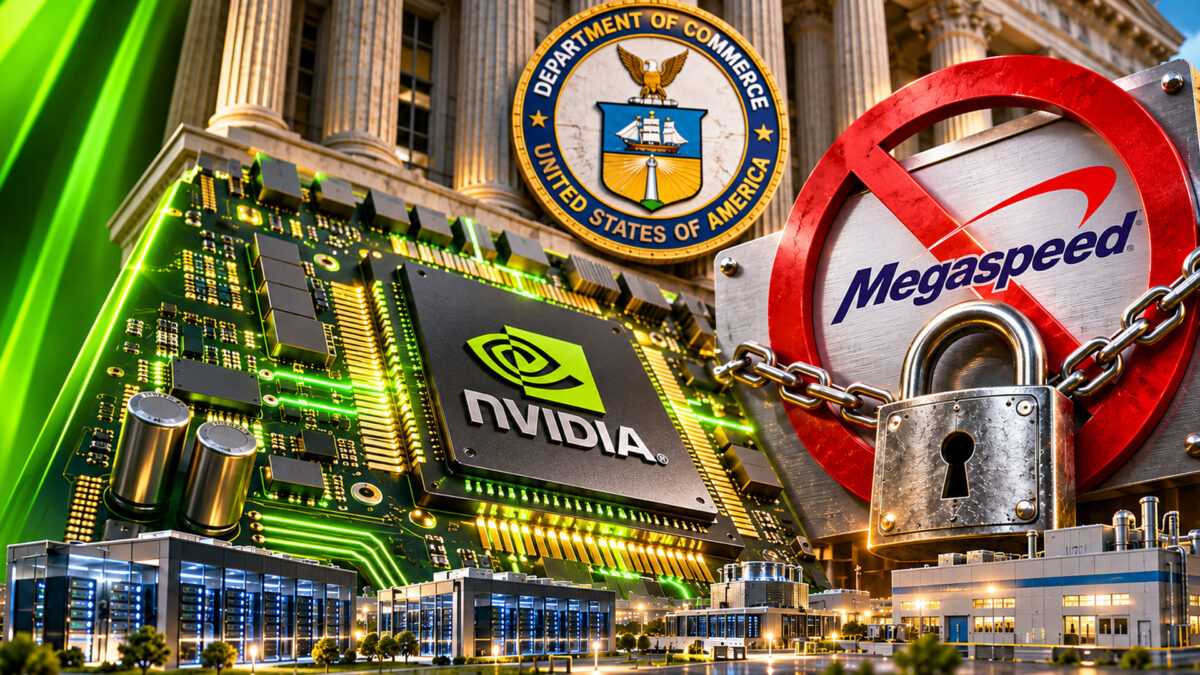
The United States has added Singapore-based technology company Megaspeed International to its trade blacklist, escalating scrutiny of an investigation into the alleged diversion of advanced Nvidia artificial intelligence chips to China. The move comes amid a widening controversy involving Nvidia chief executive Jensen Huang, former Megaspeed executive Alice Huang and questions over the enforcement of US semiconductor export controls.
The US Commerce Department formally placed Megaspeed on its Entity List on Monday, November 23. The decision restricts the company’s access to American technology, including advanced semiconductors, unless it obtains a special government licence. Such applications are generally expected to face rejection, potentially affecting the company’s ability to purchase US-origin chips, software and other technology.
The timing of the announcement attracted particular attention. It came just hours after Nvidia’s board reinstated Jensen Huang as chief executive, reversing his departure less than two weeks earlier following revelations about his personal relationships and the controversy surrounding Megaspeed.
The blacklist also extends beyond Megaspeed. The US administration included an Alibaba-linked Singapore entity and several other companies operating across Southeast Asia. The move signals Washington’s growing concern about networks that could facilitate the transfer of restricted artificial intelligence technology to unauthorised buyers.
The companies added to the list include Megaspeed’s parent company Swiftdata, its Malaysian subsidiaries MSFusion and Speedmatrix, and its Thai subsidiary Megaspeed (Thailand). Another entity named in the action is Apex Enterprise Solutions, a Singapore-based subsidiary of Chinese technology major Alibaba.
The inclusion of Apex has added another dimension to the controversy. According to reports, Apex had provided financial support to Megaspeed through its Malaysian subsidiary, Speedmatrix, in 2024. The arrangement involved Speedmatrix pledging its business as collateral for the loan.
Alibaba has rejected the allegations surrounding its Singapore subsidiary. The company said Apex had never diverted advanced computing chips covered by US export restrictions and described its inclusion on the Entity List as erroneous. It also said it would pursue legal options to protect its reputation and business interests.
The US Commerce Department’s Bureau of Industry and Security (BIS), which maintains the Entity List, said the companies were added because of the significant risk that they could be involved in diverting advanced computing products to unauthorised users or destinations. The department said their activities were considered contrary to US national security or foreign policy interests.
The Entity List is an important instrument used by Washington to control the export of sensitive technologies. Companies included on the list cannot freely receive US-origin goods, software or technology. American suppliers must obtain government approval before exporting, re-exporting or transferring controlled products to them.
Although the listing does not amount to a complete ban on every business transaction, it can make normal commercial operations considerably more difficult. Licence applications are likely to be denied, while access to spare parts, software updates, technical support and intellectual property could also become restricted.
The restrictions could hence affect its ability to maintain existing infrastructure, expand data centre operations and establish new partnerships involving American technology. The wider impact will depend on the extent of its dependence on US suppliers and the availability of alternative sources.
Megaspeed has previously denied any wrongdoing. It has maintained that its business activities are legitimate and that it complies with applicable export-control regulations in the United States and other countries.
The company also clarified that Alice Huang, who previously held a senior position at Megaspeed, officially left the organisation in August 2025 and no longer has any role in its operations.
Alice Huang, also known as Huang Le, served as the company’s director and managing director between March and November 2023. She subsequently became a central figure in the controversy after reports raised questions about her alleged links to Chinese intelligence.
The allegations against her have not been independently established. China has rejected the espionage claims as groundless.
The US decision has also drawn attention to Singapore’s response. Prime Minister Lawrence Wong said on Tuesday, November 24, that Singapore would continue investigating Megaspeed to determine whether the company had violated local laws.
Speaking during an official visit to Canberra, Wong said Singapore would take firm enforcement action if any company was found to have breached its regulations. He clarified that the country’s investigation was focused on possible violations of Singaporean law, while US authorities were pursuing their own investigation.
Wong also confirmed that Singapore had previously investigated Alice Huang but found no grounds for further prosecution at that time. He said the authorities had questioned her before releasing her.
The investigation has also raised questions about Nvidia’s responsibility for monitoring customers and preventing restricted chips from reaching unauthorised destinations. US Treasury Secretary Scott Bessent had criticised the delay in adding Megaspeed to the Entity List, questioning whether adequate checks had been carried out on the company’s business relationships.
The blacklist announcement coincided with a major leadership development at Nvidia. Jensen Huang was reinstated as chief executive on November 23, following his resignation less than two weeks earlier.