
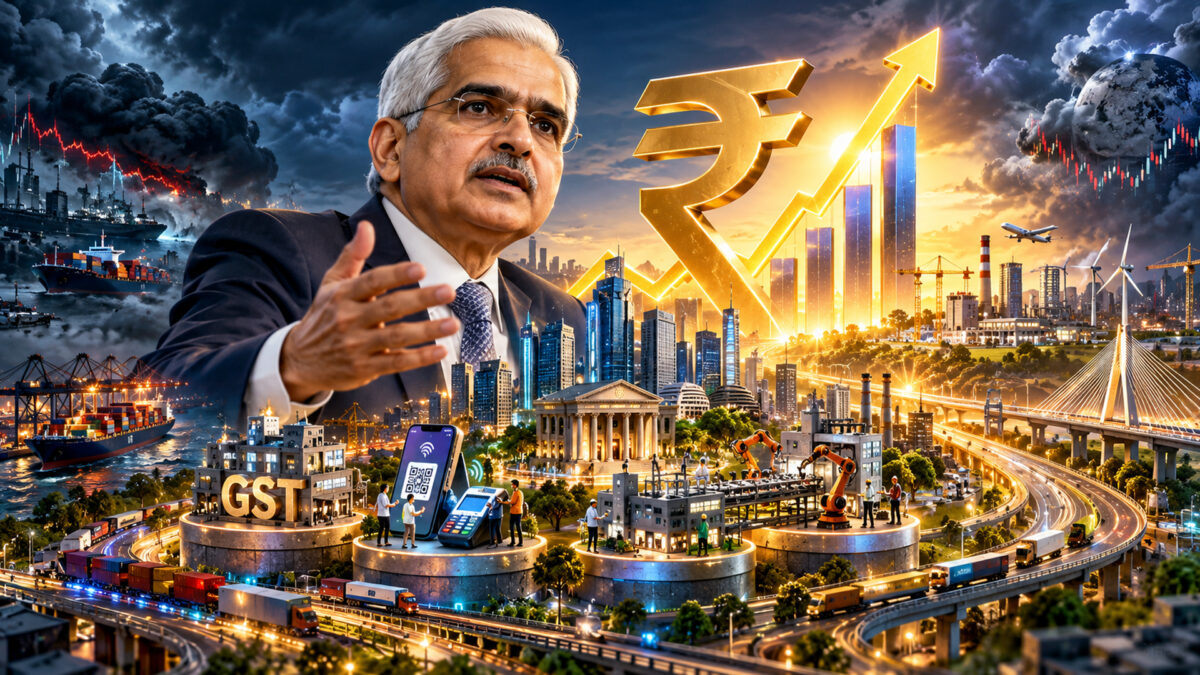
India’s economy is moving closer to the 8% growth mark, but sustaining that momentum will depend on continuing structural reforms, strengthening domestic capacity and maintaining macroeconomic stability, Shaktikanta Das, Principal Secretary-2 to Prime Minister Narendra Modi, said at the Kautilya Economic Conclave.
Das said India’s economic resilience in the face of global shocks was not accidental. It was the result of a broad set of reforms implemented over the past decade, with measures in taxation, banking, inflation management, digital payments, infrastructure and fiscal policy working together to strengthen the economy.
He also said the country was at an important stage of its development journey, with the goal of building a developed India by 2047 increasingly within reach. “A leap to Viksit Bharat by 2047 is very much in the realm of realisation,” Das said.
The comments come against the backdrop of strong recent economic growth. India’s real GDP expanded 7.8% in the first quarter of 2026-27, supported by domestic demand and investment. Das said growth over the period from July-September 2025-26 through April-June 2026-27 had averaged slightly above 8%, putting the economy within “striking distance” of that level.
Das identified three broad pillars behind India’s economic resilience: stronger governance and state capacity, macroeconomic stability, and investment in long-term productive capacity.
Several reforms, he said, were designed not as one-time policy interventions but as buffers that could help the economy absorb shocks and recover faster. Flexible inflation targeting, the Goods and Services Tax, the expansion of digital payments and banking-sector reforms were among the measures he highlighted.
India’s digital public infrastructure has also played an important role. The Jan Dhan-Aadhaar-Mobile framework helped the government deliver financial assistance quickly during the Covid-19 pandemic, while direct benefit transfers reduced leakages in welfare schemes. Das said such measures had strengthened the relationship between citizens and the state while improving the efficiency of public spending.
Macroeconomic stability has been another important part of the reform story. Das pointed to inflation management, fiscal consolidation, tax reforms, financial-sector strengthening and prudent external-sector management as factors that have improved India’s ability to withstand disruptions.
The banking sector, in particular, has undergone a significant clean-up. Gross non-performing assets of banks had fallen to 1.68% in June 2026, while bank profitability had improved, according to Das. A healthier financial system gives banks greater capacity to support investment and economic activity.
Infrastructure and productive capacity are also becoming increasingly important to India’s growth strategy. Das pointed to programmes such as Gati Shakti, the National Logistics Policy, Sagarmala and Udan, alongside investments in energy and manufacturing.
He said India was also working to reduce vulnerabilities arising from import dependence. Areas such as energy, fertilisers and rare-earth permanent magnets require greater domestic capacity, particularly at a time when global supply chains remain vulnerable to geopolitical disruptions.
At the same time, Das stressed that self-reliance should not mean economic isolation. India needs to strengthen domestic capabilities while remaining connected to global markets, supply chains and trade opportunities. Greater integration through free-trade agreements and stronger domestic manufacturing would be important for the next phase of growth.
The global environment, however, remains challenging. Das pointed to wars, geopolitical fragmentation, unilateral trade measures, technological restrictions, energy-price volatility and rising inflation as risks that could slow global growth. High public debt in advanced economies is also pushing up bond yields and limiting the fiscal room available to governments to respond to future shocks.
India, he said, is better placed to absorb some of these shocks because of stronger domestic demand, investment conditions and improvements in its financial architecture. The country’s diversification of energy sources, including renewables, biofuels and nuclear power, is also intended to reduce exposure to external energy disruptions.
Looking ahead, Das identified five areas that could shape India’s next phase of economic development: artificial intelligence, deeper financial markets, strategic self-reliance, sustainable development and human capital.
Artificial intelligence could raise productivity and improve public services, healthcare, education and scientific research, but Das also flagged concerns around data governance, cybersecurity, algorithmic bias and AI safety.
India will also need deeper sources of long-term finance as its economy expands. Das highlighted the need for stronger corporate bond markets, pension and insurance funds, infrastructure finance and green and transition finance.
The broader message from Das was that India’s next stage of growth cannot rely solely on headline GDP numbers. The focus has to shift towards building an economy that is productive, financially stable and capable of absorbing global shocks.
With growth already approaching 8%, the challenge now is to sustain that momentum while ensuring that reforms continue to strengthen the foundations of the economy. For India’s Viksit Bharat 2047 ambition, Das suggested, resilience and long-term capacity will be just as important as rapid growth.