Categories
Corporate

Suzlon Energy Q4 revenue jumps 45%, profit slips 6%

Suzlon Energy reported a 6% decline in net profit for the fourth quarter even as the company posted strong revenue growth and record deliveries during the period.

The company reported a net profit of ₹1,114 crore for the January–March quarter, lower than the same period last year. However, revenue rose sharply by 45%, driven by strong business performance and higher turbine deliveries.

Suzlon said it recorded its highest-ever deliveries during the quarter, reflecting growing demand in the renewable energy sector. The company also reported a 39% rise in EBITDA, indicating stronger operational performance despite the decline in profit.

The mixed financial results drew investor attention, with the stock witnessing pressure in trading after the earnings announcement. While the increase in revenue and deliveries was seen as a positive sign, the drop in profit raised concerns among some investors.

The renewable energy sector has remained in focus due to increasing demand for clean energy projects and government efforts to expand sustainable power generation. Suzlon, one of India’s major wind energy companies, has been closely watched for signs of growth and business recovery.

Also Read: SEBI plans new rules for Options Trading

Categories
Corporate

ONGC shares decline 4% as Q4 growth disappoints

Shares of ONGC declined by nearly 4% on May 27 after investors reacted to the company’s fourth-quarter earnings, which showed only modest growth in net profit and raised concerns over the pace of future performance.

The stock came under selling pressure in early trade following the release of the company’s March quarter results. Investors appeared cautious despite the company reporting growth in profit, as the increase was seen as lower than some market expectations.

According to the quarterly results, ONGC posted a moderate rise in net profit during the fourth quarter, supported by operational performance and production-related factors. However, pressure from crude oil price movements and market uncertainties continued to influence investor sentiment.

Market participants said investors were closely examining the company’s earnings quality and future outlook rather than focusing only on headline profit numbers. Weakness in energy stocks and broader market volatility also added pressure on the stock.

Despite the fall in the share price, some analysts maintained that the company’s long-term fundamentals remain supported by its position in the energy sector and ongoing production activities. However, near-term movement may continue to depend on crude oil trends and broader market sentiment.

The decline in ONGC shares also came during a mixed session for the broader market, where energy counters witnessed pressure while selective sectors attracted buying interest.

Investors are expected to closely monitor future guidance, operational performance and movement in global energy prices for further direction on the stock. Market experts said that while long-term prospects remain under observation, short-term sentiment is likely to stay sensitive to earnings performance and commodity market developments.

Also Read: Government launches ₹5,000 cr Coal India OFS

Categories
Corporate

Sensex slips 120 points, Nifty near 23,900 in volatile trade

Indian equity markets started on a volatile session on wednesday , where the Sensex declined by around 120 points, while the Nifty50 settled near the 23,900 mark after briefly touching the 24,000 level before slipping back under pressure from heavyweight stocks.

Markets remained range-bound as investors tracked global uncertainties, particularly escalating geopolitical tensions involving the US–Iran situation, which kept crude oil prices volatile. The Sensex moved between an intraday high near 24,000 and a low around 23,850, reflecting cautious sentiment and a lack of strong domestic triggers.

Sector-wise, performance was mixed. Buying interest in realty, metals, consumer durables, media, and select PSU stocks helped cushion the broader decline. Realty and metal stocks were among the top performers, supported by selective accumulation and steady domestic demand expectations. Marico also featured among notable gainers in the consumer space, adding strength to defensive buying.

On the other hand, pressure in heavyweight sectors dragged the indices lower. Coal India and ONGC were among the key laggards, tracking weakness in energy stocks amid crude oil volatility and global supply concerns. IT stocks also remained under pressure due to muted global demand outlook and cautious risk sentiment, while select financial stocks saw selling as well.

Global cues remained mixed. Asian markets traded with a positive bias in parts, while US futures stayed largely stable. However, broader sentiment remained cautious due to persistent geopolitical risks and fluctuations in oil prices, which continued to influence investor positioning across emerging markets.

Also Read: StrainX Bioworks raises $13 mn to boost alternative protein

Categories
Corporate

Sensex falls 480 points, Nifty slips below 23,950

Indian stock markets ended lower on Tuesday as weakness in banking and some heavyweight stocks pulled benchmark indices down. The Sensex closed 480 points lower, while the Nifty slipped below the 23,950 mark.

Banking stocks remained under pressure during the session, which affected overall market sentiment. Investors also stayed cautious amid mixed global signals and continued profit booking in several sectors.

Among the biggest losers of the day were HDFC Bank, TCS and Axis Bank, which saw selling pressure and dragged the markets lower. Bharti Airtel, Trent and Titan also ended in the red and added to the decline in benchmark indices.

However, not all stocks ended on a weak note. Tech Mahindra and Maruti Suzuki were among the key gainers of the day. Hindustan Unilever and Eternal also recorded gains and helped reduce some of the overall losses.

Even though benchmark indices closed lower, the broader market painted a slightly different picture. Mid-cap and small-cap shares showed strength and attracted buying interest from investors. This indicated that market activity remained focused on specific sectors and stocks rather than a broad market sell-off.

Investors are keeping a close watch on company earnings, global developments and sector performance for further direction. While large-cap stocks saw pressure, continued interest in smaller companies suggests investors are still looking for opportunities in the market.

For now, banking stocks remain in focus as their movement continues to have a strong impact on overall market performance.

Also Read: Government open to feedback on capital gains tax

Categories
Corporate

RVNL Q4 profit falls 43%, shares slip over 4%

Rail Vikas Nigam Limited (RVNL) reported a sharp fall in net profit for the fourth quarter, leading to pressure on its shares during trading.

The company posted a decline in profit of around 43% year-on-year during the January–March quarter, while some reports indicated an even steeper drop on a consolidated basis. Despite the weaker earnings, revenue showed only modest growth of around 5%, reflecting slower business momentum during the period.

Following the results announcement, RVNL shares came under selling pressure and fell over 4% in market trading as investors reacted to the lower earnings performance.

The company, which is involved in railway infrastructure and project development, has been closely watched by investors due to its strong order book and role in railway expansion projects across the country. However, the latest results raised concerns over profitability and the pace of growth.

The quarterly numbers come at a time when railway and infrastructure stocks have remained in focus because of continued government spending and major projects in the sector.

Investors are now likely to watch the company’s future order pipeline, project execution and margin performance for signs of recovery. Market participants will also closely track management commentary for clarity on growth prospects in the coming quarters.

Despite the weaker quarter, analysts believe long-term interest in railway infrastructure companies could continue, supported by ongoing investment in transport and connectivity projects. However, short-term stock movement may remain sensitive to earnings performance and project-related developments.

Analysts said the fall in earnings could be linked to factors such as rising project costs, changes in execution timelines and pressure on margins. While revenue continued to grow, the increase was relatively limited compared to earlier expectations.

Also Read: Hindalco profit drops 51%, announces ₹5 dividend

Categories
Corporate

Sensex in narrow range, Nifty holds above 24,000

Indian stock markets continued their upward momentum on Tuesday, with benchmark indices Sensex in narrow range and Nifty trading in positive territory above 24,000 as investors remained encouraged by easing crude oil prices and supportive global cues.

The market extended gains after a strong rally in the previous session, with investors showing confidence across several sectors. Lower international oil prices remained one of the key drivers behind the positive sentiment. Reports suggesting progress in diplomatic discussions involving the United States and Iran raised expectations of improved oil supply, leading to softer crude prices.

Buying interest was visible across energy, infrastructure and select large-cap stocks. Coal India and ONGC emerged among the leading gainers during the session, supported by sectoral strength and investor optimism. Market participants also kept a close watch on Premier Energies and Suzlon Energy as both stocks remained active in trading.

Meanwhile, some stocks witnessed selling pressure as investors booked profits following recent gains. Bharti Airtel and Sun Pharma were among the major laggards, while weakness was also visible in a few banking and healthcare counters.

Broader markets also reflected strength, indicating that investor participation was not limited to heavyweight stocks alone. Analysts believe the positive trend has been supported by global developments, stable domestic indicators and improving market sentiment.

For India, declining oil prices are viewed positively because the country imports a large share of its fuel requirements. Lower energy costs can reduce inflation pressure, support economic stability and improve the broader market outlook.

Investors are likely to remain cautious despite the ongoing rally. Factors such as geopolitical developments, foreign institutional investor activity and upcoming corporate announcements are expected to influence market direction in the coming sessions.

Market participants will also continue tracking crude oil prices and global economic signals for fresh cues that could shape investor sentiment in the days ahead.

Also Read: Students shouldn’t fear AI, says Sundar Pichai

Categories
Corporate

Sensex jumps 1000 points, Nifty near 24,000

Indian stock markets surged sharply on Monday, with the Sensex jumping around 1000 points and the Nifty moving close to the 24,000 mark. The rally was driven by strong global cues after reports of progress in US-Iran peace talks, which eased concerns over crude oil supply disruptions.

Lower oil prices boosted sentiment, as India benefits from reduced import costs and easing inflation pressure. This improved outlook supported expectations of stronger earnings for key sectors, especially energy-sensitive industries.

Among major gainers, HDFC Bank, ICICI Bank, State Bank of India, Reliance Industries, Maruti Suzuki, and Tata Motors led the rally, supported by strong buying in banking, auto, and energy stocks. Oil-linked stocks also gained as crude prices softened globally.

In contrast, Infosys, TCS, Wipro, HCL Tech, Hindustan Unilever, and ITC saw mild profit booking after recent gains. Defensive sectors like IT and FMCG underperformed as investors shifted focus toward cyclical stocks benefiting from improving risk sentiment.

Market analysts said optimism over geopolitical easing, along with expectations of steady domestic growth and foreign fund inflows, supported the broad-based market rally. Positive global cues, including stronger Asian markets and softer bond yields, added further momentum.

However, experts cautioned that volatility may persist as US-Iran negotiations remain uncertain. Any breakdown in talks could quickly reverse gains by pushing oil prices higher again, impacting inflation and market sentiment.

Also Read: Apple watchOS 27 to improve fitness tracking accuracy

Categories
Corporate

Sterlite Technologies shares jump on $1.1 bn AI deal

Shares of Sterlite Technologies gained sharply after the company announced that its subsidiary had secured a $1.1 billion contract linked to hyperscale artificial intelligence infrastructure, strengthening investor confidence and pushing the stock to fresh highs.

The company’s shares rose around 5% during trading as investors responded positively to the development. The strong market reaction also came after analysts upgraded their outlook on the stock, with some brokerages significantly increasing target prices based on expectations of stronger future growth.

According to reports, the large contract is tied to the rapidly expanding AI infrastructure space. Hyperscalers, companies that operate large-scale cloud computing and data centre networks, are increasing investments as demand for AI services, cloud platforms and high-performance computing continues to rise globally.

The deal is seen as an important milestone for Sterlite Technologies because it strengthens the company’s position in digital network and connectivity solutions. Industry experts believe rising investments in artificial intelligence infrastructure are creating new opportunities for companies involved in data networks, fibre connectivity and related technologies.

The announcement also reflects the growing demand for technology infrastructure needed to support AI systems. As businesses adopt AI tools at a faster pace, the need for stronger data centres and network systems has increased significantly.

Also Read: Tata Electronics to begin chip packaging in Assam

Categories
Corporate

Huawei reveals new strategy for advanced chips

Huawei has introduced a new approach to developing advanced semiconductor chips, signalling its efforts to overcome challenges created by continuing US sanctions and restrictions on access to cutting-edge technology.

The company has proposed what it describes as a new “scaling law” for chip development, aimed at improving performance through different design methods rather than relying only on traditional techniques used in semiconductor manufacturing. The move comes as technology companies worldwide seek ways to build more powerful chips to support artificial intelligence, data processing and next-generation computing systems.

For years, the semiconductor industry has focused on making chips smaller and fitting more transistors onto them to increase speed and efficiency. However, as manufacturing becomes more complex and expensive, companies are increasingly exploring alternative methods to improve performance.

Huawei’s latest proposal reportedly focuses on restructuring how chips are designed and connected internally. Rather than depending solely on more advanced manufacturing processes, the company is looking at ways to improve computing capabilities through different architectures and system-level designs.

The announcement is being closely watched because Huawei has faced major restrictions from the United States in recent years, limiting its access to advanced semiconductor technology and manufacturing tools. These restrictions significantly affected the company’s smartphone and technology businesses and pushed it to accelerate efforts toward self-reliance.

Also Read: Tata Electronics to begin chip packaging in Assam

Categories
Corporate

Sensex rallies over 900 points, Nifty trades above 23,950

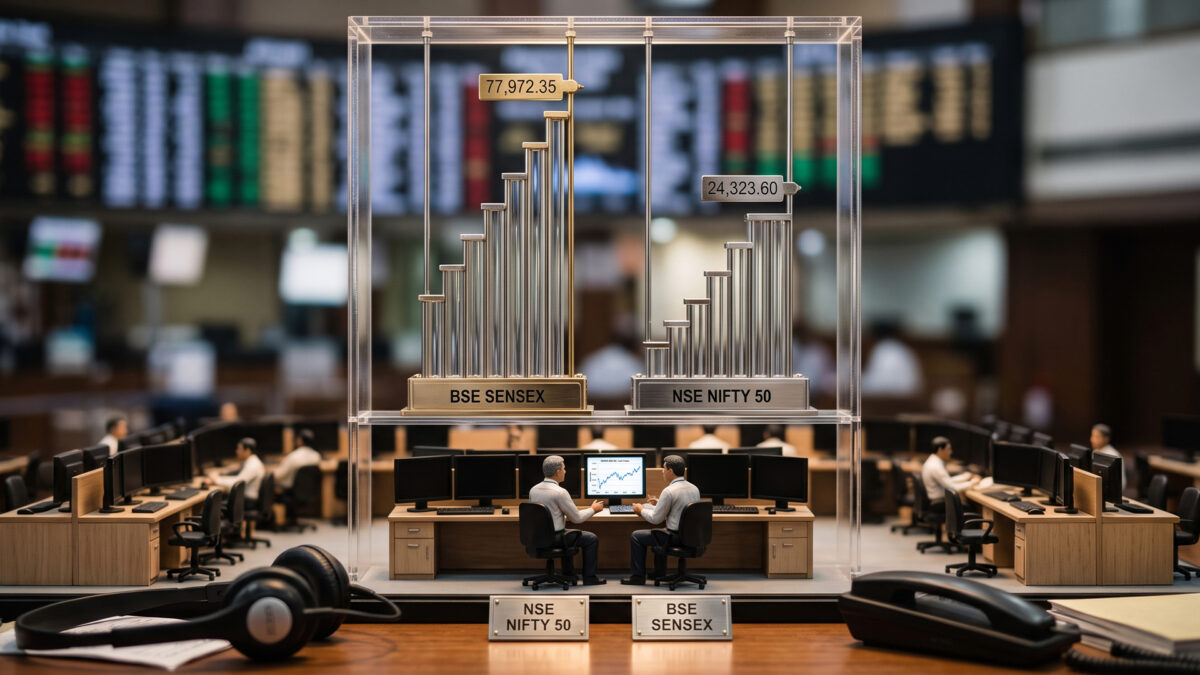
Indian equity markets began the week on a strong note on Monday, the BSE Sensex surged more than 900 points during intraday trade, while the NSE Nifty moved above the 23,950 mark, reflecting strong buying interest across sectors.

The rally was driven largely by banking, automobile and oil-related stocks, which witnessed significant buying throughout the session. Banking shares played a key role in lifting the indices, with HDFC Bank and ICICI Bank emerging among the top contributors to market gains. Investors also turned bullish on automobile counters, with Mahindra & Mahindra (M&M) recording strong gains and adding momentum to the broader market rise.

Oil and energy-related stocks also traded higher after a decline in global crude prices improved market sentiment. Lower crude oil prices are generally viewed as positive for India since the country imports a large share of its energy requirements. A reduction in oil prices can help ease inflationary pressure, lower import costs and support economic growth, factors that often improve investor confidence.

Public sector banking stocks and financial counters also remained in focus and contributed to the positive market breadth. Realty, media and select energy shares traded in positive territory as buying remained broad-based through the session.

However, some stocks failed to participate in the rally. Sun Pharma and Power Grid were among the major laggards and traded in the red as investors booked profits in a few defensive and utility stocks. Select IT and metal counters also witnessed pressure, limiting gains in the broader market.

Market analysts believe improving global sentiment and easing geopolitical concerns supported Monday’s rally. However, they continue to advise caution, noting that the Nifty’s movement near the 24,000 level will remain closely watched by investors.

The market’s next direction is expected to depend on global developments, foreign investor activity and sector-specific trends in the coming days.