Categories
Beyond

India signs $2B deal to lease Russian submarine

India has agreed to lease a nuclear submarine from Russia for about $2 billion, finalising a deal that had been under discussion for nearly ten years. The agreement coincides with Russian President Vladimir Putin’s visit to New Delhi, highlighting the strategic partnership between the two countries.

The leased submarine is expected to arrive within two years. It will be used mainly for training Indian Navy personnel in operating nuclear-powered submarines and cannot be used in combat. The lease will last ten years and includes maintenance and support services, continuing India’s practice of leasing advanced Russian submarines.

The deal gives India immediate access to advanced under-sea capabilities while its own nuclear and missile-capable submarines are still under development. Nuclear submarines have advantages over diesel-powered ones. They can stay submerged longer, are quieter, and can patrol larger areas,  strengthening India’s ability to monitor the Indian Ocean and beyond.

This lease was finalised as part of a wider set of agreements during Putin’s state visit, which also covers trade, energy, and defence cooperation. It reflects India’s effort to modernise its navy quickly while maintaining strong defence ties with Russia, even as it strengthens partnerships with other countries globally.

For the Indian Navy, this submarine lease is a fast way to gain experience with nuclear-powered vessels, helping personnel prepare for future indigenous submarines that will carry missiles and advanced weapons systems.

Also Read: Reliance starts Jio IPO process targeting record valuation

Categories
Beyond

IndiGo cancels 100+ flights, DGCA probes

IndiGo, India’s largest airline, has faced a major operational disruption over the past two days, cancelling more than 100 flights across key airports including Delhi, Bengaluru, Mumbai, and Hyderabad. Passengers were left frustrated as delays stretched for hours, with some forced to stay overnight at airports. The sudden cancellations have triggered widespread inconvenience, particularly affecting families, elderly travellers, and those with connecting flights.

The airline has pointed to multiple reasons behind the disruption. While minor technical issues, busy airports, and winter schedule adjustments played a role, the primary cause has been the implementation of updated crew-rest rules under the second phase of the Flight Duty Time Limitations (FDTL), introduced on November 1. These rules mandate longer rest periods for pilots and cabin crew between flights, limiting night schedules and requiring extended breaks. While designed to ensure safety, the rules have created an acute shortage of available crew, forcing IndiGo to cancel and reschedule flights on short notice.

The Directorate General of Civil Aviation (DGCA) has stepped in, summoning IndiGo officials to explain the widespread cancellations and demanding a detailed mitigation plan. According to DGCA data, IndiGo cancelled over 1,200 flights in November alone, with the majority attributed to crew shortages and FDTL compliance. Other reasons included airspace restrictions, ATC delays, and technical issues. The regulator has emphasised that passenger safety and minimal disruption must remain a priority.

IndiGo has assured passengers that it is working round the clock to stabilise operations. The airline is implementing “calibrated schedule adjustments” over the next 48 hours to bring flights back on track. Passengers are urged to check the latest flight status before leaving for airports and to use official channels for rebooking, refunds, or support.

The recent disruptions highlight the delicate balance airlines must maintain between operational efficiency and safety regulations. While the new crew-rest norms are intended to protect both passengers and staff, adapting to these changes has proven challenging, leaving travellers caught in the crossfire of scheduling adjustments and regulatory compliance.

Also Read: Rupee hits ₹90, consumer goods may get costlier

Categories
Beyond

Gold ₹13,000 per gram, Silver ₹1.91 lakh per kilogram

On December 4, 2025, gold and silver prices rose across India amid a weaker rupee and strong global demand. Silver climbed to around ₹191.10 per gram ( ₹1,91,100 per kilogram), reaching record highs.

Gold remained steady at elevated levels, with 24-carat gold trading at about ₹13,059 per gram and 22-carat gold near ₹11,971 per gram.

City-wise, in Chennai, 24K gold was around ₹13,158 per gram, and 22K gold at ₹12,061 per gram. Other major cities such as Delhi, Mumbai, Kolkata, Bengaluru, and Hyderabad saw similar rates, with 24K at ₹13,059/g and 22K at ₹11,971/g.

Silver also showed minor city variations: in most metros, it was priced at ₹1,91,000 per kg, while in Chennai and Hyderabad it was slightly higher, around ₹2,01,100 per kg, due to local market dynamics.

The main reason for rising prices is the depreciation of the Indian rupee against the US dollar, which makes imported precious metals costlier. Additionally, global demand for silver, both for investment and industrial use, including electronics and renewable energy, remains strong, pushing up rates.

With silver near ₹1.91 lakh per kg and gold holding above ₹13,000 per gram, it is important to check city-specific rates before making purchases. Prices can vary slightly between cities and fluctuate during the day, so timing and local rates are key considerations for jewellery purchases or investments.

Also Read: Sensex gains 100 points, Nifty steady above 26000 after early dip

Categories
Beyond

Rupee falls past ₹90 on trade and outflow pressure

The Indian rupee weakened further on Wednesday, slipping past the crucial ₹90-per-dollar mark for the first time. The currency opened lower and extended losses as persistent foreign fund outflows, strong demand for the US dollar, and uncertainty around India’s pending trade discussions pressured market sentiment.

Traders reported steady dollar buying from importers, especially in sectors like gold and electronics, which has added to the strain on the rupee. With India’s import bill rising, the demand for dollars continues to stay elevated even as global currency markets remain volatile.

Foreign investors have been pulling money out of Indian equities and bonds over the past few weeks, adding to the downward pressure. Many are staying cautious due to geopolitical tensions and concerns over global interest rate trends. This steady outflow has reduced dollar supply in domestic markets at a time when demand is already high.

Market participants also pointed to the lack of progress on the ongoing India–US trade discussions as another factor weighing on sentiment. With no clarity on when the deal might move forward, traders expect the rupee to remain under pressure in the near term.

Despite India’s strong macroeconomic backdrop, analysts say the rupee could weaken further if foreign inflows do not stabilise soon. Some expect the currency to hover near or slightly above the current levels unless global conditions improve or trade negotiations break the deadlock.

For now, the Reserve Bank of India is expected to step in when required to prevent excessive volatility, but traders believe the central bank will avoid aggressive intervention unless the rupee shows sharper swings. Overall, the mood in currency markets remains cautious as investors wait for clearer signals on trade and global risk trends.

Also Read: Gold hits ₹1.30 lakh mark, Silver climbs to ₹1.84 lakh

Categories
Beyond

Gold hits ₹1.30 lakh mark, Silver climbs to ₹1.84 lakh

Gold and silver prices continued their steady climb on Wednesday, offering yet another sign that investors are leaning heavily toward safe-haven assets amid global uncertainty. On the Multi Commodity Exchange (MCX), gold moved past ₹1.30 lakh per 10 grams, while silver surged to nearly ₹1.84 lakh per kilogram, marking a strong mid-week performance for the bullion market.

Gold opened with positive momentum and inched higher through the session. Traders say the metal is benefiting from growing expectations of an interest rate cut by the US Federal Reserve, an event that usually boosts gold’s appeal. At the same time, the Indian rupee’s weakness has added an extra push, making imports more expensive and naturally lifting local prices.

Silver’s rise has been even more striking. The white metal, supported by both investment demand and industrial use, rose around 1.5% during Wednesday’s session. Analysts note that global supply pressures and strong demand from sectors like electronics and renewable energy are helping silver maintain its sharp upward trajectory.

Market watchers say gold now finds support around ₹1.28 lakh, while immediate resistance lies close to ₹1.31 lakh. If prices hold above current levels, the metal could test new highs later this week. Silver, too, is expected to stay firm as long as it trades above the ₹1.84 lakh zone, with potential to move towards ₹1.86–₹1.88 lakh.

For everyday buyers, the latest jump may come as a mixed signal—good news for investors holding gold or silver, but slightly discouraging for those planning jewellery purchases. Still, the broader market mood suggests that bullion will remain attractive as long as global uncertainties linger and the rupee stays under pressure.

As the week progresses, traders will be watching key global data and central bank cues closely. For now, both gold and silver continue to shine brighter in the mid-week market.

Also Read: Sensex falls 250 Points, Nifty slips 80 as markets turn cautious

Categories
Beyond

Government says Sanchar Saathi optional

The Centre has clarified that the Sanchar Saathi mobile application, which recently triggered a political and public debate, will not be mandatory for smartphone users. Communications Minister Jyotiraditya Scindia informed Parliament that people are free to delete the app from their phones and that its installation is meant only to support citizens, not to monitor them.

The clarification comes days after the government directed smartphone manufacturers and importers to pre-install the app on all new devices and include it in upcoming software updates. This led to concerns that the app might collect sensitive data or open the door to state surveillance. Opposition leaders criticised the move, arguing that it risked turning smartphones into monitoring devices.

Scindia emphasised that these fears are unfounded. He stated that Sanchar Saathi neither listens to calls nor accesses private content, and that its purpose is limited to preventing telecom fraud. The app, developed by the Department of Telecommunications, provides tools that help users keep track of SIM cards issued in their name, report wrongly issued mobile connections, and block phones that have been lost or stolen.

One of its key features, the “Know Your Mobile” service, allows people to verify whether a device has a valid IMEI number — a step meant to curb the spread of cloned or fake phones often used in criminal activity. The app also connects users to the national portal where stolen devices can be blacklisted across networks, preventing their misuse. In addition, it supports reporting of spam calls and SMS, an issue that has grown alongside digital payment fraud.

While officials argue that the app strengthens digital safety, privacy experts worry about setting a precedent where government-backed apps could become compulsory in the future. They also question whether pre-installation will give citizens genuine choice.

By clarifying that Sanchar Saathi can be removed at any time, the government aims to ease public concerns and shift focus back to the app’s intended benefits. The debate, however, has highlighted a larger issue, the balance between improving cyber safety and ensuring that technological interventions do not compromise personal freedom. As smartphones continue to be central to daily life, this balance will remain under intense public scrutiny.

Also Read: Vodafone Idea shares jump 4% on relief hopes

Categories
Beyond

Rupee hits record low, students and travellers feel pinch

The Indian rupee touched a new all-time low against the US dollar this week, trading at around ₹89.85, raising concerns for students planning to study abroad and families planning international travel.

Despite India’s strong economic growth, with GDP expanding at 8.2% in the September quarter, the rupee has been under pressure. Analysts attribute the depreciation to weak foreign investment inflows, increased demand for dollars from importers, and uncertainty surrounding a potential US-India trade deal. The currency had earlier breached ₹89.49, and the slide shows no signs of immediate reversal.

For Indian students heading abroad, this depreciation has immediate financial implications. Tuition fees, accommodation, and daily expenses paid in foreign currencies now cost significantly more in rupees. Even modest fluctuations in exchange rates can add several lakhs to a student’s annual budget. Families planning holidays abroad are also likely to feel the pinch, as flight tickets, hotel bookings, and other travel expenses become costlier.

Economists note that this decline is partly a reflection of global market conditions, where the US dollar remains strong and capital inflows into emerging markets like India have slowed. Importers seeking dollars for essential commodities and trade also contribute to the rupee’s weakness. While some experts describe the depreciation as a “calibrated adjustment,” it nonetheless increases the financial burden on middle-class households managing overseas expenses.

The Reserve Bank of India (RBI) has traditionally intervened in currency markets to stabilize the rupee, but market participants suggest that the current pressure reflects broader structural trends that may persist in the near term. Investors and travellers are being advised to monitor currency movements closely and plan foreign expenditures accordingly.

For students and travellers, hedging options such as prepaid forex cards, forward contracts, or early currency conversion can help mitigate some of the costs associated with the falling rupee. Families may need to reconsider budgets for study programs, vacations, and other dollar-denominated expenses to adjust for the higher rupee cost.

The rupee’s fall is set to impact households across India, particularly students and families with plans abroad. Rising costs for education, travel, and imports are a direct consequence of the weaker currency, showing how global market movements can quickly affect everyday finances.

Also Read: Rupee slips to all-time low of 89.76 against dollar

Categories
Beyond

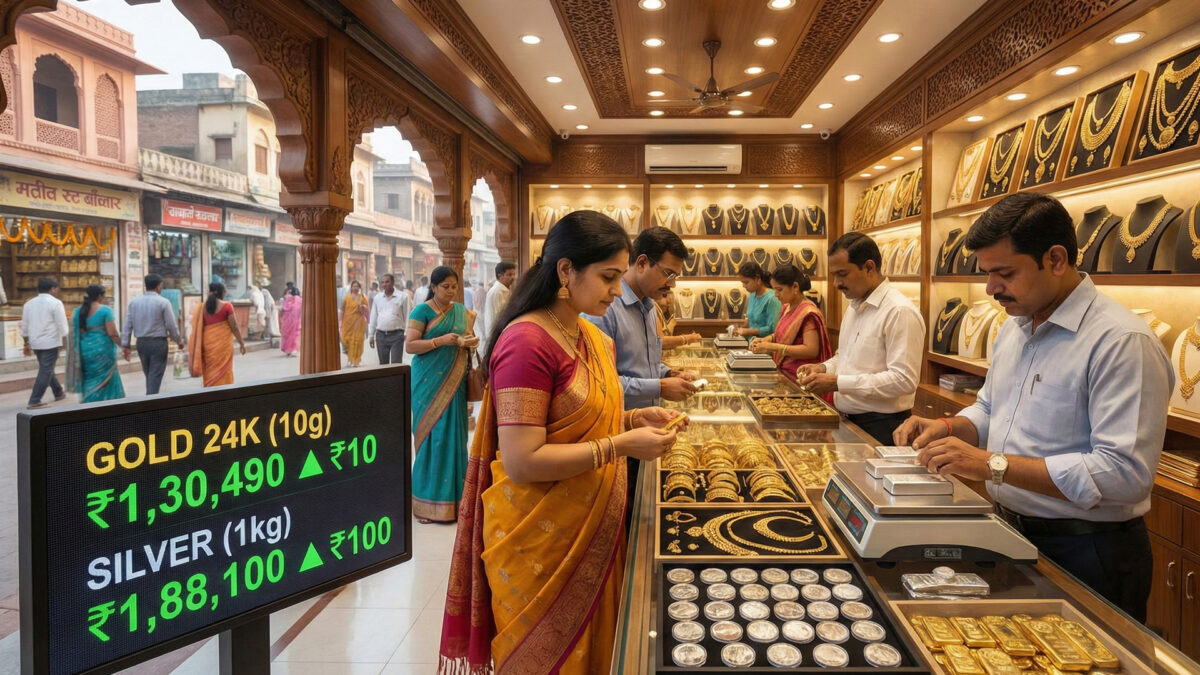
Gold rises ₹10 as silver gains ₹100 today

Gold and silver prices in India moved up slightly on December 2, offering a steady start to the month for bullion buyers. While gold saw only a marginal rise, silver recorded a comparatively stronger jump.

The price of 24-carat gold increased by ₹10, bringing the rate for 10 grams to ₹1,30,490 across major markets. The movement was similar in 22-carat gold, which also rose by ₹10 to ₹1,19,610 for 10 grams. In Chennai, gold remained costlier than other metros, with 24-carat gold priced at ₹1,31,680 and 22-carat gold at ₹1,20,710.

Silver outperformed gold on the day. One kilogram of silver was priced at ₹1,88,100 in Delhi, Mumbai and Kolkata, a rise of ₹100 from the previous session. The metal has been gaining steady traction as both industrial demand and investor interest remain firm.

Across metros, gold prices stayed largely aligned: Bengaluru, Hyderabad, Mumbai and Kolkata recorded the same 22K rate of ₹1,19,610, while 24K held at ₹1,30,490. Slight variations in Delhi and Chennai reflected local demand and logistics.

The mild uptick in gold and the stronger movement in silver come at a time when global markets are cautious, and investors are gradually shifting towards safer assets. With the wedding season still active and year-end buying picking up, traders expect bullion demand to remain stable.

As gold holds near the ₹1.30-lakh mark and silver continues its upward swing, market watchers will look to global cues and domestic buying trends to gauge the next direction in precious metal prices.

Also Read: Sensex falls 316 points, Nifty slips 88

Categories
Beyond

Rupee slips to all-time low of 89.76 against dollar

The Indian rupee dropped to a new all-time low of 89.76 per US dollar on December 1, even as the country posted an impressive 8.2% GDP growth for the July–September quarter.

The strong economic data lifted stocks to record highs and nudged the 10-year government bond yield up to 6.553%, near a one-week high. However, the growth did little to support the currency.

Since November 3, the currency has fallen nearly one full rupee against the dollar and is now one of the worst-performing major currencies of 2025, ahead of only the Turkish lira and Argentine peso.

Foreign investor sentiment remains weak. Overseas investors sold about $400 million worth of Indian equities on Friday, taking total outflows this year to more than $16 billion. Traders also said that the maturity of large positions in the non-deliverable forwards market added pressure on the rupee.

Meanwhile, data released on Friday showed the RBI’s forward book rising above $63 billion in October, indicating continued efforts to manage volatility, with state-run banks seen offering dollars intermittently. The maturity of large positions in the non-deliverable forwards (NDF) market also weighed on the currency, according to traders.

The rupee remains weighed down by the lack of progress on a US–India trade deal, higher importer demand for dollars and a balance-of-payments position that has turned less supportive.

Hopes for tariff relief faded after no concrete agreement emerged on reducing the steep 50% tariffs imposed on Indian exports.

India’s external sector continues to face pressure, with the merchandise trade deficit hitting an all-time high in October, further dampening sentiment and adding to downward pressure on the rupee.

Also Read: Ahmedabad’s GIFT City expands as $100 billion financial hub

Categories
Beyond

FPIs withdrew ₹3,765 cr from Indian markets in Nov.

Foreign Portfolio Investors (FPIs) resumed selling in November, pulling back a net ₹3,765 crore from Indian equity markets. This marked a sharp reversal after October, when FPIs had invested a net ₹14,610 crore, breaking a long spell of outflows from the domestic market.

The renewed selling was driven by a mix of global and domestic factors. On the international front, investors remained cautious due to uncertainty around the US Federal Reserve’s interest rate decisions, a strong US dollar, and volatility in global technology stocks. Geopolitical tensions and fluctuating crude oil prices also added to market jitters, prompting FPIs to reduce their exposure.

Within India, some sectors were considered overvalued after strong gains earlier in the year, while weak industrial data further dampened sentiment. Analysts observed that the selling was broad-based, affecting major sectors such as IT services, consumer services, and healthcare.

Despite the outflow, experts stressed that the trend may not indicate a sustained withdrawal of foreign funds. FPIs have shown mixed behaviour in recent weeks, buying and selling on different days, suggesting that market flows could change quickly if global and domestic conditions improve.

Looking ahead, foreign investment trends in December will likely depend on key developments, including signals from the US on interest-rate cuts and progress in India-US trade talks. Market watchers said that while FPIs are temporarily cautious, India’s relatively stable macroeconomic fundamentals and strong corporate earnings could attract fresh inflows if uncertainties ease.

Also Read: Oil prices climb as OPEC+ keeps production steady