Categories
Corporate

Sensex Up 300 Points, Nifty Over 25,600, Asian Paints, M&M Rise

Indian stock markets opened on a positive note on Thursday, supported by firm global trends. The Sensex gained over 300 points to trade near 83,750, while the Nifty 50 moved above 25,600 in early trade.

Buying in Asian Paints, Mahindra & Mahindra, Britannia Industries, and Sun Pharma lifted market sentiment. Asian Paints jumped nearly 4%, and M&M rose about 2%.

Among the top performers were Redington, CCL (India), Gujarat Pipavav, Shipping Corporation of India, and Asian Paints. Meanwhile, Delhivery, Hindalco Industries, Deepak Fertilisers, Asahi India Glass, and BEML were among the main losers.

Market analysts said investors remain cautious due to continued foreign fund outflows and mixed corporate earnings. They added that the next market trend will depend on upcoming Q2 results and global economic signals.

Also Read: RSWM, Adani Energy Team Up for Green Power

Categories
Corporate

RSWM, Adani Energy Team Up for Green Power

RSWM Ltd, a leading Indian textile manufacturer and flagship company of LNJ Bhilwara Group, has signed an agreement with Adani Energy Solutions Ltd (AESL) to procure 60 MW of renewable energy for its manufacturing facilities in Rajasthan.

Under the deal, AESL will manage the full green power value chain, while RSWM has invested ₹60 crore under a Group Captive Scheme to secure 31.53 crore units of green electricity annually. With this addition, renewable energy will cover 70% of RSWM’s total energy requirement, up from the current 33%.

“This milestone reinforces RSWM’s long-term vision of sustainable growth and industry leadership in clean energy adoption,” said Riju Jhunjhunwala, Chairman and CEO. Rajeev Gupta, Joint MD, highlighted that integrating hybrid power will reduce carbon footprint and strengthen energy security.

Kandarp Patel, CEO of AESL, added that the partnership showcases how renewable energy supports industrial growth while driving sustainability. AESL aims to expand its Commercial & Industrial energy portfolio to 7,000 MW over the next five years.

RSWM continues to embed sustainability in all operations, including energy efficiency, circular material flows, water conservation, and recycling, positioning itself as a future-ready textile leader.

Also Read: India Nears Top Three Globally, FM Sitharaman

Categories
Corporate

SEBI to Revamp Broker Rules by Dec. 2025

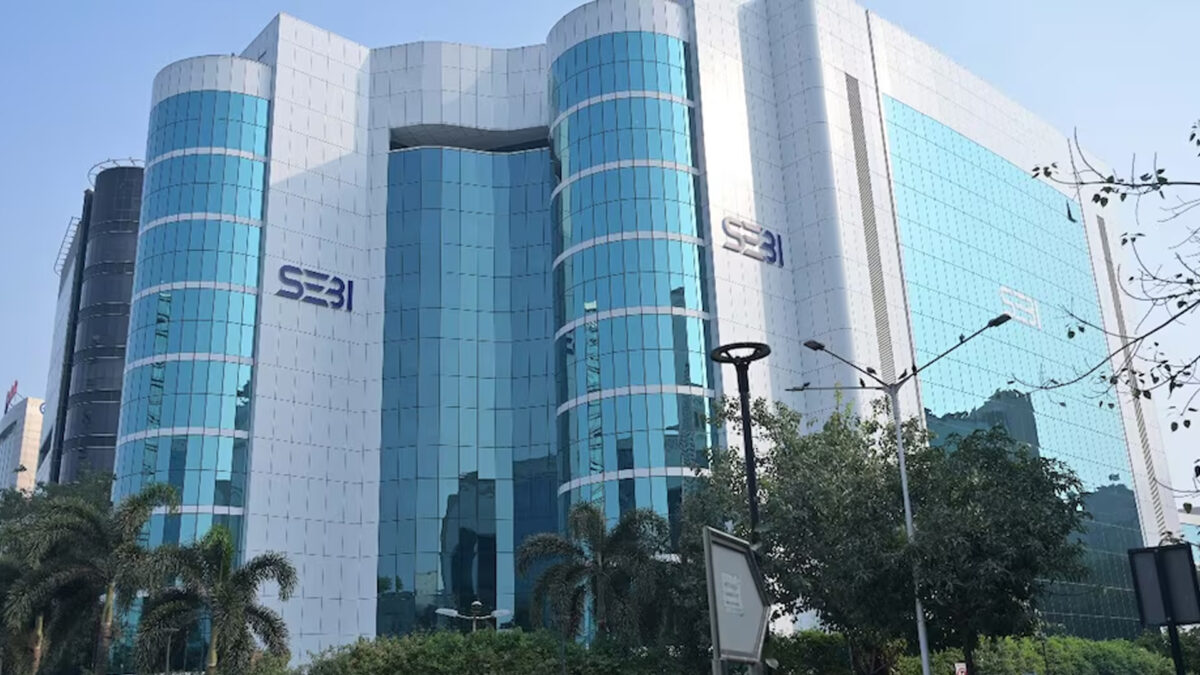
The Securities and Exchange Board of India (SEBI) is set to overhaul stock broker regulations that have been in place for over 30 years. The move aims to modernize rules, improve risk management, and strengthen data protection, including updated definitions for algorithmic and proprietary trading. SEBI Chairman Tuhin Kanta Pandey said the changes could be implemented by December 2025.

The decision follows a discussion paper issued in August and comes amid concerns about trading disruptions, such as a recent technical glitch at the Multi-Commodity Exchange (MCX). SEBI is analyzing the incident to prevent future problems and ensure market stability.

The regulator is also addressing investor concerns by allowing the transfer of physical securities bought before FY20. In addition, SEBI resolved a disclosure violation with brokerage Angel One, which will pay ₹34 lakh in settlement.

Pandey stressed that the reforms aim to make India’s markets more robust, transparent, and investor-friendly, keeping regulations in step with modern trading practices.

Also Read: Goyal in New Zealand for FTA Talks

Categories
Leaders

India Nears Top Three Globally, FM Sitharaman

India is steadily advancing toward becoming the third-largest economy in the world, Finance Minister Nirmala Sitharaman said, underlining the country’s impressive economic progress over the past decade.

Speaking at the Delhi School of Economics, she noted that India was the tenth-largest economy in 2014. Today, it ranks fifth globally, and with sustained growth, it is poised to move even higher, edging closer to joining the top three alongside the United States and China.

Sitharaman stressed that India’s growth is not just about numbers. An estimated 25 million people have been lifted out of multi-dimensional poverty in recent years, highlighting the social impact of economic development. Government reforms, infrastructure investments, and policies aimed at inclusive growth have all contributed to these achievements, she added.

The Finance Minister also pointed to significant improvements in India’s financial sector. Public sector banks are stronger today, with the long-standing twin balance sheet problem, which had strained both banks and corporate borrowers, largely resolved. This healthier banking environment is expected to boost investment, stimulate job creation, and support further economic expansion.

On fiscal management, Sitharaman noted that the government is on track to meet its fiscal deficit target of 4.4% of GDP (₹15.69 lakh crore) for FY 2025‑26, reflecting a commitment to balancing growth with fiscal responsibility. Analysts say that maintaining fiscal discipline while encouraging investment and consumption is critical to sustaining the momentum toward becoming a top-three economy.

India’s rise in global economic rankings carries broader implications. Achieving third-largest status would enhance the country’s international influence, increase foreign investment, and create more resources for sectors such as healthcare, education, and infrastructure.

Yet challenges remain: continued reforms, improved productivity, job creation, and careful navigation of global uncertainties, including inflation, commodity price volatility, and geopolitical risks, will be essential to secure this trajectory.

Sitharaman’s remarks underline that India’s growth strategy aims to combine economic scale with social progress, ensuring that prosperity reaches citizens across the country while strengthening the nation’s global standing.

Also Read: China lifts 24% US tariff, keeps 10%

Categories
Corporate

Adani Power Invokes Arbitration Clause in Bangladesh Dispute

Adani Power Ltd (APL) has opted for international arbitration to resolve a payment dispute with the Bangladesh Power Development Board (BPDB) concerning electricity supplied from its 1,600 MW Godda coal-based power plant in Jharkhand. The move comes after prolonged discussions over differences in cost calculations and billing under a 25-year Power Purchase Agreement (PPA) signed in 2017.

According to company officials, both parties have mutually agreed to invoke the dispute resolution clause to ensure transparency and protect long-term cooperation. An Adani Power spokesperson said that there are disagreements in how certain cost elements are computed and billed. Both partners have agreed to invoke the dispute-resolution process and are confident of a quick, smooth, and mutually beneficial outcome.

The BPDB, meanwhile, has stated that it remains engaged in negotiations and will consider arbitration after discussions conclude. Reports indicate that while earlier this year Bangladesh’s dues to Adani Power were nearly USD 2 billion, they have now been reduced to the equivalent of just 15 days of tariff payment, reflecting significant progress in clearing outstanding amounts.

Industry analysts view the arbitration step as a strategic move by Adani Power to formalize dispute resolution while maintaining supply stability. The company continues to export power to Bangladesh without disruption, reaffirming its commitment to support the neighbouring nation’s growing energy needs.

The Godda plant, operated through a cross-border transmission arrangement, meets a notable share of Bangladesh’s power demand. The dispute primarily relates to tax treatment, fuel costs, and related cost components that impact the final tariff structure under the PPA.

Adani Power emphasized that arbitration would not affect ongoing supply or the company’s regional growth plans. Both sides are expected to appoint arbitrators soon, aiming for an expeditious and amicable settlement.

Also Read: Starbucks Offloads China Stake to Boyu for $4 Billion

Categories
Corporate

Starbucks Offloads China Stake to Boyu for $4 Billion

Starbucks Corp has agreed to sell a 60% stake in its China retail operations to Boyu Capital for $4 billion, marking one of the most significant foreign divestments in China’s consumer sector in recent years. The move comes as the world’s largest coffee chain seeks to strengthen its position in a market increasingly dominated by agile local competitors such as Luckin Coffee.

The deal will create a joint venture in which Starbucks retains a 40% ownership, continuing to license its brand, menu, and operating systems to the Chinese unit. The transaction values Starbucks China at roughly $13 billion, reflecting its strong brand equity despite slowing growth.

Starbucks first entered the Chinese market in 1999 and has since expanded to nearly 8,000 stores across more than 250 cities. However, it now faces stiff competition from homegrown coffee brands offering lower prices and faster delivery options. The company has also been grappling with economic headwinds and changing consumer preferences in China’s post-pandemic retail landscape.

By partnering with Boyu, Starbucks aims to leverage the local firm’s market expertise, operational efficiency, and consumer insights to accelerate expansion. The coffee giant has set an ambitious goal of growing its store network to 20,000 outlets in the coming years, positioning China as its most important growth market outside the United States.

Reports suggest, Boyu Capital is in talks with major Chinese banks to secure around $1.4 billion in loans to fund the acquisition. The financing is expected to be structured as an onshore, yuan-denominated facility, which would make it one of the largest leveraged buyouts in China this year.

Industry analysts view the partial sale as a strategic recalibration rather than a retreat. The partnership allows Starbucks to maintain brand control while gaining the flexibility and capital required to compete in China’s fast-evolving beverage market.

If approved by regulators, the deal is expected to close in 2026, reshaping the dynamics of China’s booming coffee sector.

Also Read: Bharti Airtel Q2 Net Jumps 89% on Solid Sales

Categories
Corporate

Sensex Falls 150 pts, Nifty Below 25,750, Hitachi Up, Reliance Down

The Indian equity market closed largely unchanged on Monday as investors paused after the Sensex and Nifty capped their strongest monthly rally in seven months. Mild profit-booking following October’s surge was countered by selective buying in stocks buoyed by robust earnings, helping indices hold steady.

The S&P BSE Sensex inched up 39.78 points, or 0.05%, to close at 83,978.49, while the NSE Nifty 50 gained 41.25 points, or 0.16%, to end at 25,763.35.

Across global markets, cues were mixed. S&P 500 futures slipped 0.4% as of midday Tokyo time, while Japan’s Topix advanced 0.4%. Australia’s S&P/ASX 200 declined 0.9%, Hong Kong’s Hang Seng rose 0.2%, and the Shanghai Composite edged down 0.1%. Euro Stoxx 50 futures were also marginally lower at 0.2%.

At the domestic market opening, top gainers included 3AM India, Hitachi Energy, TBO Tech, City Union Bank, and RR Kabel. On the downside, Reliance Power, Affle (India), Power Grid Corporation, Hero MotoCorp, and Gland Pharma were among the top losers.

Also Read: Sensex, Nifty Hold Steady, Realty, PSU Banks Lead

Categories
Corporate

Sensex, Nifty Hold Steady, Realty, PSU Banks Lead

India’s benchmark indices ended Monday’s session almost unchanged after a volatile day of trade, with gains in realty and PSU bank stocks offset by weakness in IT and auto counters.

The Sensex rose 40 points to 83,978, while the Nifty added 41 points to 25,763. Broader indices outperformed, with midcaps and smallcaps gaining up to 0.7%.

Realty, telecom, pharma, and PSU bank stocks led the advance, each rising 1–2%. IT, FMCG, and auto shares slipped on profit-booking.

Top gainers on the Nifty included Shriram Finance, M&M, Apollo Hospitals, SBI, and Tata Consumer, while Maruti, ITC, TCS, BEL, and L&T declined.

Analysts said markets are consolidating after recent highs. The Nifty faces resistance near 26,100, with support at 25,650.

The Bank Nifty showed strength, holding above 57,600, with potential to move toward 58,500.

Global sentiment stayed mixed as investors tracked the US Fed’s next move and geopolitical cues. Experts expect the market to stay range-bound, with buying interest in realty, PSU banks, and midcaps likely to continue.

Also Read: Sensex falls 100 pts, Nifty below 25,750

Categories
Corporate

Urban Company Shares Drop 6% as Q2 Loss Hits ₹59 Cr

Urban Company shares fell nearly 6% on Monday after the home-services marketplace reported a wider consolidated net loss of ₹59.33 crore for the second quarter ended September 2025 (Q2 FY26), compared to ₹1.82 crore a year earlier. The loss came despite robust revenue growth, as elevated spending on new verticals, partner onboarding, and marketing weighed on margins.

Revenue from operations rose 37% year-on-year to ₹380 crore, reflecting continued momentum across beauty, home repair, and cleaning segments. However, total expenses surged to ₹462 crore from ₹384 crore in the same quarter last year, leading to an adjusted EBITDA loss of ₹35 crore.

A major drag on profitability was the company’s newly launched Insta Help vertical, which reported an EBITDA loss of ₹44 crore in the quarter. Excluding Insta Help, Urban Company’s core business delivered an adjusted EBITDA profit of ₹10 crore, or 0.9% of net transaction value (NTV).

Within India’s consumer services segment, excluding Insta Help, NTV grew 19% to ₹762 crore, while revenue increased 24% to ₹262 crore. The segment reported an adjusted EBITDA of ₹18 crore, equivalent to 2.4% of NTV, compared with 3.1% a year ago.

The company’s Native product category, featuring appliances such as water purifiers and smart locks, continued to expand rapidly. NTV jumped 164% year-on-year to ₹97 crore, while revenue climbed 179% to ₹75 crore. Despite this, the segment posted a smaller loss of ₹9 crore, indicating improved efficiency.

Urban Company’s international business, operating in the UAE and Singapore, also showed encouraging progress, with NTV rising 73% and revenue up 66% year-on-year, achieving near breakeven levels.

The company, which debuted on the stock exchanges earlier this year, reiterated its focus on long-term value creation through technology, service quality, and category diversification. Management said near-term losses reflect ongoing investments in scaling operations and enhancing partner experience.

Also Read: Ambuja Cements Q2 Profit Rises 364% to ₹2,302 Crore

Categories
Corporate

Sensex falls 100 pts, Nifty below 25,750

Indian stocks traded with high volatility on Monday, opening slightly lower as investors took profits after a strong rally in October. Weakness in private banks and FMCG shares pulled the markets down, though positive quarterly results and encouraging auto sales data helped limit the fall.

The mood in global markets also stayed cautious. A stronger U.S. dollar and the Federal Reserve’s cautious outlook on interest rate cuts made investors less willing to take risks.

On Friday, Indian markets had already ended lower for the second day in a row as traders booked profits following mixed corporate earnings. Financial stocks, especially HDFC Bank and ICICI Bank, faced pressure after the market regulator tightened some eligibility rules.

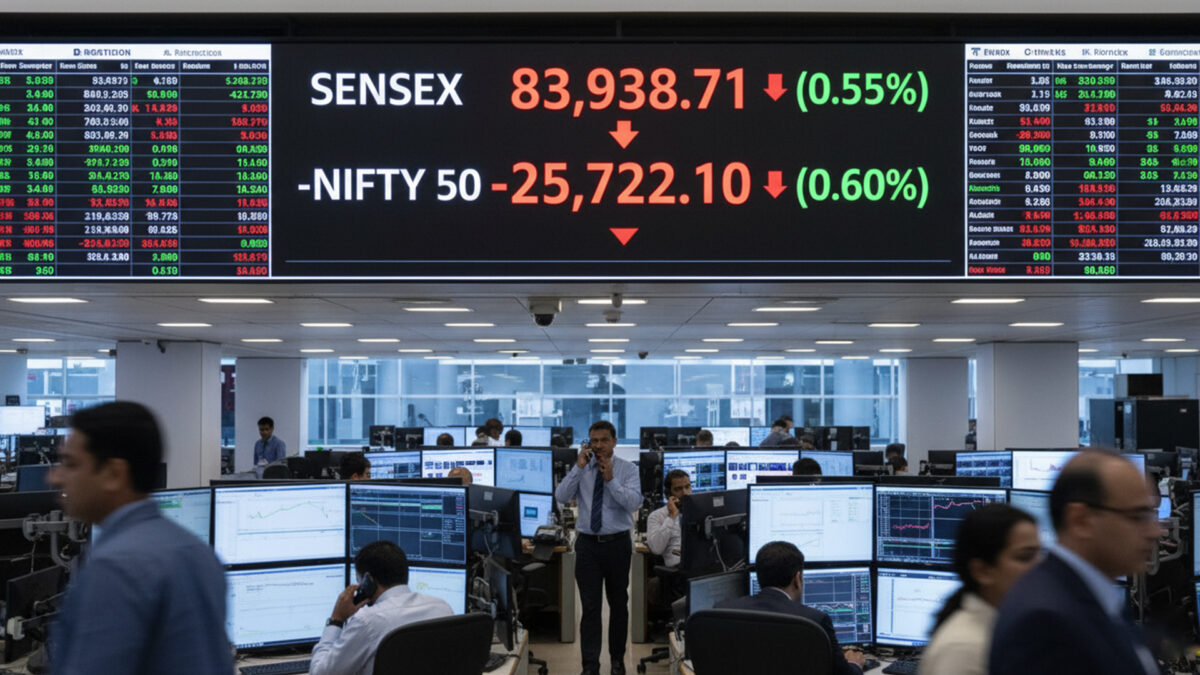
At close on Friday, the Sensex had fallen 465.75 points (0.55%) to 83,938.71, while the Nifty 50 lost 155.75 points (0.60%) to end at 25,722.10.

Analysts said the market could stay choppy in the short term as investors look for direction from global cues, crude oil prices, and upcoming earnings reports.