Categories
Beyond

US edits India trade deal factsheet

The White House has revised its factsheet on the proposed India-US interim trade deal, making key changes to language on agricultural imports, investment commitments and digital taxation following concerns flagged by New Delhi.

In the earlier version of the document, the US had stated that India would cut or eliminate tariffs on a list of American agricultural products, including tree nuts, fruits, soybean oil, wine, spirits and “certain pulses.” The mention of pulses,  a politically sensitive crop in India,  drew attention because India is the world’s largest producer and consumer of lentils, chickpeas and other pulses, and domestic farmers depend heavily on tariff protection.

In the updated factsheet, the specific reference to “certain pulses” has been removed. Instead, the language now broadly mentions improved access for a “wide range of US agricultural products,” without naming individual commodities.

Another notable revision relates to India’s proposed purchases of American goods. The original text said India was “committed” to buying more than $500 billion worth of US products over the next five years, including energy, coal and technology equipment. The revised version softens this to say India “intends” to purchase such goods, signalling that the figure is indicative rather than a binding obligation. Mentions of agricultural goods within this purchase commitment have also been omitted.

Changes were also made to the section on digital trade. The earlier draft suggested India would remove or roll back its digital services tax. The revised document now says both countries will work toward negotiating digital trade rules, bringing the language in line with prior joint statements.

Sources indicated that the corrections were made to accurately reflect what had been mutually agreed upon.

Also Read: Rupee declines 6 paise to ₹90.62 in early trade

Categories
Corporate

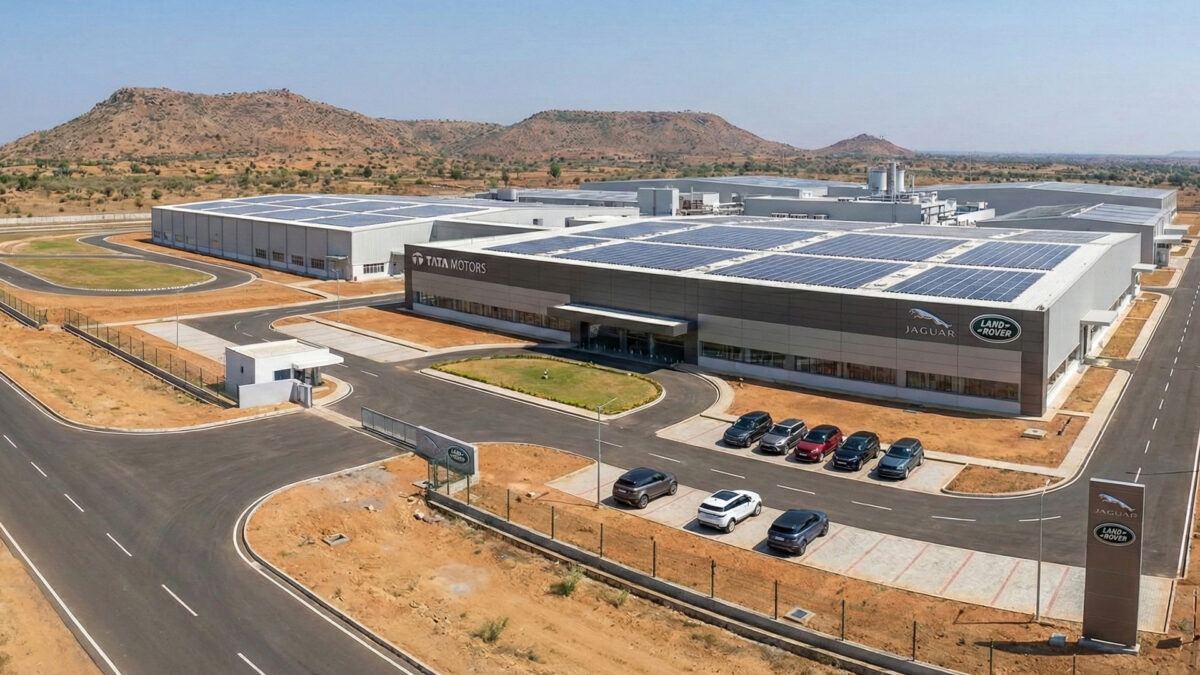
Tata Motors launches ₹9,000 cr JLR plant in Tamil Nadu

Tata Motors and its luxury arm, Jaguar Land Rover (JLR), have officially opened a new manufacturing plant in Panapakkam, Ranipet district, Tamil Nadu. The ₹9,000 crore facility is the company’s largest investment in India and will produce premium cars for both domestic and international markets.

The first vehicle to roll off the assembly line is the Range Rover Evoque, marking the start of local production of luxury SUVs. The launch was flagged off by Tamil Nadu Chief Minister M. K. Stalin alongside Tata Group Chairman N. Chandrasekaran.

Spread over a large area, the plant is designed to be sustainable, with renewable energy use and water-positive processes, reflecting Tata’s commitment to environmentally friendly operations.

Initially, the facility will focus on assembling the Range Rover Evoque, but it is expected to gradually expand to produce other Tata and JLR models, including future electric vehicles. The company aims to reach a production capacity of 2.5–3 lakh vehicles per year over the next few years.

The plant will also create more than 5,000 direct and indirect jobs, offering opportunities for local suppliers and boosting the region’s economy.

Tata Motors said the Panapakkam plant strengthens India’s position in JLR’s global manufacturing network, complementing existing facilities in the UK, China, and Brazil.

Also Read: Belagavi tech company in Karnataka sues Anthropic over name

Categories
1 Minute-Read

Eternal shares soar 7% on heavy trading

Eternal Ltd’s stock jumped 7 % on Tuesday, with unusually high trading volumes of around 9.9 crore shares on the NSE. The rally followed strong third-quarter results, with net profit rising 73 % to ₹102 crore and revenue more than tripling year-on-year.

Market activity was also supported by a large block deal worth roughly ₹344 crore. Recent company developments, including a change in CEO and the closure of a subsidiary, have kept investors’ attention on the stock.

Over the past month, Eternal shares have gained around 6.6 %, reflecting growing confidence in the company’s growth trajectory.

Categories
Beyond

Gold ETFs attract ₹24,040 cr in January

Indian investors significantly boosted their holdings in gold exchange-traded funds (ETFs) in January 2026, pouring in ₹24,040 crore — more than double the inflows recorded in December 2025. This marks the strongest monthly inflow in five months and brings gold ETF investments nearly on par with net inflows into equity mutual funds during the same period.

Data from the Association of Mutual Funds in India (AMFI) shows that the broader category of precious metal ETFs, which includes silver products, drew a combined ₹33,503 crore in January. Silver ETFs also saw robust growth, attracting ₹3,962 crore compared with December’s lower levels. In contrast, equity funds experienced a slowdown, with net inflows of around ₹24,029 crore — down 14 % from December. Large-cap equity schemes gained slightly, while mid- and small-cap funds reported weaker flows, and some tax-saving ELSS schemes even saw net outflows.

Experts attribute the strong appetite for gold ETFs to a combination of global and domestic factors. Rising inflation, currency volatility, and ongoing geopolitical tensions have encouraged investors to seek safety in gold. Its appeal is further reinforced by liquidity, transparency, and cost efficiency, making ETFs a convenient vehicle for both retail and institutional investors.

“Investors are increasingly treating gold not just as a hedge, but as a core component of their diversified portfolios,” said a market analyst. The trend reflects a shift in investment priorities, with individuals seeking stability alongside potential returns, particularly during periods of market uncertainty.

The January data highlights a broader behavioural change in India’s mutual fund landscape. While equities continue to attract attention, gold and other precious metal ETFs are emerging as key instruments for managing risk and preserving wealth. As the market navigates economic fluctuations and global pressures, investors appear to be increasingly leaning toward assets that combine safety with growth potential.

Also Read: China urges banks to cut US treasury holdings

Categories
Corporate

Sensex gains 208 points, Nifty crosses 25,900

The market extended its rally for the third straight session on Tuesday,  with benchmarks closing higher amid broad-based buying. The BSE Sensex rose 208 points to settle near 84,274, while the Nifty 50 ended at 25,935, maintaining its position above the 25,900 mark.

Sectoral buying was strong in autos, metals, and mid-cap stocks, supporting the overall market sentiment. Among the gainers, Eternal Ltd surged over 5%, Tata Steel climbed around 3%, and Mahindra & Mahindra and Tech Mahindra added more than 1.5% each. On the losing side, HCL Technologies, Bajaj Finance, Bharti Airtel, and Adani Ports saw modest declines during the session.

Foreign institutional investors continued net buying, which helped sustain the market’s uptrend. The broader indices, including mid-cap and small-cap segments, outperformed, showing participation beyond just the frontline stocks. Positive cues from global markets and selective corporate earnings also bolstered investor confidence.

A decisive move above these levels could continue the recovery. Strategists suggested selective accumulation in fundamentally strong stocks while monitoring earnings trends for sustained gains.

Also Read: Sensex gains 300+, Nifty climbs past 25,950

Categories
Corporate

BSE shares jump 6% to yearly high after strong Q3

Shares of the Bombay Stock Exchange (BSE) climbed sharply on Tuesday, rising over 6% to hit a 52-week high, after the company posted strong results for the third quarter of 2025‑26. Investors reacted positively to BSE’s higher-than-expected earnings and optimistic outlook from brokers.

BSE reported a net profit of ₹602 crore, up around 174% from ₹220 crore in the same period last year. Revenue also grew about 62%, reaching ₹1,244 crore, helped by increased trading activity and more participation in different markets.

The growth came mainly from derivatives trading, mutual fund transactions, and new listings, which boosted transaction charges and overall revenue. Analysts said the results show BSE’s strong position in India’s capital markets and its ability to generate consistent income across business segments.

On the stock market, BSE shares traded at nearly ₹3,175 each, marking their highest level in a year. This rally reflected strong investor confidence in the exchange’s performance and growth prospects.

Brokerages also reacted positively. Nuvama raised its target price and recommended buying the stock, while Jefferies increased its target price and suggested holding it, citing BSE’s growing market share and earnings momentum.

Also Read: US soybean prices drop as Brazil boosts supply

Categories
Beyond

US soybean prices drop as Brazil boosts supply

US soybean prices fell on Monday, stepping back from a recent rise that pushed them to multi-month highs. The main reasons were profit-taking by traders and an increasing supply from Brazil’s soybean harvest, which is putting downward pressure on global prices.

On the Chicago Board of Trade, the March soybean contract dropped from last week’s high of around $11.37 per bushel. Prices had jumped earlier after hints that China might buy more U.S. soybeans, which are a major export for American farmers.

However, China has not yet made large purchases. Brazilian soybeans are cheaper and more available, especially during their harvest season. This is making Chinese buyers prefer Brazilian soybeans over US supplies.

Brazil is expecting a record soybean crop this year, with strong exports already underway. These large supplies are reducing the need for China to buy more from the US, even with recent diplomatic talks encouraging sales.

US soybeans are still more expensive than Brazilian ones, which makes them less attractive for Chinese buyers, even though some small purchases have been made.

Other crops like corn and wheat also saw slight price drops, as there were no new factors to push prices higher.

Also Read: Trump’s chip tariffs may spare big tech, pressure TSMC

Categories
Technology

AI safety expert quits Anthropic, warns world at risk

Mrinank Sharma, a senior AI safety researcher at US-based artificial intelligence company Anthropic, has resigned from his role, issuing a stark warning that the world is heading towards danger if powerful technologies continue to grow without strong ethical grounding.

In a widely shared resignation note posted online, Sharma said humanity is facing several interconnected crises at the same time, from environmental stress and social unrest to rapid technological change. Artificial intelligence, he warned, could intensify these challenges if its development is not guided by wisdom, restraint, and clear human values.

Sharma headed Anthropic’s safeguards research team, where he worked on reducing risks associated with advanced AI systems. His work included studying how AI could be misused, such as assisting harmful biological research or influencing human behaviour at scale. Despite these efforts, Sharma said it was often difficult to ensure that ethical principles consistently shaped real-world decisions in high-pressure technology environments.

Without directly accusing the company of wrongdoing, Sharma wrote that aligning actions with values is far harder in practice than it appears on paper. He suggested that the broader tech ecosystem tends to prioritise speed, competition, and capability over reflection and long-term responsibility.

His resignation has sparked fresh debate across the technology sector, where concerns are growing that AI development is moving faster than society’s ability to understand and manage its consequences. Sharma’s departure adds to a list of researchers and engineers who have raised alarms about whether current safeguards are enough.

The announcement surprised many in the tech community, Sharma where he is stepping away from AI research altogether and turning to poetry and creative writing. He said this shift would allow him to explore deeper questions about meaning, responsibility, and humanity’s future in a more honest and personal way.

Also Read: Belagavi tech company in Karnataka sues Anthropic over name

Categories
Corporate

Belagavi tech company in Karnataka sues Anthropic over name

An Indian software company based in Belagavi, Karnataka, has filed a lawsuit against US-based artificial intelligence company Anthropic, accusing it of using a name that the Indian firm says it has owned and operated under for years.

The company, Anthropic Software Private Limited, was founded in 2017 and provides technology solutions in areas such as education platforms, digital connectivity, and safety systems. It claims that it has been legally using the name “Anthropic” in India well before the US AI startup entered the Indian market.

According to the lawsuit, the Indian firm says the arrival of Anthropic PBC, the American company known globally for developing the AI model Claude, has led to serious confusion among customers, partners, and even government departments. The firm argues that people often assume both companies are linked, which it says has affected its reputation and business operations.

Anthropic Software has approached the Commercial Court in Belagavi seeking legal protection for its brand identity. It has asked the court to recognise its prior use of the name in India and to stop the US company from using “Anthropic” in a way that could mislead customers. The Indian firm is also seeking damages of ₹1 crore for the alleged loss and harm caused by brand dilution.

The company’s founder stated that attempts were made earlier to resolve the issue through the trademark process, but the matter remained unresolved, forcing the firm to take legal action.

The case comes at a time when Anthropic PBC is expanding its footprint in India, including plans to set up offices and hire talent as part of its global growth strategy. The US company is backed by major investors and is considered one of the leading players in the fast-growing AI sector.

The court has issued notices to the US firm and is expected to hear the matter later this month. No interim relief has been granted so far.

Also Read: China’s BYD challenges Trump’s tariffs at US court

Categories
Leaders

Balaji Krishnamurthy named Uber CFO

Uber Technologies has named Balaji Krishnamurthy as its new Chief Financial Officer, marking an important leadership transition at the global ride-hailing and mobility company.

An Indian-origin executive with deep financial expertise, Krishnamurthy will take over the role from February 16, succeeding Prashanth Mahendra-Rajah, who is stepping down after nearly three years. Mahendra-Rajah will continue to support Uber as a senior finance advisor for a few months to ensure a smooth handover.

Krishnamurthy is not new to Uber. He has spent more than six years at the company and was most recently Vice President for Strategic Finance and Investor Relations. In this role, he worked closely with Uber’s leadership on financial planning, long-term strategy, capital allocation, and communication with global investors. His appointment reflects Uber’s preference for continuity and internal leadership as it navigates an evolving business environment.

Before joining Uber in 2019, Krishnamurthy built a strong foundation in finance and research. He spent over eight years at Goldman Sachs, where he served as Vice President in equity research, covering technology and internet companies. Earlier in his career, he also worked with Indian firms such as Info Edge India, iTrust Financial Advisors, and Irevna, gaining exposure to both Indian and global markets.

Academically, Krishnamurthy has an impressive background. He holds a Bachelor’s degree in Electronics and Communication Engineering from Manipal Institute of Technology and an MBA from the Management Development Institute (MDI), Gurugram. He also participated in an exchange programme at Copenhagen Business School and is a Chartered Financial Analyst (CFA). In 2025, he further strengthened his leadership credentials by completing the CFO Leadership Program at Harvard Business School.

His elevation comes at a crucial time for Uber. The company has reported strong growth in trips and gross bookings, even as it balances profitability goals with investments in future technologies such as electric mobility, autonomous vehicles, and platform expansion.

Uber CEO Dara Khosrowshahi has expressed confidence in Krishnamurthy’s ability to guide the company’s financial strategy, citing his deep understanding of Uber’s business and culture.

Also Read: Radiance Renewables raises $100m from Danish, Dutch Funds