
Categories
Corporate

NSE makes market debut, closes at ₹1,800 today

The National Stock Exchange of India (NSE) made its long-awaited stock market debut on Thursday, completing a journey that began more than a decade ago. The country’s largest exchange listed its shares on the Bombay Stock Exchange (BSE), turning its long-time rival into the platform for its own public-market debut.

NSE shares opened at ₹1,800, a 0.84% premium to the initial public offering (IPO) price of ₹1,785. The stock climbed as much as 5% during the session before settling at ₹1,818, up 1.85% from the issue price. The closing price gave NSE a market capitalisation of about ₹4.5 lakh crore, or nearly $47 billion.

The listing marks the end of a lengthy process for NSE, which had faced regulatory and legal hurdles before finally moving ahead with its IPO. The ₹22,569-crore issue was fully an offer for sale, meaning the exchange itself did not receive fresh capital from the offering. Existing shareholders sold their shares to investors.

The IPO was subscribed 5.71 times, reflecting strong demand overall. Institutional investors drove much of the interest, while retail participation was comparatively modest. The listing has now added millions of investors to NSE’s shareholder base and brought the exchange itself into the public markets it operates.

There was a strong sense of irony in Thursday’s listing. NSE was created in the early 1990s to bring greater technology, transparency and nationwide access to India’s stock market, challenging the dominance of the then broker-controlled BSE.

More than three decades later, NSE had to list on the BSE itself.

The arrangement is required under market regulations. A recognised stock exchange cannot list its own securities on its own platform and must use another recognised exchange. That is why NSE shares began trading on the BSE rather than the NSE.

The moment also highlighted how dramatically India’s stock market has changed since NSE began operations. Its electronic trading system helped move the market away from the traditional open-outcry model and made trading more accessible across the country.

NSE began operations in the wholesale debt market in 1994 and entered the equity market later that year. It overtook BSE in equity trading within about a year and has since become the dominant exchange in several key segments.

NSE now accounts for about 93% of India’s cash equity trading and nearly 75% of the options market, according to Reuters. Its derivatives business has become a major source of revenue, with transaction charges from derivatives accounting for about 68% of operating revenue in the June quarter.

That dependence on derivatives is also one of the key issues investors will be watching after the listing.

Trading activity in equity derivatives has slowed since 2024 following regulatory measures, higher taxes and other changes aimed at curbing excessive speculation. A moderation in options activity could therefore affect the pace of NSE’s future earnings growth.

The exchange’s ability to expand beyond its traditional revenue streams will be important as investors begin evaluating NSE as a listed company rather than simply as the operator of India’s biggest stock market.

New products, technology services and continued growth in capital-market participation could provide additional avenues for revenue. Brokerage firm Macquarie has pointed to the potential for stronger valuation if new products gain traction.

NSE’s public listing has also put the spotlight back on the competition between India’s two major stock exchanges.

BSE, which became a listed company in 2017, has a market value of around ₹1.3 lakh crore. NSE’s debut valuation is therefore several times larger, reflecting its much greater scale in equity and derivatives trading.

The comparison is particularly interesting because BSE has been growing rapidly from a smaller base. Its recent expansion in equity derivatives has helped increase trading volumes and revenue, while NSE continues to hold a commanding share of the overall market.

The two exchanges are therefore entering a new phase of competition, with investors now able to track their performance as listed companies.

NSE’s listing also comes at a busy time for India’s primary market. The ₹22,569-crore issue ranks among the country’s largest IPOs and follows several sizeable public offerings this year.

India has raised about $9.9 billion through more than 190 IPOs so far in 2026, according to LSEG data cited by Reuters. The NSE listing adds another major name to the country’s expanding listed-company universe, with Jio Platforms also expected to enter the public markets later this year.

The listing also gives investors a direct way to participate in the business of India’s capital-market infrastructure. NSE’s future performance will now be measured not only by its trading dominance but also by earnings growth, product diversification, regulatory changes and its ability to maintain its position as the market evolves.

After years of waiting, NSE has finally become a listed company. Its first trading session has set the starting point for a new chapter — one in which the exchange itself will be under the same market spotlight that its platform has long provided to others.

 

Categories
Corporate

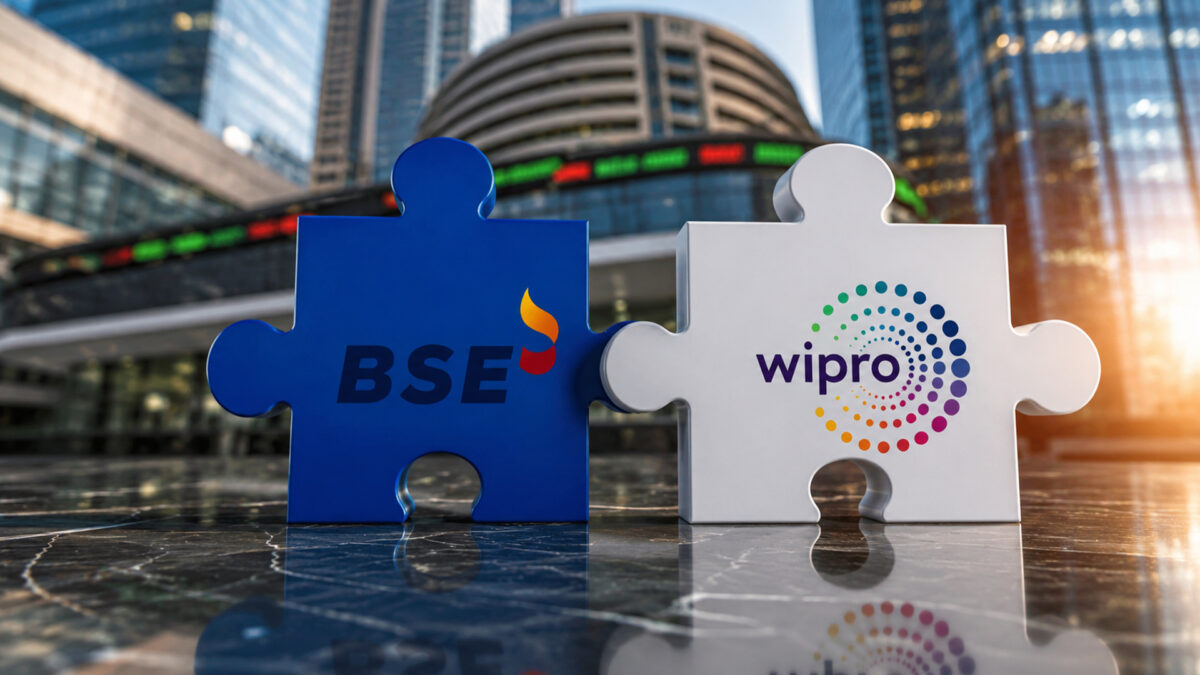
BSE replaces Wipro in September index reshuffle

The Bombay Stock Exchange (BSE) is set to enter India’s benchmark Nifty 50 index, replacing information technology major Wipro from September 30, 2026. The change was announced as part of the latest semi-annual review by NSE Indices and marks a significant shift in the composition of one of India’s most closely tracked stock market indices.

The move reflects the changing structure of India’s equity market. BSE’s six-month average free-float market capitalisation has risen significantly, allowing it to meet the eligibility requirement for inclusion in the Nifty 50. Under the index methodology, a stock must have a free-float market capitalisation at least 1.5 times that of the smallest Nifty 50 constituent for the replacement to take place. BSE met that threshold against Wipro.

For BSE, the inclusion is an important milestone. The stock exchange has seen a strong rally in its shares over the past year, helped by growing activity in India’s equity and derivatives markets. Its inclusion in the Nifty 50 will also increase its visibility among domestic and international investors.

BSE shares gained sharply after the replacement announcement, with the stock rising more than 3% during Monday’s trading session before paring some gains. The stock has been among the stronger performers in the financial market segment this year, reflecting expectations around the exchange’s expanding business and increased trading activity.

The Nifty 50 tracks 50 large and liquid companies listed on the National Stock Exchange. It is widely used as a benchmark by mutual funds, exchange-traded funds and other investment products. Passive funds that track the index generally adjust their holdings whenever the index composition changes.

That is why the BSE-Wipro switch could result in significant fund flows. Analysts estimate that passive funds could direct about $691 million towards BSE shares following its inclusion, while Wipro could see outflows of around $240 million as funds tracking the Nifty 50 remove the stock from their portfolios.

Such flows are largely mechanical and do not necessarily reflect a sudden change in the fundamental outlook for either company. Index funds are required to adjust their portfolios to match the new composition, creating additional buying demand for the incoming stock and selling pressure on the outgoing one.

For Wipro, the exclusion is a notable development. The IT services company has been a long-standing member of the Nifty 50, although it has faced sustained pressure in recent months. The company’s shares have declined significantly this year amid broader concerns over the outlook for Indian IT services companies.

One of the biggest issues confronting the sector is the growing use of artificial intelligence. Investors have been assessing whether rapid advances in AI could reduce demand for some traditional software and technology services, potentially affecting revenue growth and margins for established IT companies.

Wipro has also faced broader sector-wide concerns, with Indian IT stocks under pressure as investors reassess valuations and long-term growth prospects. The Nifty IT index has experienced a significant decline this year, reflecting these worries.

The Nifty 50 change does not mean Wipro is being removed from the stock market or that its business has become fundamentally weaker. It simply means that, under the index’s rules, another company currently has a stronger position based on market-capitalisation and liquidity criteria.

Wipro’s exit will nevertheless matter because of the large amount of money benchmarked to the Nifty 50. Index-tracking funds will have to reduce or eliminate their Wipro holdings as the new composition takes effect. This could create short-term selling pressure around the implementation date.

BSE, meanwhile, stands to benefit from the opposite effect. Funds tracking the benchmark will need to acquire the exchange’s shares, potentially creating additional demand. The company could also receive greater visibility among global investors who use the Nifty 50 as a primary gauge of Indian equities.

The inclusion is particularly interesting because BSE operates in the same broad capital-markets ecosystem as the National Stock Exchange. The exchange has been expanding its presence in equity derivatives and other market segments, benefiting from the rapid growth of retail participation in Indian financial markets.

India has seen a substantial increase in household participation in equities through direct investing, mutual funds and systematic investment plans. Rising participation has contributed to higher trading volumes and greater activity across the country’s stock exchanges.

The Nifty 50 reshuffle therefore reflects more than a change in two stocks. It highlights how quickly market leadership can change as companies grow, valuations shift and investor participation evolves.

For investors, the immediate focus will be on how BSE and Wipro shares behave between now and September 30. BSE could continue to attract attention because of expected passive fund buying, while Wipro may face pressure from index-related selling.

However, market participants are likely to distinguish between these technical flows and the companies’ underlying fundamentals. Once the index adjustment is completed, stock prices will ultimately depend on earnings, business growth, valuations and investor expectations.

The BSE inclusion also strengthens the exchange’s standing in India’s capital-market ecosystem. For Wipro, meanwhile, the exit represents a difficult phase for a company that has been a familiar name in the benchmark for years.

The Nifty 50 reshuffle will officially take effect on September 30. Until then, investors are likely to track BSE’s share-price performance, Wipro’s response and estimates of index-related fund flows. The change serves as another reminder that India’s benchmark index is constantly evolving with the changing fortunes of its listed companies.

Categories
Corporate

BSE shares jump 6% to yearly high after strong Q3

Shares of the Bombay Stock Exchange (BSE) climbed sharply on Tuesday, rising over 6% to hit a 52-week high, after the company posted strong results for the third quarter of 2025‑26. Investors reacted positively to BSE’s higher-than-expected earnings and optimistic outlook from brokers.

BSE reported a net profit of ₹602 crore, up around 174% from ₹220 crore in the same period last year. Revenue also grew about 62%, reaching ₹1,244 crore, helped by increased trading activity and more participation in different markets.

The growth came mainly from derivatives trading, mutual fund transactions, and new listings, which boosted transaction charges and overall revenue. Analysts said the results show BSE’s strong position in India’s capital markets and its ability to generate consistent income across business segments.

On the stock market, BSE shares traded at nearly ₹3,175 each, marking their highest level in a year. This rally reflected strong investor confidence in the exchange’s performance and growth prospects.

Brokerages also reacted positively. Nuvama raised its target price and recommended buying the stock, while Jefferies increased its target price and suggested holding it, citing BSE’s growing market share and earnings momentum.

Also Read: US soybean prices drop as Brazil boosts supply