
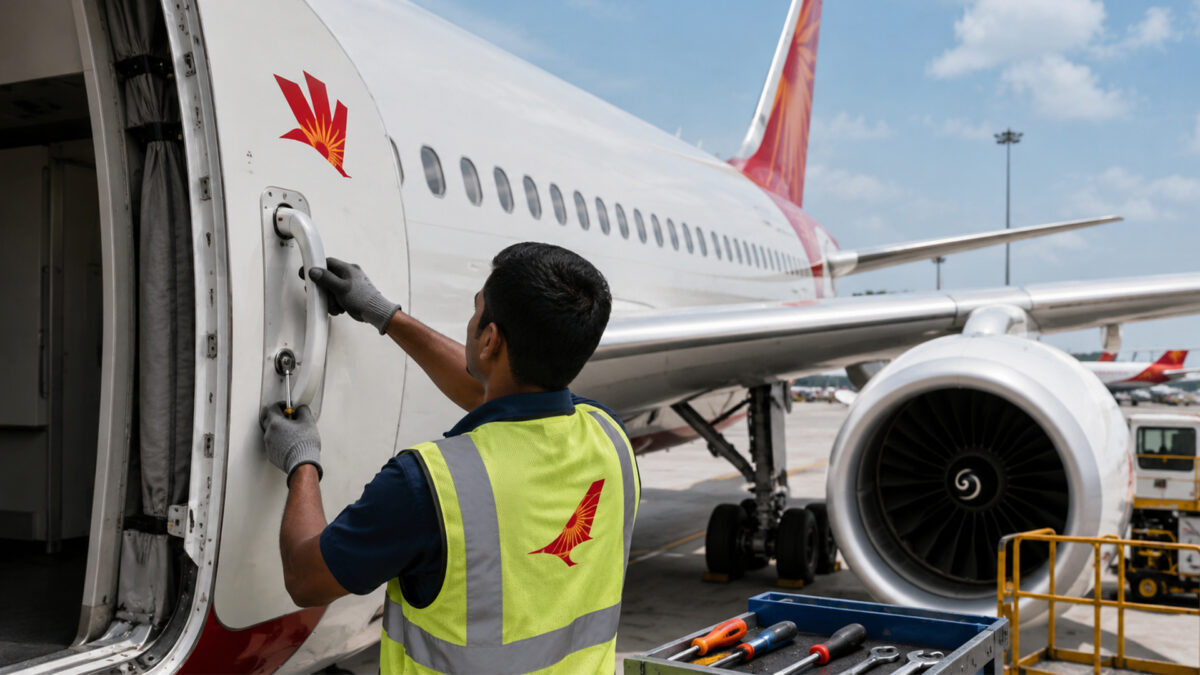
Air India has started upgrading parts of its Boeing 787 Dreamliner fleet after the US Federal Aviation Administration (FAA) issued a safety directive highlighting a potential issue with door assist handles on certain aircraft. The airline has clarified that the modifications are purely precautionary and that there is no immediate risk to passengers or flight operations.
The phased upgrade programme is already underway and is being carried out alongside scheduled maintenance to avoid disruptions to domestic and international services. Air India said the work is part of its commitment to maintaining the highest standards of aviation safety and regulatory compliance.
The FAA recently issued an Airworthiness Directive (AD) covering select Boeing 787-8, 787-9 and 787-10 aircraft after receiving reports of door assist handles becoming detached from their lower attachment points during inspections. While the issue was discovered on the ground rather than during flights, the regulator warned that a detached handle could pose a risk of injury to passengers, crew members or maintenance personnel. In an emergency, the defect could also make opening an aircraft door more difficult.
Although the directive has drawn attention, aviation experts stress that it is a preventive measure rather than an indication that the aircraft are unsafe to fly. Airworthiness Directives are regularly issued by aviation regulators worldwide whenever a design improvement or inspection is considered necessary to maintain safety standards.
Air India has responded quickly to the directive by beginning modifications across the affected aircraft in its fleet. According to airline sources, several older Boeing 787 Dreamliners have already undergone the required changes, while the remaining aircraft will be upgraded in phases over the coming months.
The airline currently operates 35 Boeing 787 Dreamliners. The fleet includes 26 Boeing 787-8 aircraft from the legacy Air India fleet and nine Boeing 787-9 aircraft, including those inducted after the merger with Vistara. These aircraft serve several long-haul international destinations and form an important part of the airline’s global network.
Officials familiar with the development said the modifications are being carried out without affecting passengers or scheduled services. Since the work is being integrated into routine maintenance checks, travellers are unlikely to notice any operational changes.
The FAA directive requires airlines to install additional retaining components on the door assist handle assembly to prevent the handle from becoming detached. Depending on the aircraft’s configuration, operators may also need to inspect the support brackets, install identification markings and carry out corrective actions wherever necessary.
These additional retainers are designed to keep the assist handle securely in place, reducing the possibility of accidental separation while the aircraft door is being opened or closed. The FAA said the modification will improve reliability and ensure emergency exits function as intended under all operating conditions.
The issue first came to light during routine inspections when maintenance personnel found that some door assist handles had become disengaged from their attachment points. Although there have been no reported injuries or incidents linked to the problem, regulators chose to act before it could develop into a larger safety concern.
Air India has maintained that there is no immediate operational impact and that passenger safety has never been compromised. The airline’s decision to begin the upgrades immediately reflects its intention to comply with international aviation standards and complete the modifications well within the regulator’s timeline.
The directive is not limited to Air India. Airlines around the world operating affected Boeing 787 aircraft are expected to carry out the required inspections and modifications. In India, IndiGo, which operates leased Boeing 787 Dreamliners for select international routes, will also be required to comply with the directive wherever applicable.
The Boeing 787 Dreamliner is one of the most widely used long-haul aircraft globally. Known for its fuel efficiency, lightweight composite structure and improved passenger comfort, the aircraft is operated by dozens of international carriers on medium- and long-haul routes.
The safety directives such as these are a routine part of aircraft maintenance. As manufacturers gather operational data from aircraft in service, regulators may identify components that require improvements or additional inspections. Airlines are then required to implement the recommended modifications within specified timelines.
For passengers, the latest development should be viewed as evidence of the aviation industry’s layered safety system rather than a cause for concern. Aircraft manufacturers, airlines and regulators continuously monitor fleet performance to identify even minor issues before they can affect operations.
By beginning the FAA-mandated Boeing 787 Dreamliner upgrades promptly, Air India aims to strengthen passenger confidence while ensuring its fleet continues to meet global safety standards. The phased modifications are expected to be completed without disrupting flight schedules, allowing the airline to continue operating its long-haul network smoothly while reinforcing its commitment to safety, compliance and operational excellence.
Air India’s ongoing fleet upgrade programme also aligns with its broader transformation strategy under the Tata Group. Alongside introducing new aircraft and refurbishing existing cabins, the airline has been investing heavily in engineering, maintenance and operational reliability to improve the overall travel experience.