
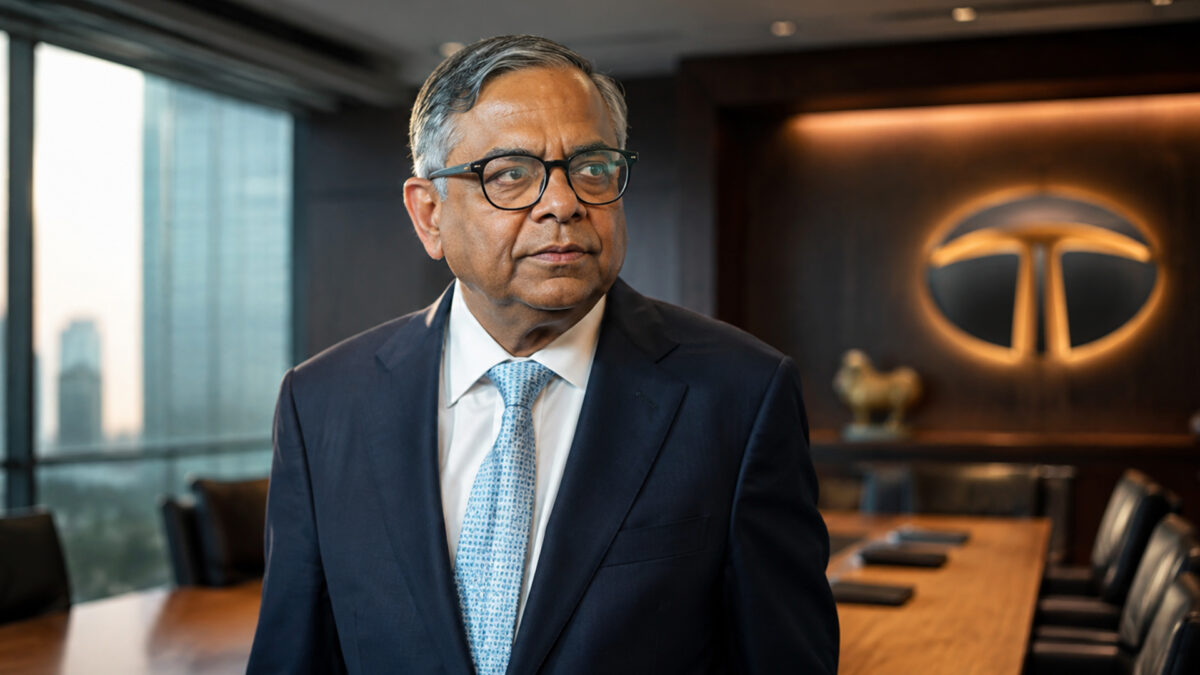
N Chandrasekaran has resigned as chairman of Tata Sons, bringing a significant leadership transition to the Tata Group after nearly a decade at the helm of its holding company. Chandrasekaran, however, will continue in the position until the end of his current term on February 20, 2027, according to people familiar with the development and his statement.
The decision comes just days before the Tata Sons annual general meeting scheduled for August 18. The meeting had been expected to consider the reappointment of Chandrasekaran as a director, a key requirement for him to continue as chairman. His decision not to seek another term effectively removes that uncertainty and sets the stage for a leadership succession process at one of India’s most influential business groups.
In his communication to the Tata Sons board, Chandrasekaran said he would not offer himself for reappointment after his existing tenure ends. He also asked the board to begin the process of identifying his successor. The announcement marks the beginning of a transition rather than an immediate departure, allowing him to remain involved in the group’s affairs for several months.
The development follows weeks of uncertainty around Chandrasekaran’s position and the Tata Sons board. Earlier reports had said he was considering stepping down ahead of the August 18 AGM amid questions surrounding his reappointment and tensions within the Tata Trusts structure. Those reports had raised the possibility of an unexpected change at the top of the Tata Group.
Chandrasekaran’s exit is important because Tata Sons sits at the centre of the group’s sprawling business interests, with significant holdings and influence across information technology, automobiles, steel, power, consumer products, hotels, aviation and financial services. The chairman also plays a central role in determining the group’s long-term investment priorities and capital allocation.
His tenure has been marked by an aggressive expansion strategy. Under Chandrasekaran, the Tata Group pushed deeper into aviation following the acquisition and consolidation of Air India, while also increasing investments in semiconductors, electronics manufacturing, batteries, artificial intelligence and other emerging businesses.
The group has simultaneously worked to strengthen its position in traditional businesses while building new growth platforms. Tata Electronics has emerged as a major focus of the group’s semiconductor and electronics ambitions, while Tata Digital has been developed as a consumer technology platform. The group’s investments in battery manufacturing and defence-related capabilities have also formed part of its longer-term strategy.
Air India has been one of the most visible projects during Chandrasekaran’s tenure. The Tata Group has been attempting to rebuild the airline following its return to private ownership, with investments in aircraft, technology, operations and customer experience. Chandrasekaran recently described the transformation of Air India as a five-to-10-year effort, highlighting the scale of the challenge facing the group.
The leadership change comes even as Tata Sons remains financially strong. The company’s annual report for FY26 showed revenue rising 9.1% to Rs 42,367 crore, while profit after tax increased 21.8% to Rs 31,961 crore. The improvement was supported by investment gains and earnings from its portfolio of businesses.
At the broader Tata Group level, the business has continued to expand despite challenges in several large investments. The group reported aggregate FY26 revenue of about Rs 16.24 lakh crore, while profit after tax rose sharply during the year.
The financial performance, however, has existed alongside pressure in some of the group’s newer businesses. Air India recorded substantial losses, while Tata Digital, Tata Electronics and battery-related ventures have also required significant investment. Chandrasekaran has defended these businesses as long-term strategic bets rather than investments expected to generate immediate returns.
Markets reacted quickly to the news. Shares of several Tata Group companies came under pressure after the resignation announcement, with Tata Consultancy Services among the most closely watched stocks. TCS shares were reported to be down more than 3% during Wednesday’s trading session, while other Tata companies also declined. The market reaction reflected investor uncertainty surrounding the group’s future leadership and succession process.
Chandrasekaran joined the Tata Group nearly four decades ago and rose through its ranks before becoming chief executive of Tata Consultancy Services in 2009. He became chairman of Tata Sons in 2017, succeeding Ratan Tata in the role. His tenure has therefore covered a major period of transformation for the conglomerate, including the expansion of its global technology, automotive and aviation interests.
The immediate focus will now shift to succession planning, putting Tata Sons among the major Indian businesses undergoing senior leadership and succession changes. The board will have to identify a leader capable of managing both the group’s established businesses and its ambitious new investments. The next chairman will inherit a conglomerate with a strong financial base, but also major projects requiring sustained capital, execution and strategic patience.
For the Tata Group, the transition is therefore more than a change at the top. It will determine how the conglomerate balances its traditional businesses with its newer bets in technology, aviation, semiconductors, batteries and digital services. With Chandrasekaran remaining until February 2027, the group has several months to prepare for a carefully managed leadership handover.