
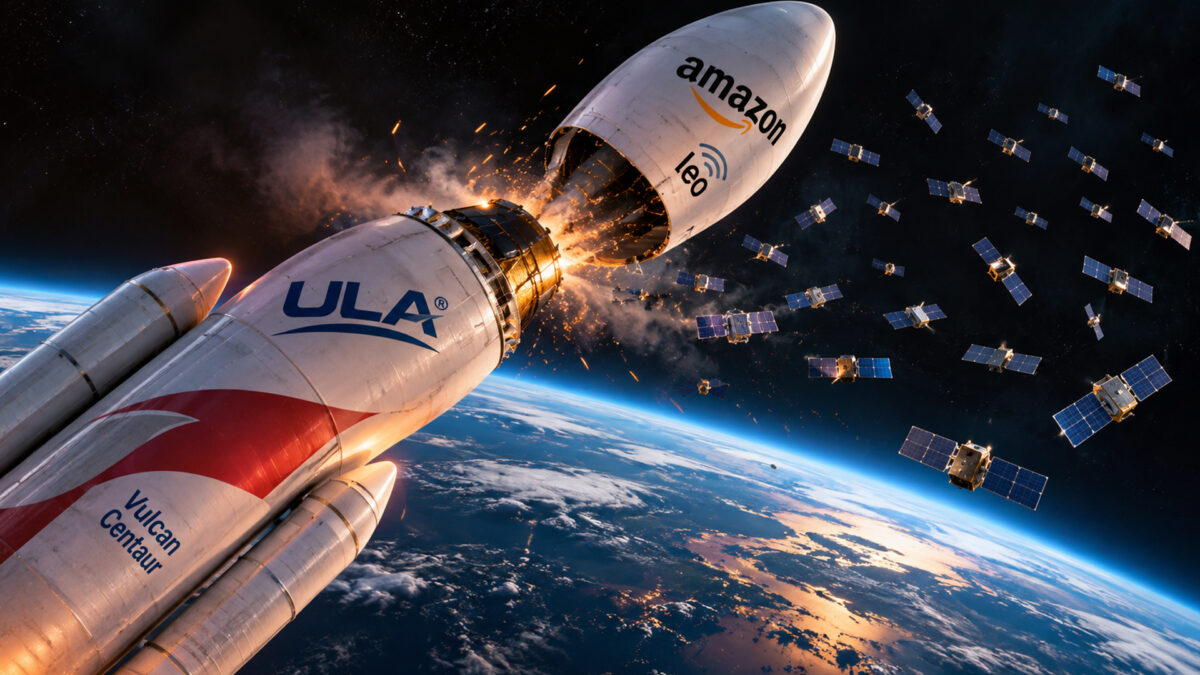
Amazon has suffered a major setback in its ambitious satellite internet programme after a United Launch Alliance (ULA) Vulcan rocket failed minutes after liftoff, resulting in the loss of all 40 satellites onboard. The incident, which occurred on November 15, marks the first complete mission failure in the history of ULA and raises fresh concerns over the reliability of the company’s next-generation launch vehicle.
The rocket lifted off from Space Launch Complex 41 at Cape Canaveral Space Force Station in Florida at 12.40 pm local time on Sunday. It was carrying 40 broadband satellites intended for Amazon’s Leo network, which aims to provide high-speed internet connectivity across the world and compete with Elon Musk’s Starlink.
The launch initially appeared to proceed as planned. However, approximately 10 minutes after liftoff, the rocket experienced an anomaly and failed to deliver its payload into the intended orbit.
ULA confirmed the failure in a statement, saying data received by its launch director indicated that the Vulcan vehicle had encountered an anomaly during flight. The company said it would work with Amazon and other organisations to determine the cause and identify the corrective measures required before returning the rocket to service.
The exact reason for the failure remains unknown. ULA said it did not yet have sufficient flight data to establish what went wrong, adding that every launch provides information that can help improve future missions.
What went wrong with the Vulcan rocket?
Preliminary observations suggest that the problem may have occurred during the operation of the rocket’s upper stage. Following the separation of the first-stage booster, the Centaur V upper stage was expected to continue the journey towards orbit by firing its engines.
According to Spaceflight Now, the first stage appeared to burn longer than planned before separating. The Centaur upper stage also appeared to make unusual orientation adjustments during its initial engine burn.
However, these observations have not been confirmed as the cause of the failure. Investigators will need to examine telemetry, engine performance and other flight data before determining what triggered the anomaly.
The investigation is particularly important because Vulcan had returned to flight after a gap of approximately nine months. Earlier missions had raised concerns about solid rocket booster nozzle problems, prompting additional technical reviews. Its BE-4 engines, manufactured by Jeff Bezos-owned Blue Origin, had also undergone modifications following separate technical concerns.
Blue Origin is assisting ULA with the latest investigation. However, it remains unclear whether the BE-4 engines played any role in Sunday’s failure.
A major setback for Amazon Leo
The 40 lost satellites were part of Amazon’s Leo broadband constellation, previously known as Project Kuiper. The programme is designed to deliver internet services through a network of satellites operating in low Earth orbit.
Amazon plans to deploy more than 3,200 satellites to establish global coverage and compete with established satellite internet services, particularly SpaceX’s Starlink.
According to Reuters, Amazon had deployed 398 Leo satellites across 14 launches before Sunday’s incident, representing around 12% of the 3,236 satellites required for its planned network.
The company had hoped to begin initial internet services in 2026. Losing another batch of 40 satellites could complicate its deployment schedule, particularly as it depends on multiple external launch providers to put its spacecraft into orbit.
Amazon had contracted ULA for 38 Vulcan launches as part of its satellite deployment strategy. Sunday’s mission was the first of these launches. The company has also booked launches using Blue Origin’s New Glenn, Europe’s Ariane 6 and SpaceX’s Falcon 9 rockets.
In a statement, Amazon acknowledged the risks associated with space launches and described Sunday’s mission as an inaugural flight under the partnership. It expressed confidence in ULA’s ability to investigate the incident and continue working towards its long-term plans for Vulcan.
First mission failure in ULA’s history
The incident represents a significant blow to ULA, a joint venture between aerospace companies Boeing and Lockheed Martin. Established in 2006, the company had maintained a record of successful missions until Sunday’s failure.
Vulcan is ULA’s next-generation heavy-lift rocket, developed to replace its older Atlas V and Delta IV launch vehicles. It made its debut in January 2024 and has completed five flights, including Sunday’s unsuccessful mission.
The failure could also affect the company’s efforts to establish Vulcan as a dependable launch vehicle for commercial customers and US national security missions.
The US Space Force had earlier placed restrictions on national security launches involving Vulcan following concerns about solid rocket booster performance. Although the earlier missions successfully delivered their payloads, additional reviews were required before the rocket could resume those assignments.
Space launch competition faces fresh challenges
The failure comes at a difficult time for the commercial space industry, particularly companies seeking to expand satellite internet services.
SpaceX has established a considerable advantage through Starlink, which operates a much larger satellite network and serves millions of customers worldwide. Unlike Amazon, SpaceX has its own launch vehicles, allowing it to deploy satellites without depending entirely on external providers.
Amazon’s reliance on multiple launch companies has made its deployment plans vulnerable to technical setbacks and delays across the industry. The loss of 40 satellites adds another challenge to its efforts to narrow the gap with Starlink.
For ULA, the immediate priority will be identifying the cause of the anomaly and establishing the corrective measures needed to restore confidence in Vulcan. Until the investigation is completed, the rocket’s next launch schedule remains uncertain.
The incident serves as a reminder of the technical risks involved in space exploration and commercial satellite deployment. For Amazon, the challenge now is to recover lost ground in an increasingly competitive satellite internet market.