
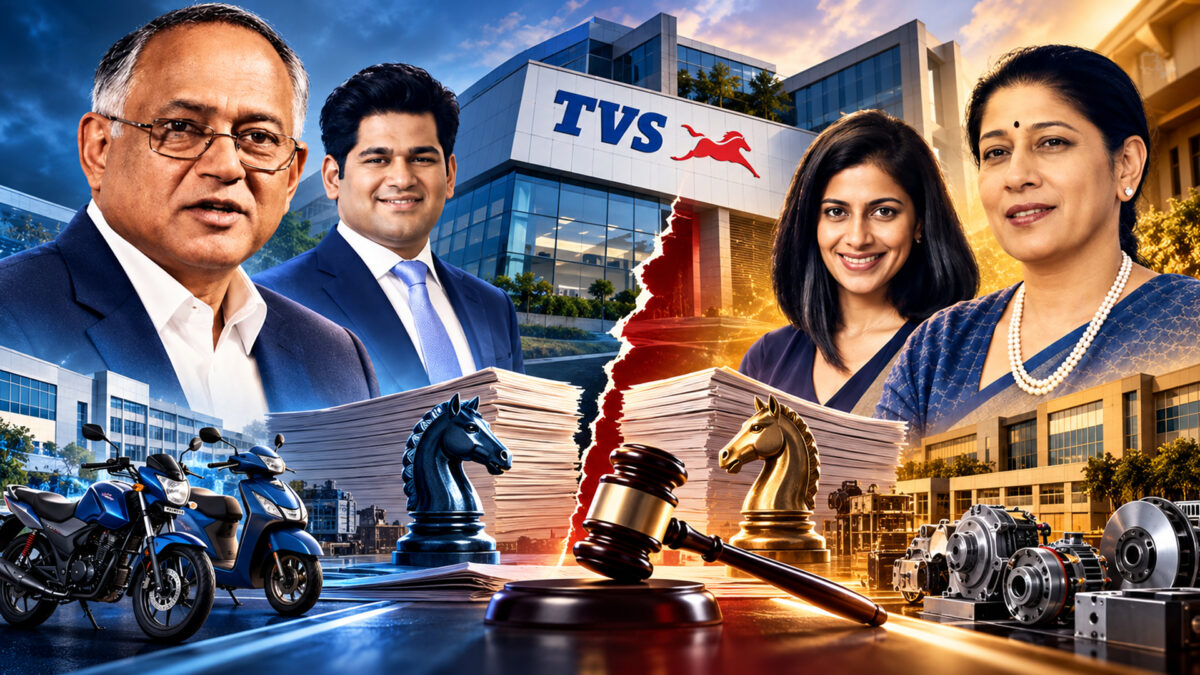
The long-running disagreement over the division of business interests within the TVS family has taken a legal turn, with members of the family filing caveats against one another in Chennai courts. The move signals that both sides are preparing for possible legal proceedings even as Venu Srinivasan’s wife, Mallika Srinivasan, and daughter, Lakshmi Venu, continue to call for an amicable settlement through discussions.
Venu Srinivasan, chairman emeritus of TVS Motor Company, and his son Sudarshan Venu are on one side of the dispute, while Mallika and Lakshmi are on the other. The disagreement centres on whether the family’s business interests and wealth have been divided fairly, rather than simply on who manages particular companies.
Eight caveats were filed on October 12 and 13 in Chennai’s City Civil Court and Commercial Court, according to people familiar with the matter. Four were filed in each court. Reports have also indicated steps to protect the parties’ positions in proceedings before other legal forums.
A caveat is a preventive legal filing that asks a court to give the person filing it an opportunity to be heard before passing an order that could affect their interests. It does not, by itself, mean that a lawsuit has been filed or that a court has ruled on the underlying dispute. However, the filings suggest that family members are taking precautions against possible applications seeking interim relief.
The latest development follows reports earlier this month that disagreements had emerged over the succession and economic division of the family’s business interests. The dispute has drawn attention because of the family’s longstanding presence in India’s automobile, engineering and manufacturing sectors.
At the heart of the disagreement is the interpretation of a memorandum of understanding (MoU) signed in March 2024. Venu and Sudarshan maintain that the agreement established a settlement between the family members. Mallika and Lakshmi, however, argue that the MoU did not amount to a comprehensive economic settlement of the family’s wealth.
In earlier joint statements, Mallika and Lakshmi said arrangements involving the use of brands, trademarks and non-compete obligations should not be treated as proof that the economic interests had been fairly divided. They have called for a process that recognises what they describe as rightful economic ownership.
Their position draws a distinction between management responsibilities and ownership rights. A family member being appointed to lead a company, they argue, does not automatically settle the question of how the underlying assets and financial interests should be distributed.
Venu’s side has maintained that the division was fair and transparent and followed consultations within the family. Reports on the dispute indicate that the allocation of businesses, ownership stakes and financial obligations forms part of the broader disagreement. The two sides have not publicly reached a common position on whether the 2024 arrangement resolves these issues.
Mallika and Lakshmi reiterated their preference for dialogue in a statement on October 27. A spokesperson said they continued to seek an amicable resolution through transparent discussions and dialogue. The statement indicates that, despite the legal precautions, the mother-daughter duo has not abandoned the possibility of settling the matter outside court.
The family members have significant roles in separate parts of the wider business landscape. Venu Srinivasan is associated with TVS Motor Company, where Sudarshan serves as chairman and managing director. Lakshmi Venu is vice-chair of Tractors and Farm Equipment Limited (TAFE) and managing director of Sundaram-Clayton. Mallika Srinivasan chairs and leads TAFE.
The businesses and their ownership structures should not be conflated. TAFE belongs to the separate Amalgamations Group, and Mallika has said it should not be treated as part of the economic settlement within the Venu Srinivasan family. The wider family business arrangements are therefore more complex than a straightforward division of company leadership positions.
The caveat filings come amid heightened scrutiny of succession planning in large Indian family-owned businesses, where ownership, control, valuation and inheritance can involve different legal and financial questions. Disagreements can become especially difficult when family members take different views of earlier agreements or the value of assets allocated to each side.
The immediate question is whether the parties can find common ground through negotiations or whether the dispute will move into more formal litigation. Mallika and Lakshmi have publicly favoured dialogue, while the caveats show that the family members are also preparing to protect their legal positions. The outcome could shape the future ownership arrangements of businesses linked to one of India’s prominent industrial families.