
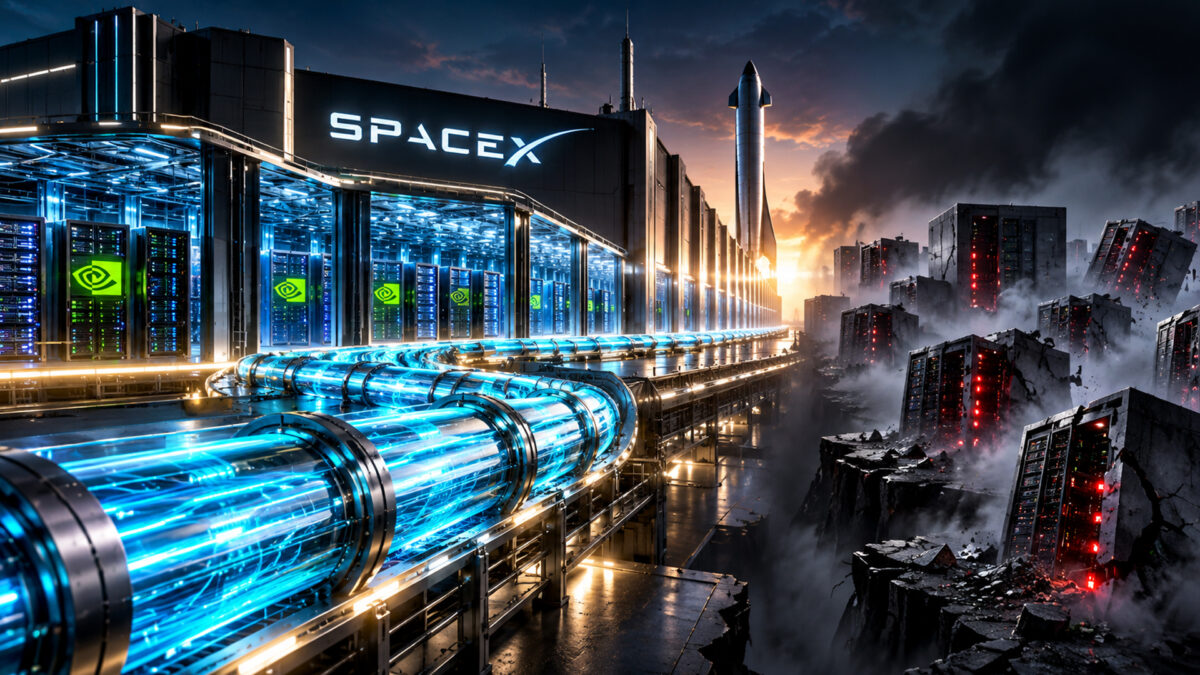
SpaceX has secured $40 billion in debt financing to purchase advanced processors for artificial intelligence (AI) computing, according to CEO Elon Musk. The deal highlights the enormous financial commitments required to expand AI infrastructure as technology companies compete to build more powerful computing systems and support increasingly sophisticated AI models.
Musk announced the financing in a post on X on October 25, saying the borrowing would primarily fund graphics processing units (GPUs) expected to arrive in the first and second quarters of 2027. He described the financing as callable debt and said it would not have a major impact on the company’s current-quarter financial position.
The announcement follows reports earlier this month that SpaceX was negotiating with banks and asset managers to raise $40 billion for Nvidia AI chips. However, subsequent reporting indicated that discussions over final pricing were still ongoing, leaving some uncertainty about the precise status and structure of the financing.
The proposed funding reflects the growing cost of developing AI computing capacity. GPUs are specialised processors that handle the enormous calculations required to train and operate modern AI models. Technology companies are racing to secure these chips as demand for generative AI, cloud computing and data-centre services continues to expand.
SpaceX‘s financing also demonstrates how Musk is positioning the company beyond its traditional rocket-launch and satellite-internet businesses.
Why SpaceX needs the funding
SpaceX plans to expand its AI computing infrastructure using Nvidia processors. These chips can power large-scale data centres that supply computing resources for training AI systems, running applications and supporting enterprise customers.
Building such infrastructure requires substantial spending on processors, networking equipment, power supplies, cooling systems and data-centre facilities. Companies must often commit billions of dollars before their investments generate sufficient revenue, making access to financing a critical part of the AI race.
Musk said SpaceX’s investment-grade credit standing and income from its Starlink satellite-internet service and rocket-launch operations had helped preserve its access to debt markets. These established businesses provide revenue beyond AI computing, potentially making the company more attractive to lenders than firms dependent entirely on AI data centres.
SpaceX’s financial performance has also strengthened its position. Its revenue rose 161% year-on-year to $14.58 billion in the third quarter of 2026. Capital expenditure, however, nearly tripled to $19.6 billion, reflecting the scale of investment required to support its expanding operations.
The figures underline the balance SpaceX must maintain between growth and financial discipline. Access to credit can accelerate its AI expansion, but the company must also ensure that its growing computing capacity generates enough business to justify the expense.
Financing structure remains under scrutiny
Although Musk said the debt deal had closed, reports on October 26 indicated that negotiations over pricing were continuing. Bloomberg reported that bankers led by Goldman Sachs had been discussing a financing structure with investors, including Apollo Global Management, while Apollo-backed Atlas SP was expected to manage the financing vehicle.
The proposed arrangement was designed to keep the borrowing outside SpaceX’s direct balance sheet, according to reports. However, the final terms, including pricing and other financing details, were not fully established in the publicly available reporting.
The distinction matters because the cost of borrowing influences how much a company ultimately pays for its AI infrastructure. It also determines how financing risks are distributed between the company, investors and other participants.
Musk warns of pressure on AI cloud companies
Alongside the funding announcement, Musk warned that access to debt was becoming increasingly difficult for companies without substantial revenue outside AI data centres. He predicted widespread failures and consolidation among more than 200 so-called neocloud companies.
Neocloud providers specialise in offering computing capacity, often using high-performance GPUs, to AI developers and businesses. Their services allow customers to access powerful hardware without building their own data centres. However, these providers can face financial pressure when infrastructure costs rise faster than customer revenue.
Musk argued that companies with diversified income streams would be better placed to withstand tighter lending conditions. He also said SpaceX would not acquire struggling neocloud businesses.
His comments come as investors assess whether the rapid expansion of AI infrastructure can deliver sustainable returns. Demand for computing power remains strong, but the expense of purchasing chips and operating data centres has increased the financial risks associated with the sector.
AI investment enters a costly phase
SpaceX’s $40 billion financing plan illustrates how the AI race is becoming a competition for capital as well as technology. Access to advanced chips is essential, but companies must also secure affordable funding, reliable electricity and customers willing to pay for computing services.
For Nvidia, the financing highlights the continued importance of its GPUs to large-scale AI development. For SpaceX, the investment could provide the computing resources needed to expand its AI ambitions, although the returns will depend on execution and demand.
The coming quarters will show how effectively SpaceX converts its infrastructure spending into revenue. Its established satellite and launch businesses offer financial support, but the scale of its AI investment leaves little room for inefficient spending.
As AI companies seek ever-larger pools of computing power, financing costs and access to credit are likely to become increasingly important. SpaceX’s deal is a significant example of that shift, while Musk’s warning suggests that the next stage of the AI boom could separate well-funded companies from those struggling to sustain their expansion.