
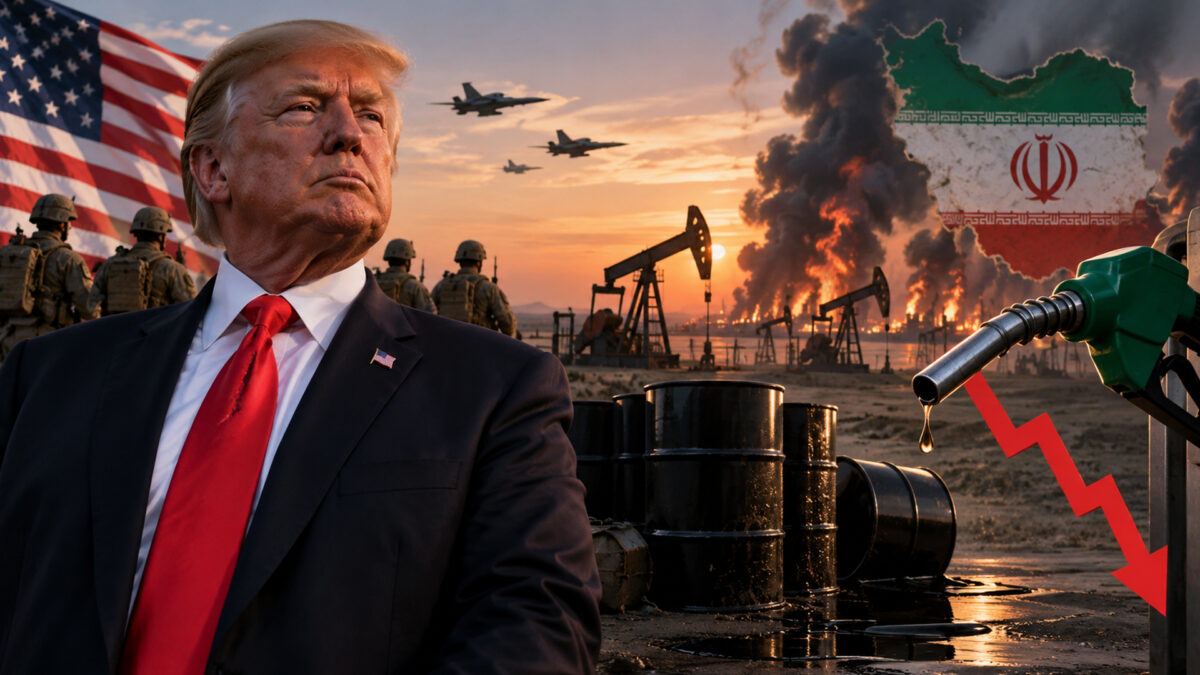
US President Donald Trump has predicted a dramatic fall in American gasoline prices, saying fuel could eventually become cheaper than $2 a gallon after what he described as a US victory in the war with Iran.
Trump made the claim as the Iran conflict continued to create uncertainty across global energy markets. He said oil prices would drop “precipitously” once the war was over and suggested that gasoline prices could first fall towards $3 a gallon before eventually slipping below the $2 mark.
The forecast is striking because US consumers are currently paying considerably more at the pump. Average gasoline prices have risen above $4 a gallon, meaning prices would have to fall by more than half for motorists to reach the level Trump has predicted.
The president has repeatedly connected the conflict with Iran to energy prices, arguing that a successful US campaign would eventually remove the supply risks that have pushed crude oil higher. He has also maintained that Iran must not be allowed to develop a nuclear weapon.
Trump’s comments come at a particularly sensitive time for the global oil market. Brent crude has been trading close to $100 a barrel, while US West Texas Intermediate crude has remained above $90. Traders have been closely watching developments in the Middle East because any disruption to oil production or transportation could have consequences far beyond the region.
One of the biggest concerns is the Strait of Hormuz, the narrow waterway between Iran and Oman through which a substantial share of the world’s oil supply passes. Any prolonged disruption to shipping through the strait could tighten global supplies and push crude prices higher.
Iran has warned that attacks on its energy infrastructure could trigger retaliation against US interests and energy facilities in the region. The threats have added to concerns about oil tankers, production facilities and shipping routes becoming targets as the conflict escalates.
The US has also stepped up pressure on Iran’s oil trade. American officials have threatened action against vessels involved in transporting Iranian crude, increasing the risks for companies and countries involved in the region’s energy trade.
For oil traders, the biggest question is whether the conflict will ultimately reduce or increase supply risks. A settlement could have the opposite effect of an escalation. If fighting stops and shipping routes become safer, some of the geopolitical premium built into crude prices could disappear.
That could bring oil prices down and eventually provide relief to consumers. But reaching $2-a-gallon gasoline would require a much larger and more sustained decline.
Crude oil is only one part of the price motorists pay at petrol stations. Refining costs, transportation, taxes and regional market conditions also influence gasoline prices. As a result, even a sharp decline in crude prices does not automatically translate into an equivalent fall in retail fuel prices.
The current gap between Trump’s prediction and actual prices therefore remains substantial.
Still, cheaper energy has been a recurring theme in Trump’s economic messaging. Lower gasoline prices would directly reduce household expenses for American drivers and could also lower transportation and production costs for businesses. A sustained decline in energy prices could, in turn, help ease inflationary pressures.
The impact would extend beyond the United States. Global crude prices influence the cost of fuel, transportation and several industrial commodities in oil-importing economies such as India. A prolonged fall in international oil prices could reduce India’s crude import bill and provide some relief to inflation, while a sharp increase would have the opposite effect.
China and other major economies would also be affected because of their large energy requirements. Global demand is another important factor that will determine where crude prices head once the immediate geopolitical uncertainty fades.
The oil market has already shown that prices do not always move in a straight line during geopolitical crises. Supply concerns can push prices higher, but expectations of weaker demand, alternative supply routes and production from countries outside the Middle East can limit those gains.
That makes the timing of Trump’s forecast important. His below-$2 gasoline prediction depends on the Iran conflict ending in a way that allows oil supplies and shipping to normalise. It would also require sufficient global production and relatively subdued demand.
If the conflict instead expands to involve more oil facilities, tankers or critical shipping routes, crude prices could move sharply in the opposite direction. In that scenario, the prospect of gasoline below $2 would move even further away.
Trump’s statement is best viewed as a political and economic forecast rather than an indication of an imminent collapse in fuel prices. The US president is presenting cheaper gasoline as a potential benefit of ending the Iran conflict, but the energy market remains highly sensitive to events on the ground.