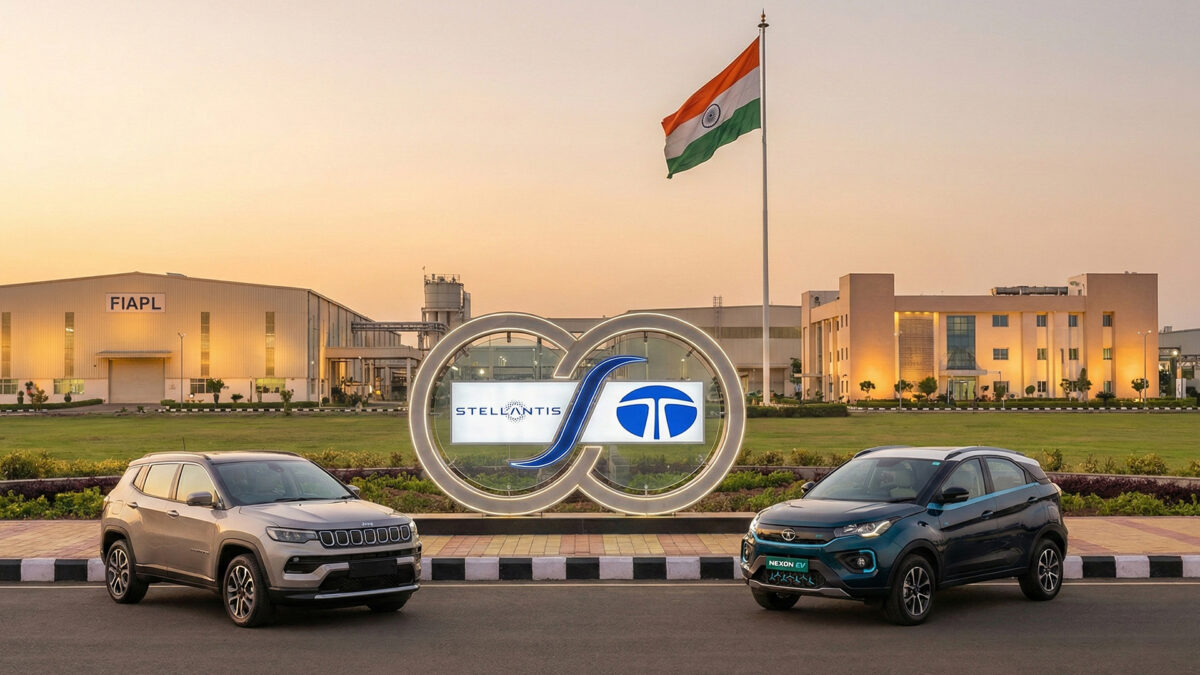
Tata Motors Passenger Vehicles and global automotive group Stellantis have expanded their long-standing partnership, taking their collaboration beyond manufacturing into advanced vehicle technology and product development. Under a new definitive agreement signed on October 12, vehicles developed through the partnership will be manufactured in India for distribution across more than 50 international markets.
The agreement brings together Tata Motors’ vehicle architecture and technology capabilities with Stellantis’ product development expertise and engineering resources in India. The companies aim to use these complementary strengths to develop vehicles suited to different customer preferences, regulatory requirements and operating conditions across global markets.
The expanded arrangement marks a significant step in the relationship between the two automotive groups. Their collaboration has largely centred on manufacturing through Fiat India Automobiles Private Limited (FIAPL), their 50:50 joint venture. The new agreement extends this relationship into vehicle technology and architecture, giving the partnership a larger role in Stellantis’ international product strategy.
Under the agreement, Tata Motors Passenger Vehicles (TMPV) will provide Stellantis access to its product technology and vehicle architecture. Stellantis will build on these capabilities through its engineering and product development operations in India, adapting vehicles for international markets. Manufacturing will take place at the FIAPL facility in Ranjangaon, near Pune, Maharashtra.
The companies expect the arrangement to strengthen India’s position as a global automotive manufacturing and engineering hub. India offers a combination of established manufacturing infrastructure, engineering talent and supplier networks that can support vehicle development for overseas markets. Using these capabilities could help the partners improve production efficiency and strengthen their export competitiveness.
Shailesh Chandra, managing director and chief executive officer of Tata Motors Passenger Vehicles, described the agreement as an important extension of the relationship into advanced vehicle technology and architecture. He said the collaboration would combine the companies’ strengths to develop vehicles in India for customers at home and abroad.
Tianshu Xin, chief operating officer of Stellantis’ Asia-Pacific region, said partnerships were central to the company’s approach to creating value in the region. Combining Tata Motors’ capabilities in India with Stellantis’ global product development experience and market reach could help the companies develop competitive vehicles and expand export opportunities.
The deal builds on a memorandum of understanding signed in February 2026, when the companies agreed to explore broader cooperation in manufacturing, engineering and supply chains in India and overseas. The definitive agreement now establishes a clearer framework for collaboration in product technology and vehicle architecture.
The expansion comes as global automakers look for ways to manage the rising cost of vehicle development. New models increasingly require investment in software, electronics, safety systems, powertrain technology and compliance with different emissions and safety regulations. Sharing platforms and engineering resources can help manufacturers spread development costs, shorten product development cycles and improve economies of scale.
The partnership could also support Stellantis as it works to strengthen its presence in international markets. The group has a portfolio of 14 automotive brands, including Jeep, Citroën, Fiat, Peugeot, Opel, Maserati and Alfa Romeo, with operations across Europe, North America, South America, the Middle East, Africa and Asia-Pacific. Its Indian operations can serve as a base for developing and manufacturing vehicles for selected overseas markets.
Tata Motors, meanwhile, gains an opportunity to extend the international relevance of its vehicle technology and engineering capabilities. The agreement could create additional opportunities linked to manufacturing, supplier development and exports, while strengthening the company’s position in global automotive value chains.
The partnership also reflects a broader shift in the industry towards cross-border collaboration. Automakers are increasingly sharing platforms, production facilities and technology as they navigate changing customer preferences, tighter regulations and competition from manufacturers offering increasingly affordable vehicles, particularly in the electric vehicle segment.
However, several details of the new agreement remain undisclosed. The companies have not announced the specific models to be developed under the arrangement, the investment involved, production timelines or expected export volumes. The scale of the commercial opportunity will depend on how quickly the partners translate the agreement into products and establish demand across the targeted markets.
The expanded Tata Motors-Stellantis partnership places India at the centre of a wider global vehicle development strategy. By combining local engineering and manufacturing capabilities with international product expertise and market access, the companies are seeking to build a more competitive foundation for future exports. The next milestone will be turning the agreement into vehicles that meet the needs of customers across diverse markets.