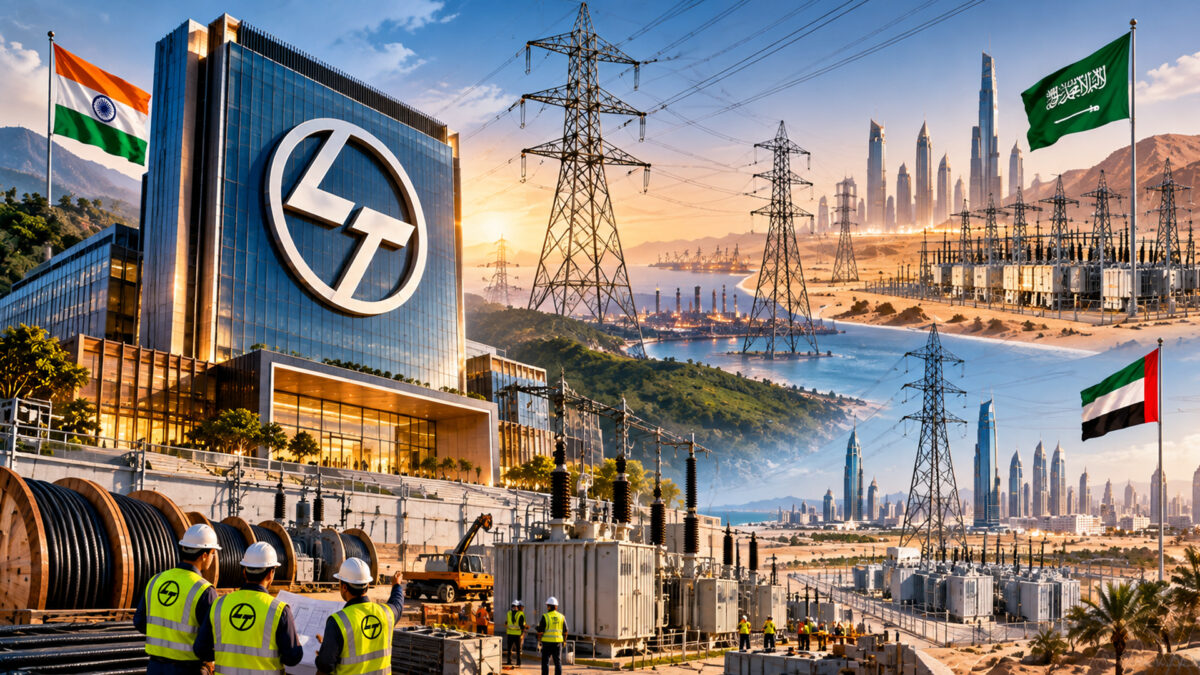
Larsen & Toubro (L&T) is expanding its footprint in the power infrastructure market after winning a series of transmission and distribution contracts worth ₹10,000 crore to ₹15,000 crore across India and West Asia.
The fresh orders underline the growing demand for electricity networks capable of handling rising power consumption as well as the rapid addition of renewable energy capacity. L&T said its Power Transmission & Distribution business has secured the contracts in India, Saudi Arabia and the United Arab Emirates.
The projects span different parts of the electricity value chain, including high-voltage transmission systems, substations and associated infrastructure. Together, they give the engineering major a sizeable new pipeline at a time when grid investment is becoming increasingly important to energy companies and governments.
A major part of the international order intake comes from Saudi Arabia, where L&T has won contracts involving 380 kV transmission lines and substations. The projects are expected to support the kingdom’s expanding electricity network and improve the movement of power from new generation facilities to consumption centres.
Saudi Arabia is investing heavily in renewable energy as part of its broader economic diversification programme. Large solar projects are being developed across the country, creating a parallel need for transmission infrastructure. Power generated in remote locations needs to be transported efficiently to cities, industries and other major demand centres.
L&T‘s Saudi business has already built a presence in the country’s power sector, and the latest contracts deepen that relationship. The company’s experience in large-scale engineering, procurement and construction projects gives it an opportunity to participate in the kingdom’s continuing infrastructure spending.
The United Arab Emirates has also contributed to the new order pipeline. L&T has received contracts for the construction of 132/11 kV substations and associated cabling work. Such facilities are essential for stepping down electricity to distribution levels before it reaches consumers and businesses.
The UAE is simultaneously investing in power reliability, new infrastructure and cleaner sources of energy. That combination is creating demand for modern transmission and distribution networks.
India remains another important market for the business. L&T has secured a project from a private-sector developer to establish a transmission system in Visakhapatnam, including transmission lines and substations.
The domestic project comes against the backdrop of India’s rapidly changing electricity landscape. Electricity demand is rising as industrial production expands, cities grow and more households and businesses adopt electricity-intensive technologies. At the same time, the country is adding large amounts of solar and wind capacity.
That combination is putting greater pressure on the power grid. New generation capacity alone cannot solve the problem unless adequate transmission infrastructure is available to carry electricity to areas where it is needed.
This is where L&T sees a long-term opportunity. Its PT&D business works across transmission, substations, distribution networks and related power infrastructure, giving it exposure to multiple stages of grid development.
The latest order wins also show how the company’s international strategy is complementing its domestic business. India provides a large and growing market, while countries in West Asia are committing significant capital to infrastructure modernisation and energy diversification.
The Middle East is particularly attractive for Indian engineering companies because governments in the region are moving beyond traditional oil and gas investments. Saudi Arabia and the UAE are developing renewable-energy projects, smart infrastructure and modern electricity networks as they prepare for changing energy needs.
Transmission systems are becoming even more important as renewable energy accounts for a larger share of electricity generation. Solar and wind projects tend to be located where natural resources are strongest, which can be far from population centres. This requires high-capacity transmission corridors to connect generation with demand.
Grid flexibility is another emerging requirement. Renewable power generation can vary according to sunlight and wind conditions, making it necessary for electricity networks to handle changing flows. New substations and transmission infrastructure can help improve the resilience and efficiency of the wider grid.
L&T’s latest contracts come as the company continues to build a large order book across infrastructure and engineering segments. Large-ticket EPC contracts provide revenue visibility while allowing the company to leverage its project-management and engineering capabilities across geographies.
The orders are also strategically relevant because they are spread across three markets rather than being concentrated in one location. Such diversification can help L&T balance variations in infrastructure spending across individual countries.
The company expects the energy transition to generate sustained demand for transmission and distribution infrastructure. As governments increase investments in renewable energy, the supporting grid will need to expand alongside generation.
That could make power transmission one of the most important infrastructure opportunities of the coming years. India’s renewable-energy ambitions and West Asia’s push for economic and energy diversification are both creating a need for large-scale grid investments.
L&T’s latest contracts place its Power Transmission & Distribution business at the centre of that opportunity. The immediate benefit is a new ₹10,000-15,000 crore order pipeline. The longer-term opportunity lies in participating in the infrastructure needed to move cleaner and more reliable electricity across some of the world’s fastest-growing power markets.