Categories
Corporate

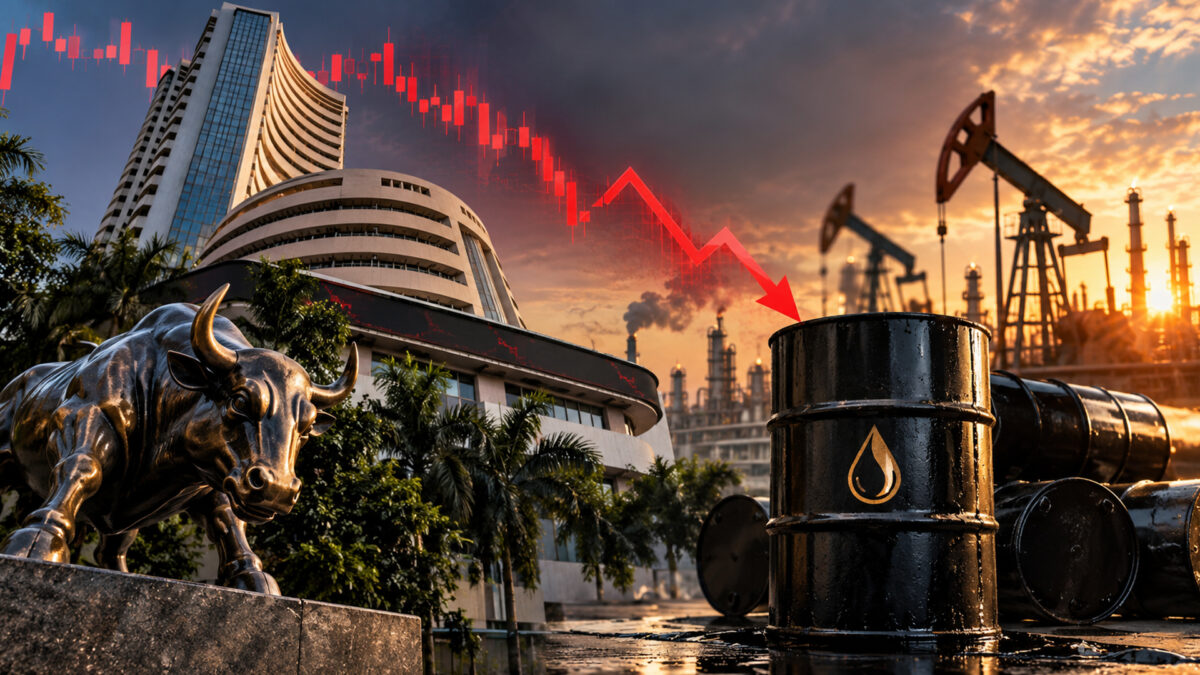
Sensex plunges 777 points, Nifty slips below 23,150

The markets reversed early gains sharply on Tuesday, with the Sensex falling 778 points and the Nifty slipping below the 23,150 mark as rising crude oil prices, higher US bond yields and Middle East tensions weighed on investor sentiment.

The Sensex closed at 74,003.82, down 777.94 points, or 1.04%. The Nifty 50 declined 279.05 points, or 1.19%, to end at 23,118.60. The Nifty closed at its lowest level in nearly five months.

The session began on a positive note. The Sensex gained more than 400 points in early trade, while the Nifty moved above 23,500. The gains, however, quickly faded as selling pressure intensified across most sectors. The Sensex eventually lost more than 1,400 points from its intraday high.

Investor wealth fell by around ₹9 lakh crore during the session as concerns over inflation, crude oil prices and global interest rates increased.

Rising crude oil prices remained one of the biggest concerns for Indian investors. Brent crude climbed around 2% to nearly $108 a barrel as tensions in West Asia continued to disrupt energy markets. Reports of damage to Saudi energy infrastructure added to fears of tighter global oil supplies.

Higher oil prices are particularly worrying for India because the country relies heavily on crude imports. A sustained rise in crude prices can increase the import bill, put pressure on the rupee and make it harder for inflation to ease.

Global bond markets also added to the pressure. The US 10-year Treasury yield recently moved above 5%, raising concerns that borrowing costs could remain high for longer. Investors are also reassessing expectations around the US Federal Reserve as higher energy prices could keep inflation elevated.

Higher US yields tend to make dollar-denominated assets more attractive and can encourage foreign investors to reduce exposure to emerging markets such as India. Continued foreign portfolio investor selling has already been a concern for domestic equities.

The sell-off was broad-based. Fifteen of the 16 major sectoral indices ended lower. Nifty Financial Services fell around 1.8%, while the auto index dropped about 2%. Mid-cap and small-cap stocks also faced heavy selling, declining around 2.1% and 2.4%, respectively.

Information technology stocks were the notable exception. The Nifty IT index gained about 2.2%, helped by expectations that a weaker rupee and stronger demand for technology services could support the sector.

HCL Technologies emerged as the biggest gainer among major Nifty stocks, rising 3.95% to ₹1,253.70. Infosys climbed 3.79% to ₹1,077, while Tata Consultancy Services gained 2.28% to ₹2,251. Tech Mahindra rose 2.26% to ₹1,575.90 and Wipro added 1.55% to ₹170.

HDFC Bank also finished higher, gaining about 1.2%. The private lender had submitted two candidates to the Reserve Bank of India for consideration for its next chief executive officer.

The broader market, meanwhile, remained under pressure as investors moved away from riskier assets. Bharat Electronics was the biggest loser among the major stocks, falling 5.30% to ₹382.90. Shriram Finance declined 4.74% to ₹979.80, while Adani Enterprises dropped 4.29% to ₹2,928.60.

InterGlobe Aviation fell 3.96% to ₹4,776 and Grasim Industries declined 3.38% to ₹3,171.

Market participants are also keeping an eye on the rupee, crude prices and upcoming US economic signals. Any further escalation in West Asia could push oil prices higher and add to inflationary pressure.

The large pipeline of initial public offerings in India is another factor being watched by investors. A busy IPO market could absorb some domestic liquidity at a time when foreign fund flows remain uncertain.

The sharp reversal on Tuesday highlights the fragile mood in Indian markets. Investors are balancing strong domestic economic fundamentals against a difficult global backdrop marked by geopolitical tensions, expensive crude oil and higher interest rates.

The immediate direction of the Sensex and Nifty is likely to depend on movements in crude oil, global bond yields, foreign fund flows and developments in West Asia.

 

Categories
Corporate

Sensex falls 120 points, Nifty ends below 23,400

Indian stock markets ended lower on Friday as rising crude oil prices, weak global cues and continuing tensions in West Asia kept investors cautious. The Sensex fell 120.83 points, or 0.16%, to close at 74,781.76, while the Nifty 50 declined 79.70 points, or 0.34%, to settle at 23,398.10.

The decline came after a highly volatile session. The benchmarks opened sharply lower, with the Sensex falling more than 700 points and the Nifty dropping below 23,250 in early trade. The market later recovered much of the morning losses as buying emerged in selected heavyweight stocks.

Friday’s fall extended the recent weakness in the Indian stock market. Both benchmark indices recorded their fifth straight weekly decline. The Nifty ended the week more than 2% lower, while the Sensex also lost over 2%. Over the past five weeks, both indices have fallen nearly 4.8%, reflecting the growing pressure from global risks and expensive crude oil.

The biggest concern for investors remained crude oil. Brent crude prices rose sharply during the week and moved above $100 a barrel as tensions in the Middle East disrupted supply expectations. The latest rise followed attacks and threats affecting shipping routes around the Strait of Hormuz and the Red Sea.

Higher crude prices are particularly worrying for India because the country imports a large share of its oil requirements. A prolonged increase in oil prices can raise India’s import bill, put pressure on the rupee and increase inflation risks. It can also squeeze the profits of companies that depend heavily on fuel and other energy inputs.

The impact was visible across several sectors. Metal stocks came under pressure as investors worried about higher input costs and weaker global economic conditions. Tata Steel was among the biggest Sensex losers, falling 1.67%. Reliance Industries declined 1.33%, while Sun Pharmaceutical Industries, Bajaj Finance and NTPC also ended lower.

HDFC Bank was the strongest performer among Sensex stocks, gaining 2.02%. Tech Mahindra rose 1.38%, while HCL Technologies advanced 0.85%. Eternal also finished higher. The gains in these stocks helped the broader market recover from its steep early decline.

Among Nifty stocks, HDFC Life Insurance, Power Grid Corporation, ONGC, Bharti Airtel and Tech Mahindra were among the notable gainers. On the other side, HCL Technologies, Hindalco Industries, Tata Steel, Adani Enterprises and Mahindra & Mahindra were among the leading losers.

The IT sector remained under pressure during the week. The Nifty IT index recorded a sharp weekly decline as investors worried that higher US inflation and bond yields could limit the Federal Reserve’s room to ease monetary policy. The sector fell about 5.8% for the week, making it the weakest major sectoral index.

Financial stocks also faced pressure. The Nifty financial services sector declined during the week, while HDFC Bank and ICICI Bank remained under watch. HDFC Bank had fallen for six consecutive weeks before Friday’s recovery, with investors also tracking uncertainty surrounding its future leadership.

The broader market was not spared either. Small-cap and mid-cap stocks recorded weekly losses as investors reduced exposure to riskier assets. Fourteen of the 16 major sectors recorded losses during the week, showing how widespread the selling pressure had become.

The rupee also added to market concerns. The Indian currency recorded its sharpest weekly decline since May, falling about 1% against the US dollar. A weaker rupee can make imported crude oil more expensive, adding another layer of pressure on India’s inflation and current account outlook.

Bond yields have also risen as investors assess the inflation impact of higher oil prices. The rise in global yields has made equities less attractive and increased concerns that central banks may keep interest rates higher for longer.

Foreign investor activity remains another concern for Dalal Street. Foreign institutional investors sold shares worth ₹438.24 crore on Thursday, while domestic institutional investors bought equities worth ₹1,025.85 crore. The domestic buying provided some support but was not enough to completely offset the broader negative sentiment.

Investors are now closely watching crude oil prices, developments in the Middle East and upcoming US inflation data. The US data could influence expectations around the Federal Reserve’s next interest-rate decision and, in turn, determine the direction of global markets.

With the Sensex and Nifty already coming off five consecutive weekly losses, investors are likely to remain cautious. Any easing in geopolitical tensions or crude prices could provide relief, but another spike in oil prices could put fresh pressure on Indian equities.

Indian markets will remain closed on Monday for a local holiday, giving investors an additional day to assess global developments before trading resumes.


Categories
Corporate

Sensex climbs 130 points, Nifty settles above 23,450

Indian stock markets managed to break a three-session losing streak on Thursday, September 10, as buying in key heavyweight stocks helped the benchmarks recover from a weak afternoon session. The Sensex ended 138.36 points, or 0.19%, higher at 74,902.59, while the Nifty 50 gained 46.30 points, or 0.20%, to close at 23,477.80.

The session was far more volatile than the final numbers suggested. The Sensex and Nifty moved between gains and losses through most of the trading day as investors remained cautious about rising crude oil prices and continued geopolitical tensions. The real turnaround came during the closing auction session, when heavy buying pushed both indices sharply higher before they settled with modest gains.

The Sensex had slipped around 135 points and the Nifty was down more than 40 points shortly before the closing auction. The sharp late recovery was particularly notable because Thursday also marked the weekly derivatives expiry for the Sensex, adding to intraday volatility and sudden swings in stock prices.

Power Grid emerged as the top Sensex gainer, rising 1.82%. Tech Mahindra followed with a gain of 1.14%, while Bharti Airtel advanced 0.85% and Axis Bank added 0.61%. State Bank of India, ITC and Infosys were also among the stronger names during the session.

HDFC Life was another notable gainer, with its shares rising around 2%. The broader market also saw interest in several individual stocks. Molbio Diagnostics climbed 16% during the day, extending its two-day gain to nearly 30%. IRB Infrastructure also advanced after reporting a 25% year-on-year increase in August toll revenue, while Dilip Buildcon gained after receiving a letter of intent for a major petroleum pipeline project.

On the losing side, Tata Steel was the biggest Sensex laggard, falling 1.62%. IndiGo declined 1.27%, while ICICI Bank slipped 1.01%. Mahindra & Mahindra, Adani Ports, Reliance Industries, Sun Pharma, InterGlobe Aviation and Bharat Electronics also featured among stocks under pressure at different points during the session.

The recovery in Indian equities came despite continued pressure from the global crude oil market. Brent crude remained above the $100-a-barrel mark and crossed $102 during the day, as concerns over supply disruptions linked to the Iran-US conflict continued to weigh on investor sentiment. Higher oil prices are particularly important for India because the country relies heavily on imports to meet its energy needs.

A sustained rise in crude can put pressure on India’s inflation outlook, corporate margins and the rupee. The Indian currency had already weakened to around ₹95.08 against the US dollar on Wednesday, adding another concern for investors.

Global markets also remained cautious. Asian equities fell during the morning session, with Japan’s Nikkei and South Korea’s Kospi coming under pressure. Wall Street had also ended lower in the previous session as rising oil prices revived worries about inflation and interest rates. Investors are now watching upcoming US inflation data, including the Producer Price Index and Consumer Price Index, for clues about the Federal Reserve’s next policy move.

The previous day’s heavy sell-off had left investors on edge. On Wednesday, the Sensex had plunged 813.35 points to 74,764.23, while the Nifty dropped 203.60 points to 23,431.50. IT stocks were among the worst hit, with HCL Technologies, Infosys, Tech Mahindra and TCS posting sharp declines. The fall came as crude crossed $100 and tensions in West Asia intensified.

Thursday’s rebound therefore offered some relief, but it did not completely change the cautious mood in the market. The Nifty remains below key levels seen earlier in the year, while the Sensex has also faced repeated selling pressure in recent sessions.

Foreign investors have remained a source of pressure. On Wednesday, foreign institutional investors sold Indian equities worth ₹583 crore, while domestic institutional investors bought shares worth ₹1,509 crore. The stronger domestic buying provided some support to the market amid continued foreign selling.

Another development during Thursday’s session was a brief outage at the BSE. The exchange said an issue affecting one partition of the cash segment began around 9:42 am and was resolved by 10:08 am, while other parts of the exchange continued to operate normally.

The market is now heading into another session with crude prices, geopolitical developments, global bond yields and US inflation data likely to remain key drivers. Thursday’s late recovery showed that buyers are still willing to step in after sharp declines, but the sharp swings also underline how sensitive Indian equities remain to global risks.

With oil above $100 and September already proving difficult for equities, investors are likely to remain selective.


Categories
Corporate

Sensex settles 555 points lower, Nifty below 23,650

Indian benchmark indices ended sharply lower on Tuesday, as rising crude oil prices and renewed tensions in the Middle East made investors more cautious. The Sensex slipped 555.23 points, or 0.73%, to close at 75,577.58, while the Nifty 50 fell 144.05 points, or 0.61%, to settle at 23,635.10.

The sell-off gathered pace during the session as concerns over expensive oil weighed on sentiment. With Brent crude moving closer to the psychologically important $100-a-barrel mark, investors worried about the possible impact on India’s import bill, inflation and the rupee.

Banking stocks were among the biggest drags on the benchmarks. ICICI Bank, Axis Bank, SBI Life Insurance, Reliance Industries and UltraTech Cement featured among the prominent Nifty losers. ICICI Bank was down around 2%, while HDFC Bank and other heavyweight financial stocks also remained under pressure.

The weakness in large-cap stocks played a major role in Tuesday’s decline. Because several of these companies carry significant weight in the Sensex and Nifty, their losses had a noticeable impact on the headline indices.

There were, however, some bright spots. Bharat Electronics (BEL), ONGC, Hindustan Unilever, Eicher Motors and Adani Ports were among the notable Nifty gainers, providing limited support to the broader market.

Defence stocks were particularly active after the government cleared military acquisition proposals worth around ₹1.10 lakh crore. The announcement boosted expectations of fresh orders for domestic defence manufacturers and lifted investor interest in the sector.

Outside the benchmark indices, several stocks also moved sharply on company-specific developments. GE Vernova T&D India gained strongly after emerging as the lowest bidder for a major Power Grid transmission project. PVR INOX advanced following its announcement of a ₹300-crore share buyback, while Hindustan Copper benefited from firm copper prices.

The broader market held up better than the frontline indices. Mid-cap and small-cap stocks showed resilience, suggesting that investors were not selling indiscriminately. Instead, much of the pressure remained concentrated in large-cap banking, energy and other heavyweight counters.

Crude oil remained the biggest concern through the session. Brent prices rose as continuing uncertainty in the Middle East, including tensions involving Iran and concerns over key shipping routes, raised fears of supply disruptions.

This development matters for India because the country relies heavily on imported crude. A prolonged rise in oil prices could increase the cost of imports and put pressure on inflation. It can also hurt companies with high fuel and transportation costs and make it harder for the Reserve Bank of India to manage inflationary pressures.

The Indian rupee also weakened, ending around ₹94.82 against the US dollar, compared with ₹94.49 in the previous session. A weaker rupee makes dollar-priced commodities such as crude oil more expensive and can add to the pressure created by higher global oil prices.

Investors are also watching developments in global bond markets and expectations surrounding the US Federal Reserve’s interest-rate policy. Higher US bond yields and a stronger dollar can reduce the appeal of emerging-market assets and influence foreign portfolio investment flows into India.

The latest fall adds to a recent period of weakness on Dalal Street. The Sensex and Nifty have both faced selling pressure over the past several sessions as investors assess the possible impact of geopolitical risks, higher energy prices and global monetary policy.

Yet the market’s performance also showed that investors continue to look for opportunities in sectors with strong domestic triggers. Defence stocks benefited from government spending plans, while individual companies such as GE Vernova T&D India and PVR INOX found buyers on the back of corporate developments.

The immediate focus for investors is likely to remain on crude oil prices, Middle East developments, the rupee, foreign fund flows and global interest rates. Any further rise in oil prices could keep pressure on Indian equities, particularly sectors sensitive to fuel costs and inflation.

At the same time, an easing of geopolitical tensions or a retreat in crude prices could provide some breathing room for the market.
Tuesday’s session left the Sensex at 75,577.58 and the Nifty at 23,635.10, reflecting a cautious mood across Dalal Street. With global risks still influencing domestic markets, investors are likely to remain selective until there is greater clarity on oil prices and the geopolitical situation.


Categories
Corporate

Sensex slips 380 points, Nifty ends below 23,800

The markets ended lower on Monday, with the Sensex falling 383 points and the Nifty slipping below the 23,800 mark as investors remained cautious amid rising crude oil prices, heightened US-Iran tensions and concerns over US interest rates.

The BSE Sensex declined 382.63 points, or 0.50%, to close at 76,132.81, while the NSE Nifty50 fell 123.65 points, or 0.52%, to end at 23,779.15. The decline extended the market’s losing run, with global uncertainty continuing to overshadow positive domestic economic signals.

Selling was broad-based, although select stocks managed to buck the trend. Apollo Hospitals, Bharti Airtel, Larsen & Toubro, Coal India and Max Healthcare were among the notable gainers. Healthcare stocks were particularly resilient, helping the pharma and healthcare segments outperform the broader market.

At the other end, Infosys emerged as the biggest loser among the Nifty 50 stocks. Tech Mahindra, TCS and other IT counters also faced heavy selling. Infosys fell around 3.8%, while Tech Mahindra and TCS declined as investors worried that higher US borrowing costs could weigh on technology spending.

The IT sector was among the biggest drags on the market, falling more than 2%. The weakness came after stronger-than-expected US jobs data strengthened expectations that the US Federal Reserve may keep interest rates elevated for longer. Higher interest rates could reduce corporate technology spending in the US, an important market for Indian IT companies.

Rising crude oil prices added to the pressure. Brent crude climbed close to $97 a barrel as escalating tensions between the US and Iran raised concerns over potential disruptions to oil supplies and shipping through the Strait of Hormuz.

For India, the oil price rise is particularly important because the country relies heavily on imports to meet its energy requirements. Expensive crude can increase the import bill, put pressure on inflation and raise costs for businesses, particularly airlines, paints, tyres and other fuel-sensitive industries.

The geopolitical situation also encouraged investors to adopt a defensive approach. The possibility of a prolonged US-Iran confrontation and uncertainty around energy supplies have increased volatility across global financial markets.

Foreign institutional investors remained another source of pressure. FIIs continued to withdraw money from Indian equities, limiting the market’s ability to recover despite domestic institutional buying. Foreign investors sold about Rs 3,112 crore worth of Indian equities, while domestic institutional investors provided some support.

Sectoral performance reflected the cautious mood. IT and media stocks were among the weakest performers, while insurance and several financial counters also came under pressure. Healthcare remained relatively stronger, while select auto, telecom and infrastructure stocks attracted buying interest.

Among individual stocks, Apollo Hospitals stood out on the gaining side, while Bharti Airtel, L&T and Coal India also showed resilience. The strength in these counters provided some support to the broader market but was not enough to offset losses in heavyweight IT and financial stocks.

Infosys led the list of major losers, followed by Tech Mahindra and other technology stocks. PVR INOX and Zee Entertainment also witnessed sharp declines amid company-specific developments, adding to the weakness in individual stocks.

The broader market was also subdued, with the Nifty Midcap index declining around 0.5%. Market breadth remained weak as selling pressure spread across several sectors and stocks.

Analysts are now watching the 23,800 level closely. A sustained move below this mark could keep the Nifty under pressure, while a recovery above 23,900-24,000 may be needed to signal a meaningful improvement in sentiment.

Monday’s session therefore offered little comfort to investors. While stocks such as Apollo Hospitals and Bharti Airtel demonstrated pockets of strength, sharp losses in Infosys, Tech Mahindra and other IT counters showed how quickly global concerns can influence Indian equities.


Categories
Corporate

Sensex ends 360 points higher, Nifty nears 23,900

The markets finally managed to put an end to their four-session losing streak on Friday, although the recovery was not strong enough to erase concerns that have weighed on investors throughout the week.

The Sensex gained 362.57 points, or 0.48%, to close at 76,515.43, while the Nifty 50 added 24.25 points, or 0.10%, to settle at 23,897.70. The Nifty remained just short of the 23,900 mark, while the Sensex gave up a large portion of its early gains before the closing bell.

The session began on a much stronger note. The Sensex jumped more than 500 points in early trade and the Nifty briefly moved above 23,900, helped by positive global signals and buying in heavyweight stocks. As the day progressed, however, investors turned cautious, limiting the gains and keeping the broader market mood subdued.

Friday’s rebound was led largely by metal, insurance, oil and gas and selected financial stocks. The Nifty Metal index was among the strongest sectoral performers, rising more than 1%. Buying interest in Tata Steel and other metal counters provided an important lift to the benchmarks.

Insurance stocks were another bright spot. SBI Life Insurance emerged as the biggest Nifty 50 gainer, rising 3.50%. Tata Steel followed with a 2.49% gain, while HDFC Life Insurance advanced 2.42%. Reliance Industries gained 1.50%, Trent rose 1.33% and JSW Steel added 1.30%.

The gains, however, were offset by weakness in several large companies. HCL Technologies fell 1.94% to become the biggest Nifty 50 loser. Bharti Airtel declined 1.55%, while Maruti Suzuki slipped 1.27%. Bajaj Finserv lost 1.11%, Max Healthcare fell 1.02% and Tata Consumer Products declined 0.90%.

Pharmaceutical stocks remained under pressure, with the Nifty Pharma index falling around 0.68%. Auto, information technology, PSU banking and realty stocks also traded lower. The weakness in auto stocks has become a growing concern, with investors watching vehicle sales and demand trends closely.

The broader market delivered a mixed performance. While the Nifty Midcap index ended slightly lower, the Smallcap index gained around 0.2% and touched a fresh record high. More than 180 stocks recorded new 52-week highs during the session, showing that buying interest remained strong in selected pockets despite the cautious mood in the headline indices.

Several individual stocks also attracted attention. Capital-market companies gained after market regulator SEBI indicated that it would review the methodology used to determine derivative settlement prices. The move followed concerns over sharp volatility linked to the closing auction process. Shares of BSE, Angel One and other market-related companies saw buying interest.

Newly listed companies also had a strong debut. ESDS Software opened significantly above its issue price, while Priority Jewels also listed at a premium, reflecting continued investor appetite for select initial public offerings despite the uncertain market environment.

Global factors continued to remain important for Indian investors. Crude oil prices have climbed sharply amid renewed tensions involving the United States and Iran. Brent crude was trading close to $96 a barrel, raising concerns over India’s import bill and the potential impact on inflation. Higher oil prices are particularly important for India because the country relies heavily on imports to meet its energy requirements.

Global bond yields and expectations around US interest rates also influenced sentiment. US markets ended higher and Treasury yields eased, while Asian markets opened on a positive note. Investors are now closely watching upcoming US jobs data for clues about the Federal Reserve’s next move on interest rates.

Domestic institutional investors continued to provide some support to Indian equities. Foreign institutional investors remained sellers, while domestic institutions absorbed part of that selling pressure. This has helped prevent sharper declines even as global uncertainty continues to influence trading.

Despite Friday’s recovery, the weekly picture remained weak. Both the Sensex and Nifty recorded their fourth consecutive weekly decline, with the Sensex falling about 1% and the Nifty around 1.2% for the week. Rising crude prices, higher global bond yields and continued foreign selling have kept investors cautious.

Friday’s performance offered some relief but did not yet signal a decisive change in market direction. The ability of the Nifty to hold close to 23,900 will remain important in the near term. With global markets, crude oil and US economic data continuing to shape sentiment, traders are likely to remain selective rather than chase broad-based gains.


Categories
Corporate

Sensex plunges 400 points, Nifty below 23,900

The markets gave up their early gains on Thursday as selling pressure returned in the final hours of trading. The BSE Sensex closed 417.49 points, or 0.55 per cent, lower at 76,152.86. The NSE Nifty50 declined 41 points, or 0.17 per cent, to settle at 23,873.45. The late decline came after both indices had traded higher during the first half of the session.

The market’s weakness was particularly visible during the new closing auction session (CAS). At around 3:15 pm, the Sensex was still close to the previous day’s level, but it subsequently lost more than 400 points by the final settlement. The Nifty also slipped below the important 23,900 mark.

The session had started on a more positive note. The Sensex jumped more than 200 points in early trade, while the Nifty moved above 23,950. Adani Ports and Power Grid were among the stocks supporting the initial recovery. GIFT Nifty had also indicated a positive start, pointing to gains of more than 100 points before the market opened.

However, the early optimism did not last. Investors remained concerned about the impact of elevated crude oil prices on inflation, corporate costs and economic growth. Renewed uncertainty surrounding the US-Iran conflict added another layer of risk, particularly because prolonged geopolitical tensions could disrupt energy supplies from the Middle East.

Oil prices remained a major focus for Dalal Street. Brent crude was trading around $95 a barrel during the session after prices had risen sharply in recent days. While crude eased at times on Thursday, investors continued to worry that further escalation in the Middle East could push energy prices higher.

Higher global bond yields also weighed on sentiment. Rising yields can make equities less attractive and increase concerns about financing costs and future interest-rate conditions. Investors were therefore watching global bond markets closely while also awaiting key US economic data that could influence expectations for the Federal Reserve’s monetary policy.

The selling was not uniform across the market. Banking and real estate stocks provided some support, helping limit the broader decline. The Nifty Realty index gained more than 2 per cent, while Nifty Media, Private Bank, PSU Bank and Nifty Bank also outperformed.

Broader markets were comparatively stronger. The Nifty MidCap 100 rose 0.37 per cent, while the Nifty SmallCap 100 gained 1.20 per cent. The performance indicated that buying interest remained present in several mid- and small-cap stocks even as large-cap benchmarks ended lower.

Among individual stocks, Adani Ports and Axis Bank were among the notable gainers. Adani Ports benefited from positive company-specific developments, including strong cargo volumes, while banking stocks received support from improved liquidity conditions and renewed investor interest.

On the losing side, Bajaj Auto, Tech Mahindra and Trent were among the biggest drags on the Nifty50. Information technology and automobile stocks faced pressure, with the Nifty IT and Nifty Auto indices ending among the weaker sectoral performers. Healthcare and FMCG stocks also underperformed.

Swiggy remained another stock in focus. Its shares fell for a third consecutive session after MSCI announced changes to its index treatment. Swiggy is set to be removed from MSCI’s Global Standard Indexes from September 7 after the company’s foreign ownership limit was reduced to 49.5 per cent from 100 per cent. Such index changes can affect demand from global funds that track benchmark indices.

Several other stocks attracted attention during the trading session. SML Mahindra gained more than 8 per cent after reporting strong August sales, bucking the broader market weakness. Wakefit Innovations also rose after Nomura initiated coverage with a Buy rating.

The rupee also strengthened during the session. The currency rose 67 paise to 94.30 against the US dollar in morning trade, reaching a two-month high, according to market updates. Strong foreign currency inflows and improved banking-system liquidity provided some support to financial markets.

India’s banking system was sitting on a liquidity surplus of ₹7.76 lakh crore, its highest level in more than four-and-a-half years. The increase followed substantial foreign-exchange inflows raised by banks through dedicated programmes, adding to liquidity in the domestic financial system.

Despite the day’s decline, analysts pointed to 23,800 as an important near-term support level for the Nifty. A decisive break below that zone could increase selling pressure towards 23,700-23,600, while the 24,000-24,150 range remains an important resistance area.

The market numbers are because of crude oil, geopolitical developments, global bond yields and overseas market trends. The contrasting performance of large-cap benchmarks and broader market indices also suggests that investors are becoming more selective rather than exiting equities across the board.

The September 3 trading session therefore ended with a mixed message. The Sensex and Nifty remained under pressure, but strength in banking, realty and smaller companies showed that domestic buying interest had not disappeared. With global risks still elevated, traders are likely to remain cautious and focus on stock-specific opportunities in the sessions ahead.


Categories
Corporate

Sensex falls 370 points, Nifty slips below 23,950

Indian equity markets extended their losing streak for a third straight session on Wednesday, as rising crude oil prices, escalating US-Iran tensions and a sell-off in global markets weighed heavily on investor sentiment.

The benchmark BSE Sensex fell 373.93 points, or 0.49 per cent, to close at 76,570.35. The NSE Nifty50 declined 141.35 points, or 0.59 per cent, and settled at 23,914.45, slipping below the closely watched 24,000 mark.

The session was considerably more volatile than the final numbers suggested. The Sensex opened nearly 682 points lower at 76,262, while the Nifty started the day 220 points down at 23,835.50. At one point, the Sensex dropped more than 800 points and the Nifty moved below 23,800 as investors reacted to growing concerns over the global economic outlook.

The biggest pressure came from the sharp rise in crude oil prices following renewed escalation in the US-Iran conflict. Brent crude moved towards $97 a barrel during the day, raising concerns for oil-importing economies such as India. Higher crude prices can increase the country’s import bill, put pressure on the rupee and make inflation management more difficult.

India imports a large share of its crude oil requirements, making the domestic economy particularly sensitive to sustained oil price increases. Investors are therefore closely watching developments in West Asia and their possible impact on energy supplies.

The oil shock has also changed expectations around interest rates. A prolonged increase in crude prices could keep inflation elevated, potentially limiting the room available to central banks to reduce borrowing costs. At the same time, higher US Treasury yields have made global investors more cautious about riskier assets such as emerging-market equities.

The pressure was visible across most sectors on the domestic market. The Nifty IT index was the worst-performing major sectoral index, falling around 2.5 per cent. Realty declined 2.14 per cent and the Auto index lost 1.88 per cent. Media, cement and financial services stocks also remained under pressure, while pharma, healthcare and PSU banks saw relatively smaller declines.

Auto stocks were particularly weak after August sales data and broader concerns about demand weighed on sentiment. Hero MotoCorp fell sharply, declining 4.6 per cent, while other automobile stocks also faced selling pressure. The Nifty Auto index ended among the weakest sectoral performers.


Information technology stocks also struggled as investors continued to worry about higher global bond yields and their impact on valuations. Wipro fell around 2.5 per cent, while HCL Technologies and Infosys also ended lower.

Despite the broad sell-off, a few large-cap stocks managed to buck the trend. Adani Ports emerged among the leading Sensex gainers, while Bajaj Finserv, Power Grid, NTPC and Titan also recorded gains. Reliance Industries and L&T were among the other stocks that showed resilience during the session.

On the losing side, Eicher Motors and Wipro were among the biggest drags on the benchmark. HDFC Bank, Mahindra & Mahindra and HCL Technologies also declined sharply. The weakness in heavyweight stocks added to the pressure on both the Sensex and Nifty.

The broader market did not escape the selling either. Mid-cap and small-cap stocks declined as investors reduced exposure to riskier assets. The Nifty Midcap 50 fell about 0.70 per cent, reflecting the cautious mood beyond the benchmark indices.

Global cues remained negative throughout the day. Asian markets fell sharply, with Japan’s Nikkei declining 1.6 per cent and South Korea’s Kospi dropping 2.87 per cent. Hong Kong’s Hang Seng and China’s Shanghai Composite also traded lower. The weakness followed losses on Wall Street, where investors were already concerned about inflation and rising oil prices.

The latest decline means Indian benchmark indices have now fallen for three consecutive sessions. According to market data, the Sensex and Nifty have lost roughly 5 per cent since the Iran conflict began more than six months ago.

The rupee, meanwhile, remained relatively stable despite the pressure from higher crude prices and US bond yields. The Indian currency closed at around ₹94.97 against the US dollar, compared with ₹94.95 in the previous session. Continued intervention by the Reserve Bank of India has helped limit volatility in the currency market.

Foreign and domestic institutional flows offered some support to the market. Foreign Institutional Investors were net buyers of around ₹1,143 crore, while Domestic Institutional Investors bought equities worth about ₹1,847 crore. However, these purchases were not enough to offset the broader risk-off sentiment created by global developments.

The market is now entering a period where global developments could continue to dictate short-term direction. Investors will closely track crude oil prices, developments in the US-Iran conflict, US Treasury yields and upcoming inflation and economic data.

The immediate concern is whether the rise in oil prices will prove temporary or become a sustained shock. A prolonged period of expensive crude could affect India’s inflation outlook, corporate margins and economic growth while increasing pressure on the country’s external finances.

Categories
Corporate

Sensex ends flat, Nifty slips below 24,100

Indian equity markets ended almost flat on Tuesday, September 1, as rising crude oil prices, higher global bond yields and renewed US-Iran tensions kept investors cautious. The benchmark indices recovered from sharper intraday losses but failed to hold on to early gains.

The BSE Sensex closed at 76,944.28, down 12.99 points, or 0.02%. The Nifty 50 ended at 24,055.80, declining 24.60 points, or 0.10%. The Nifty slipped below the important 24,100 mark and remained close to the 24,000 level through much of the session.

The market opened on a relatively positive note but quickly turned volatile as investors assessed the impact of higher oil prices and growing geopolitical uncertainty. Brent crude moved above $92 a barrel amid concerns over the latest escalation in the US-Iran conflict. For India, which depends heavily on imported crude, an extended rise in oil prices could increase the import bill, put pressure on the rupee and add to inflation risks.

The rise in global bond yields added to the pressure on equities. Higher yields can make emerging-market assets less attractive and may encourage foreign investors to move money towards relatively safer assets. Foreign institutional investor flows have therefore remained an important factor for the domestic market.

Banking and automobile stocks were among the biggest drags on the Nifty. The Nifty Bank index declined around 1.1%, while the Nifty Auto index fell nearly 1.2%. Pharmaceutical stocks also weakened, with the Nifty Pharma index falling around 1.6%.

Among the top Nifty losers, Shriram Finance fell 4.58%, while Maruti Suzuki declined 4.41%. Nestle India dropped 3.90%, Max Healthcare lost 3.75% and InterGlobe Aviation, the parent of IndiGo, slipped 3.48%.

Maruti Suzuki faced strong selling pressure after the company reported its August sales figures. Although annual sales growth remained positive, investors focused on the month-on-month movement and the stock’s elevated valuation. The decline made Maruti one of the biggest drags on the benchmark.

Other stocks also witnessed sharp losses. SBI fell 2.51%, while IndusInd Bank declined 2.36%. The weakness in financial stocks reflected broader caution around banks and other interest-rate-sensitive businesses.

The broader market was weaker than the headline indices suggested. The Nifty Midcap index declined about 1.4%, while the Nifty Smallcap index fell around 0.2%. Market breadth remained negative, indicating that selling extended beyond a handful of large-cap stocks.

However, several heavyweight stocks offered support to the benchmarks. ITC was among the strongest performers, gaining around 4%, while Reliance Industries rose about 2.5%. Adani Ports and Bharti Airtel were also among the prominent gainers.

Reliance Industries provided meaningful support to the Sensex and Nifty after a brokerage raised its price target for the company, citing expectations of stronger refining margins. The stock’s gains helped offset some of the weakness in banking and automobile counters.

Kotak Mahindra Bank was another notable gainer, rising around 1.3%-1.5%. The stock benefited from developments around the bank’s leadership and succession plans. Information technology and FMCG stocks also provided some stability, with both sectors gaining around 0.9%.

The day’s trading showed how closely Indian markets are currently responding to global developments. Investors are balancing India’s strong domestic growth outlook against concerns over oil prices, geopolitical tensions, foreign capital flows and global interest rates.

India’s economic data offered some reassurance. The economy expanded 7.8% year-on-year in the April-June quarter of 2026-27, highlighting the strength of domestic demand despite the challenging global backdrop. The strong growth number, however, was unable to completely overcome concerns about higher energy costs and global financial conditions.

The rupee also remained an important market indicator. The currency ended around ₹94.95 against the US dollar, strengthening from the previous close of ₹95.17. A sustained rise in crude prices could nevertheless put renewed pressure on the rupee because higher oil prices increase India’s dollar demand for energy imports.

Investors are now likely to track developments in the Middle East closely, particularly any further escalation involving the US and Iran. Any disruption to crude supplies or key shipping routes could push oil prices higher and increase pressure on inflation-sensitive economies such as India.

Domestic investors will also monitor foreign institutional investor activity, global bond yields and upcoming economic indicators. The performance of heavyweight stocks such as Reliance Industries, ITC, banks and technology companies could determine whether the Nifty is able to sustain the 24,000 level.

Tuesday’s session ultimately reflected a market caught between strong domestic fundamentals and a difficult global environment. The marginal decline in the Sensex masks broader weakness across several sectors, while the Nifty’s close below 24,100 shows that investors remain cautious.

With crude oil above $92 a barrel and geopolitical risks still elevated, volatility is likely to remain a key feature of Indian stock market trading in the near term.


Categories
Corporate

Sensex falls 300 points, Nifty slips below 24,100

The markets ended lower on Monday as rising crude oil prices, renewed US-Iran tensions and concerns over higher US interest rates weighed on investor sentiment. The benchmark Sensex fell 307.23 points, or 0.40%, to close at 76,957.27, while the Nifty 50 declined 95.25 points, or 0.39%, to settle at 24,080.40.

The weak session reflected a cautious mood among investors as geopolitical uncertainty returned to the forefront. Fresh military action involving the United States and Iran pushed crude oil prices higher, raising concerns for oil-importing economies such as India. The country imports around 85% of its crude oil requirements, making a sustained rise in global oil prices a key risk for inflation, corporate margins and the rupee.

The market started the day on a weak note. The Sensex opened around 190 points lower, while the Nifty was down nearly 105 points. The Nifty slipped below the important 24,000 level during the session, touching an intraday low of 23,993.60. The Sensex also fell to an intraday low of 76,751.32 before recovering some ground towards the close.

Crude oil remained one of the biggest concerns for investors. Oil prices rose after US strikes on Iranian launch sites near the Strait of Hormuz were followed by Iranian attacks on American military bases in Jordan. Brent crude moved above $90 a barrel, reviving fears that higher energy costs could put additional pressure on India’s inflation outlook and increase input costs for several businesses.

The prospect of higher US interest rates added to the pressure. Recent comments from US Federal Reserve officials have increased expectations of a possible rate hike, prompting investors to reassess riskier assets. Higher US bond yields can also reduce the attractiveness of emerging-market equities and put pressure on capital flows into markets such as India.

Among individual stocks, Adani Enterprises and Adani Ports & SEZ were the biggest losers on the Nifty 50, falling 9.76% and 6.70%, respectively. ITC declined 3.95%, Bharti Airtel fell 3.75%, while Tata Motors Passenger Vehicles dropped 3.30%.

On the other side, Sun Pharmaceutical Industries was the top Nifty 50 gainer, rising 3.38%. Nestle India gained 2.88%, Axis Bank advanced 2.77%, Max Healthcare Institute rose 2.76% and Grasim Industries climbed 2.46%.

The broader market presented a mixed picture. While the Nifty Smallcap 100 declined 0.74%, the Nifty Midcap 100 managed to finish 0.24% higher. Aurobindo Pharma was among the notable mid-cap gainers, rising 4.36%, while Lenskart Solutions, FSN E-Commerce Ventures, One 97 Communications and Polycab India also posted gains.

Aurobindo Pharma gained after its US subsidiary launched generic versions of Advair Diskus in the American market. Lenskart rose 4.22%, FSN E-Commerce Ventures gained 4.14%, One 97 Communications advanced 4.01% and Polycab India increased 3.93%.

The small-cap segment, however, remained under pressure. Kaynes Technology India, Wockhardt, Jyoti CNC Automation, Nuvama Wealth Management and Chambal Fertilizers were among the major decliners. Ather Energy stood out among the gainers, climbing 6.27% and touching a 52-week high following its recent product launches.

Another important factor behind Monday’s volatility was the latest MSCI index rebalancing. The changes triggered substantial stock-specific buying and selling, particularly towards the market close. A new closing-auction mechanism for stocks with futures and options also faced its first major test during the reshuffle.

Reliance Industries fell 0.8% after its MSCI weighting was reduced, while Eternal recovered from an earlier decline after its index weight increased. Some mid-cap stocks, including Laurus Labs and Adani Energy Solutions, experienced sharper moves because index-related orders were large compared with their available trading liquidity.

HDFC Bank was another key stock in focus. Its shares fell around 1.6% after the private sector lender said CEO Sashidhar Jagdishan would not seek reappointment when his current term ends in October. Given the bank’s large weight in the benchmark indices, the decline also contributed to market weakness.

Sectorally, eight of the 16 major sectoral indices ended lower. Metal, IT, PSU Bank, Realty and Media stocks faced selling pressure, while pharmaceutical and selected financial stocks offered some support. The mixed performance showed that investors were not abandoning equities broadly but were becoming more selective amid rising global risks.

The Sensex and Nifty also ended August with monthly losses, reflecting the pressure created by global uncertainty and volatile capital flows. With September beginning against this unsettled backdrop, investors are likely to watch global cues closely before taking fresh positions.