
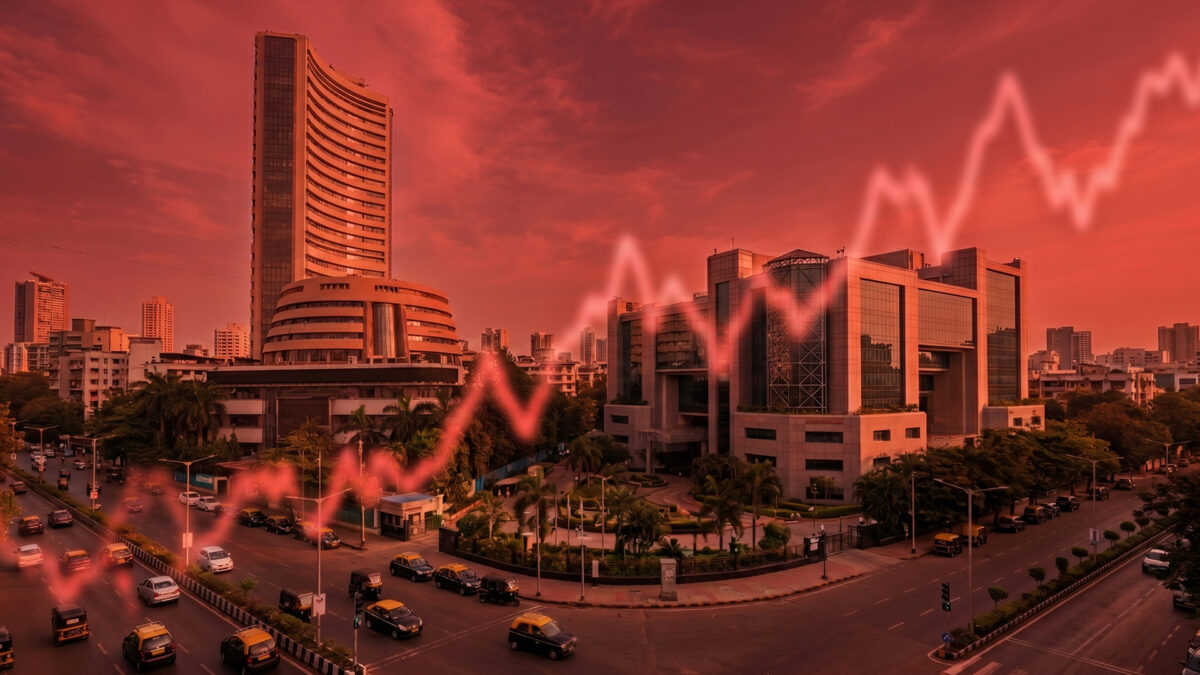
Indian equity markets ended lower on Friday as investors booked profits amid weak global cues and cautious sentiment ahead of key economic developments. Selling in heavyweight banking and information technology stocks dragged the benchmark indices lower, outweighing gains in select pharmaceutical shares.
The BSE Sensex declined 331 points, or 0.43%, to settle at 76,059, while the NSE Nifty 50 slipped 102 points, or 0.43%, to close at 23,767. The benchmarks traded in negative territory for most of the session as investors remained cautious amid mixed global signals and corporate earnings.
Among the top gainers on the Sensex were Cipla, Sun Pharma, Asian Paints and Nestle India, supported by buying in defensive sectors such as pharmaceuticals and consumer goods. These stocks attracted investor interest as markets turned risk-averse.
On the other hand, Infosys, HDFC Bank, ICICI Bank, Kotak Mahindra Bank and Axis Bank were among the biggest losers of the day. Selling in these heavyweight stocks put significant pressure on the benchmark indices and prevented any meaningful recovery during the session.
Market experts said profit booking after the recent rally, coupled with weak global sentiment, prompted investors to reduce exposure to large-cap stocks. Banking and IT shares witnessed the sharpest selling as traders turned cautious ahead of upcoming global economic data and further corporate earnings announcements.
Global markets also offered little support. Asian equities largely closed lower following mixed cues from Wall Street, while uncertainty surrounding global growth, trade developments and interest rate expectations kept investor sentiment subdued. Volatility in crude oil prices also added to market concerns.
Higher crude oil prices remain a key risk for India, as rising import costs can increase inflationary pressures and impact corporate margins. Investors therefore remained cautious despite strong domestic economic fundamentals.
The broader market mirrored the weakness seen in benchmark indices. Mid-cap and small-cap stocks also witnessed selling pressure, although declines were relatively contained in some sectors. Analysts noted that investors preferred quality large-cap stocks with strong earnings visibility while avoiding riskier bets.
Sector-wise, banking, financial services and information technology emerged as the biggest losers, while pharmaceutical and FMCG stocks outperformed the broader market. Defensive buying in healthcare shares helped limit the overall decline.
Foreign institutional investors (FIIs) continued to adopt a cautious stance amid global uncertainties, while domestic institutional investors provided selective support. Analysts believe institutional fund flows will remain an important driver of market direction in the coming weeks.
Investors are also closely tracking the ongoing corporate earnings season, with quarterly results expected to influence stock-specific movements. Strong earnings from select companies could help improve market sentiment, while weaker-than-expected numbers may keep volatility elevated.
The primary market, meanwhile, continues to remain active, with several large IPOs attracting healthy investor interest. Market participants believe robust participation in public issues reflects confidence in India’s long-term economic growth despite short-term fluctuations in secondary markets.
Analysts said Friday’s decline should be viewed as a normal market correction rather than a sign of weakening fundamentals. India’s economy continues to benefit from strong domestic consumption, steady infrastructure spending and improving corporate performance, which are expected to support equities over the long term.
Going forward, investors will monitor global market trends, crude oil prices, foreign fund flows, inflation data and central bank commentary for fresh cues. Corporate earnings and macroeconomic indicators are also expected to determine the near-term direction of the stock market.
Market participants will now turn their attention to upcoming corporate earnings, FII flows, global cues and crude oil prices for fresh direction. Analysts expect these factors to shape investor sentiment and determine whether the benchmark indices can regain momentum in the week ahead.