
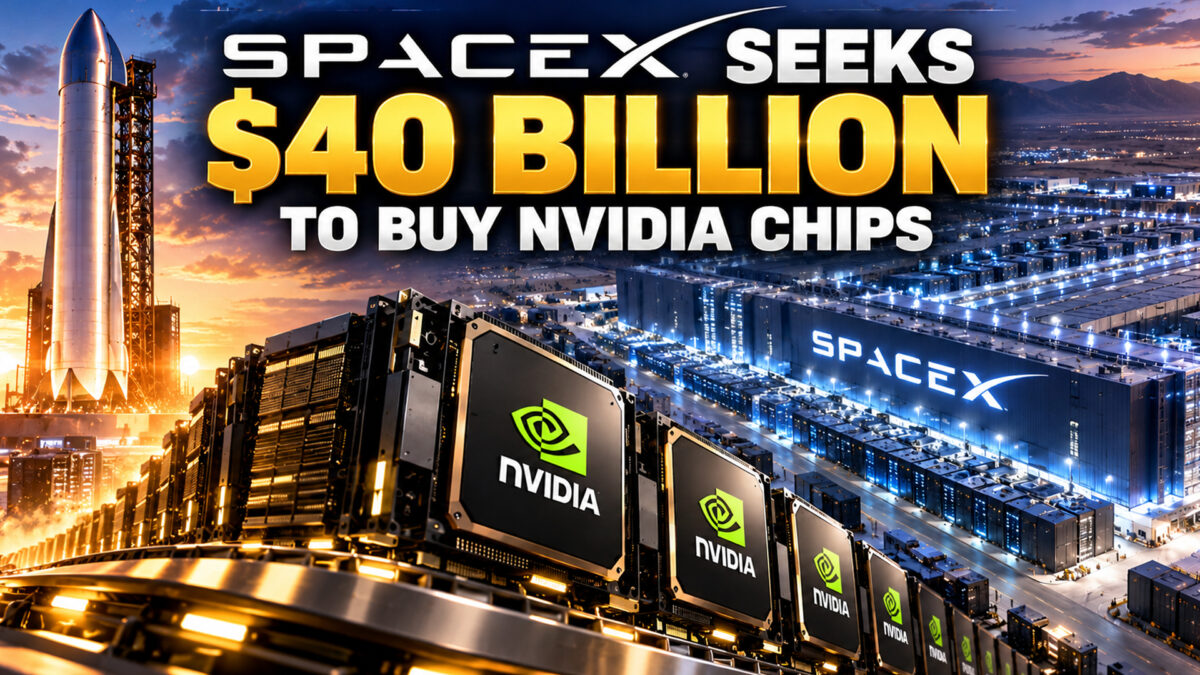
Elon Musk’s SpaceX is looking beyond rockets and satellites. The company is now preparing to spend tens of billions of dollars on artificial intelligence infrastructure, with plans to raise about $40 billion to buy Nvidia’s advanced AI chips.
SpaceX is in discussions with banks and asset managers to arrange the financing, according to people familiar with the matter. The proposed package is expected to include around $10 billion in bank loans and another $30 billion through investment-grade debt. Apollo Global Management is expected to lead the transaction and help place the debt with investors, while PIMCO is among the lenders that have been in talks. The deal is expected to close in 2027.
The size of the proposed financing highlights just how expensive the race to build AI computing capacity has become. Technology companies are spending heavily on Nvidia graphics processing units, data centres, power infrastructure and networking equipment as they compete for the computing resources needed to develop and run increasingly sophisticated AI systems.
SpaceX is positioning itself as a major player in that race.
Musk has said SpaceX intends to use Nvidia hardware exclusively for its data centres. He has also indicated that the Colossus 2 data centre operated by his AI venture xAI could more than double its Nvidia chip capacity by December.
The strategy marks a significant expansion of SpaceX’s role. The company is best known for its Falcon rockets, Starlink satellite network and increasingly ambitious space projects. Its growing focus on data centres suggests that computing power could become another major part of Musk’s technology empire.
The proposed $40 billion financing is expected to give SpaceX access to a large supply of Nvidia’s latest AI processors without requiring the company to fund the entire purchase from its own cash reserves.
The move also shows how the AI boom is increasingly being financed through debt markets. Morgan Stanley estimates that AI infrastructure could require about $1.5 trillion in external financing by 2028. Companies need enormous amounts of capital not only to purchase chips but also to construct data centres and secure the electricity and other infrastructure required to operate them.
Apollo’s expected role is particularly significant. The investment firm has been expanding its presence in technology financing and recently led a major chip financing transaction involving processors from Nvidia rival Broadcom.
Nvidia itself has also been working to bring more capital into the AI infrastructure ecosystem. In August, the chipmaker announced partnerships with major financial firms including Apollo, BlackRock, Blackstone, Brookfield, Goldman Sachs and KKR. Those financing platforms are intended to mobilise more than $500 billion for AI infrastructure projects.
The SpaceX transaction would therefore fit into a much larger shift in how the AI industry is being funded. Instead of relying only on technology companies’ balance sheets or traditional venture capital, increasingly large pools of institutional money are being directed towards the physical infrastructure behind AI.
SpaceX’s own financial position makes the borrowing plan notable. The company raised $86 billion through its initial public offering in June and subsequently sold $25 billion of high-grade bonds. Its decision to raise additional debt so soon reflects the enormous scale of its planned capital expenditure.
Investors, however, will also be watching the company’s borrowing closely. SpaceX’s bonds came under pressure after its earlier debt sale as concerns emerged about rising leverage and heavy spending. The new financing could add further scrutiny over how quickly the company is expanding its balance sheet.
The proposed purchase would be a major boost for Nvidia, which dominates the market for high-end AI processors. Musk has previously praised Nvidia’s latest architecture and said SpaceX had decided to build its AI infrastructure exclusively around Nvidia technology.
The deal could also deepen the relationship between Musk and Nvidia CEO Jensen Huang. Nvidia has financial ties to Musk’s wider AI ecosystem and has been positioning itself not simply as a chip supplier but as a participant in the financing and development of the broader AI infrastructure market.
SpaceX’s proposed borrowing ultimately reflects a simple reality: AI requires enormous amounts of computing power, and computing power requires enormous amounts of money.
Musk appears willing to make that bet at scale. If the financing goes ahead, SpaceX will be committing billions of dollars to Nvidia chips and data-centre infrastructure even as the company continues spending heavily on rockets, satellites and space technology.
The next phase of Musk’s technology ambitions may therefore be as much about machines on Earth as missions beyond it. SpaceX’s $40 billion chip financing plan shows how rapidly the boundaries between space technology, artificial intelligence and computing infrastructure are beginning to disappear.