
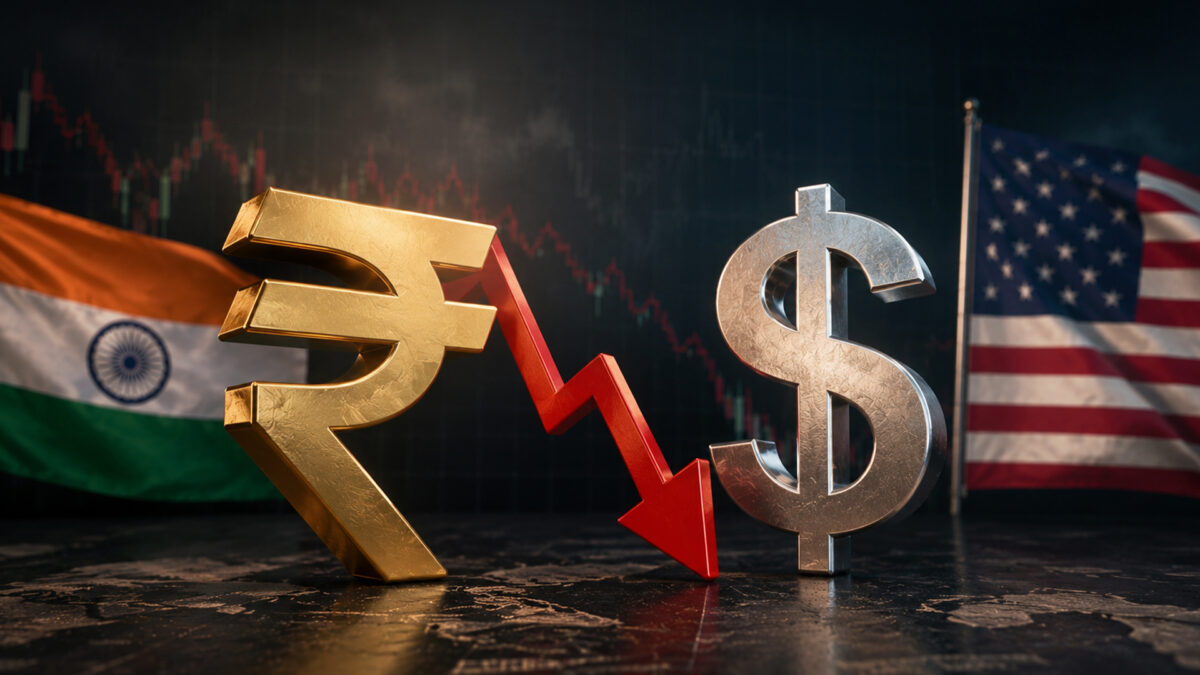
The Indian rupee weakened by 11 paise to 96.36 against the US dollar in early trade on Wednesday, extending its recent losses as global uncertainty, rising crude oil prices and a stronger US dollar continued to weigh on the domestic currency. Currency traders said the rupee remained under pressure as investors shifted towards safer assets amid escalating geopolitical tensions in West Asia.
The latest decline comes at a time when financial markets across the world are grappling with uncertainty over the conflict involving the United States and Iran. Concerns that the situation could disrupt global oil supplies pushed crude prices sharply higher, prompting investors to move away from riskier emerging-market assets and towards the US dollar, traditionally regarded as a safe-haven currency during periods of uncertainty.
One of the biggest reasons behind the rupee’s weakness is the sustained increase in Brent crude oil prices, which climbed above $92 per barrel. India imports nearly 85 per cent of its crude oil requirements, making higher oil prices a major concern for the economy. When crude prices rise, India has to spend more dollars on imports, increasing demand for the American currency and putting pressure on the rupee.
Higher crude prices also have wider economic implications. They increase transportation and manufacturing costs, push up inflation and widen the country’s current account deficit. These factors often reduce investor confidence and create additional pressure on the domestic currency.
Another factor weighing on the rupee is the strengthening of the US dollar index. Expectations that the US Federal Reserve may continue with a cautious approach on interest rates have supported the dollar against most global currencies. Higher US interest rates generally attract global capital into dollar-denominated assets, leading to outflows from emerging markets such as India.
Foreign institutional investors (FIIs) have also remained cautious amid volatile global conditions. Continued selling in Indian equities has increased demand for dollars, contributing to the rupee’s decline. At the same time, importers have stepped up dollar purchases to meet payment obligations, adding to pressure on the local currency.
The weakness in the rupee mirrored the mood in domestic equity markets. Benchmark indices Sensex and Nifty 50 traded sharply lower during the session as investors reacted to rising crude prices and geopolitical tensions. Market experts said global developments are currently having a greater influence on Indian financial markets than domestic factors.
Despite the decline, analysts believe India’s macroeconomic fundamentals remain relatively strong. Healthy foreign exchange reserves, robust economic growth and continued domestic demand are expected to provide some support to the rupee over the medium term. The Reserve Bank of India (RBI) is also closely monitoring currency movements and is expected to intervene whenever necessary to prevent excessive volatility.
A weaker rupee has mixed implications for the economy. Export-oriented sectors such as information technology, pharmaceuticals, textiles and engineering may benefit because their overseas earnings become more valuable when converted into Indian currency. However, industries dependent on imports—including oil marketing companies, airlines, automobile manufacturers and electronics firms—could face higher input costs, which may eventually be passed on to consumers.
Economists say the rupee’s near-term movement will depend largely on global developments. Investors are closely watching crude oil prices, geopolitical tensions, US economic data, Federal Reserve policy signals and foreign investment flows for fresh direction.
If tensions in West Asia ease and crude prices soften, the rupee could recover some of its recent losses. However, any further escalation in the conflict or a sustained rise in oil prices may keep the currency under pressure.
For ordinary Indians, a weaker rupee can make imported goods, overseas education and foreign travel more expensive. Businesses that rely on imported raw materials may also face higher costs. While exporters may gain in the short term, economists believe stability in the currency remains important for sustaining long-term economic growth.
Market participants expect the rupee to remain volatile over the coming days as global developments continue to dominate investor sentiment. Much will depend on how geopolitical tensions evolve and whether crude oil prices stabilise. Until then, currency traders are likely to remain cautious, with every major international development influencing the direction of the Indian rupee.
Also Read: Gold nears ₹145,000, Silver at ₹225,860