
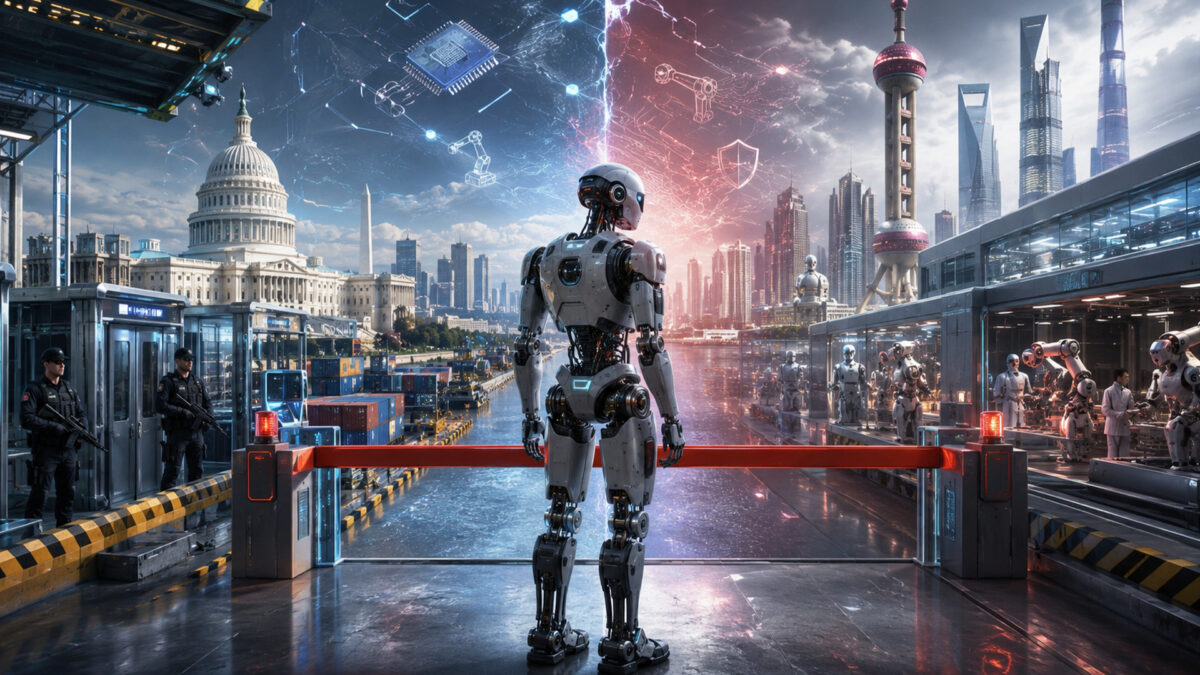
The United States has tightened its technology restrictions on China by blocking new imports of Chinese-made humanoid and four-legged robots, citing national security and cybersecurity risks. The move comes at a sensitive time for US-China relations, just weeks before Chinese President Xi Jinping is expected to meet US President Donald Trump in September.
The Federal Communications Commission (FCC) announced the restrictions on July 28, adding foreign-produced advanced robotic devices to its list of equipment considered a national security risk. The decision means new models of humanoid robots, quadruped robots and certain connected power inverters will face a major barrier to entering the US market.
The policy is particularly significant because China has built a commanding position in the global humanoid robot market. Chinese manufacturers are estimated to account for about 85% of the worldwide humanoid robotics market. The country has also rapidly increased production, lowered costs and expanded exports as companies race to commercialise robots that can work in factories, warehouses and other environments.
The FCC says the decision is not simply about trade competition. It argues that advanced robots can create cybersecurity and supply-chain risks because they combine cameras, sensors, wireless connectivity and sophisticated software. If compromised, such devices could potentially collect data, disrupt operations or become a pathway into connected networks.
The agency has also raised concerns about dependence on foreign manufacturing for technologies that could become important to US industry and national infrastructure. FCC Chairman Brendan Carr said the commission wanted to help secure America’s critical supply chains and reduce vulnerabilities linked to offshore production.
For ordinary consumers, the impact will not be immediate across every robot already sold in the United States. The restrictions are aimed mainly at new or previously unauthorised models. Robots that have already received the necessary US approvals are not simply being removed from the market because of the new decision.
That distinction matters for Chinese robotics companies that already have products in the US. Unitree Technology, one of China’s best-known robot makers, is among the companies most exposed to the policy. Its humanoid and quadruped robots have become popular because they are considerably cheaper than many competing platforms developed in the US.
Unitree is now facing the issue at an important moment. The company is preparing for a planned Shanghai STAR Market initial public offering, and it has warned investors that growing US restrictions could affect its overseas expansion. More than 40% of its revenue has come from international markets in the periods disclosed in its IPO filing, while the US has accounted for as much as 19.54% of sales.
The broader numbers show why the US decision could have an impact beyond one company. Around 15,000 humanoid robots were shipped worldwide in 2025, according to Omdia data cited by the Associated Press. Chinese companies Unitree and AGIBOT each shipped more than 5,000 units, while leading US companies such as Tesla and Figure AI shipped only a few hundred or fewer.
This gap has become an important part of the US-China technology race. Washington is increasingly concerned that Chinese companies could establish the same kind of cost and manufacturing advantage in robotics that they have built in areas such as electric vehicles, batteries and solar equipment.
For the United States, humanoid robots are no longer viewed simply as futuristic machines. They are increasingly linked to artificial intelligence, manufacturing and industrial automation. The idea is that robots powered by increasingly capable AI systems could eventually take on repetitive or physically demanding jobs, helping factories address labour shortages and increase productivity.
That is also why the restrictions are closely connected to America’s broader AI strategy. The Trump administration wants more strategic manufacturing and technology production to take place inside the United States. Officials have argued that allowing foreign companies to dominate key parts of the robotics supply chain could create vulnerabilities as the technology becomes more important.
China has strongly rejected the US action. Beijing has accused Washington of using national security as a justification for protectionism and targeting Chinese businesses. The Chinese government has warned that it will take necessary measures if US actions materially harm Chinese interests.
The timing makes the dispute even more politically sensitive. The robot restrictions were announced ahead of a planned September meeting between Trump and Xi. Technology, trade and supply-chain security are already major points of tension between the two countries, and the new robotics restrictions could add another issue to the agenda.
For China, the immediate US market may be important, but its enormous domestic market gives its robot makers room to continue scaling. Analysts cited by the Associated Press believe restricting access to the US is unlikely by itself to slow China’s overall humanoid robotics development significantly because Chinese manufacturers have a large home market and growing opportunities elsewhere.
The US-China technology rivalry is therefore moving into a new area. After years of disputes over semiconductors, artificial intelligence, electric vehicles and drones, humanoid robots are becoming another strategic battleground.