The Centre has received 20 bids from companies seeking to set up integrated rare earth permanent magnet manufacturing facilities in India, marking a major step in the government’s effort to build a domestic supply chain for a strategically important industrial component. Larsen & Toubro (L&T), Coal India and ReNew are among the prominent companies that have submitted bids under the ₹7,280-crore scheme.
The Ministry of Heavy Industries received the bids through a global tender floated on the Central Public Procurement portal. The technical bids were opened on Thursday, August 13, in the presence of participating companies. The bidding process is aimed at selecting manufacturers for integrated sintered NdFeB rare earth permanent magnets, which are widely used in modern energy, transport and technology industries.
Apart from L&T, Coal India and ReNew, the bidders include Attero Recycling, 20 Microns, Lohum Magnets & Energy Solutions, NEO Performance Materials of Singapore, Proterial India and Prozeal Green Energy. Other companies and consortia have also expressed interest, indicating that the government’s push to develop a domestic rare earth magnet industry has attracted participants from mining, metals, recycling, energy and advanced materials sectors.
The scheme seeks to create a total domestic manufacturing capacity of 6,000 metric tonnes per annum (MTPA). The capacity will be divided among five beneficiaries selected through a competitive bidding process. Each successful beneficiary can receive an allocation of up to 1,200 MTPA.
The Centre approved the scheme in November 2025 with a financial outlay of ₹7,280 crore. The Ministry of Heavy Industries subsequently issued the request for proposal in March 2026, inviting companies to establish integrated manufacturing facilities in the country. The deadline for submitting bids was August 12, with the technical bids opened a day later.
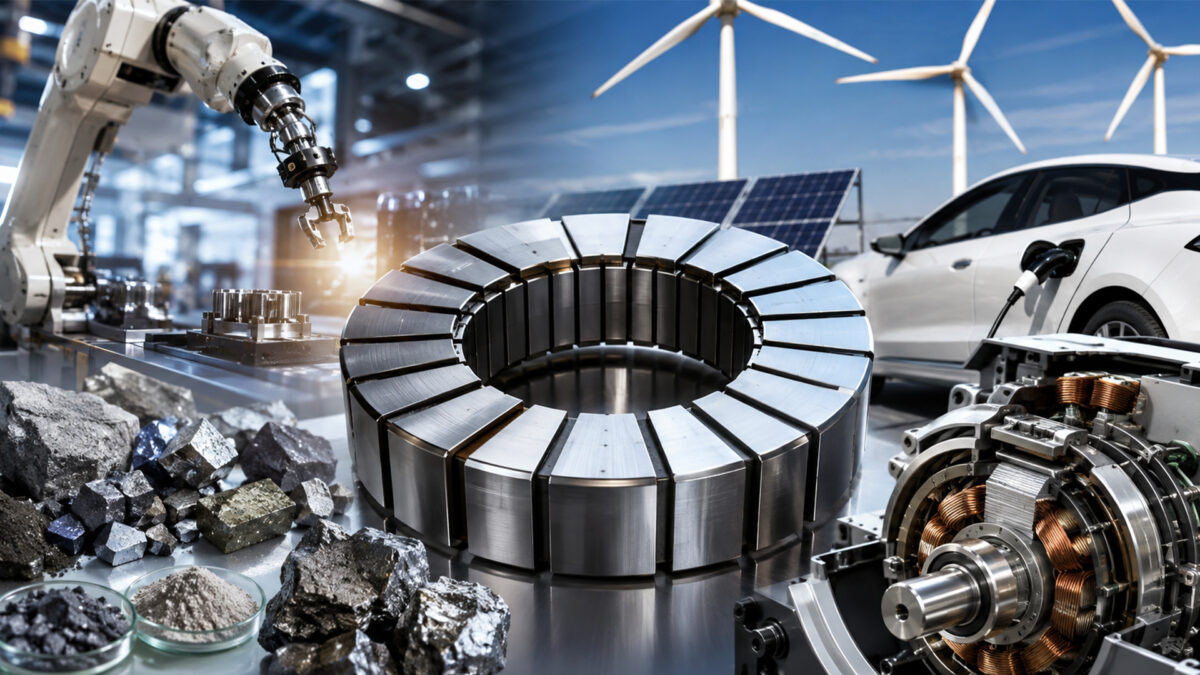
The initiative is aimed at addressing one of India’s key vulnerabilities in the critical minerals supply chain. Rare earth permanent magnets are essential components in products where powerful magnets are required in compact sizes. They are used in electric vehicles, wind turbines, electronics, industrial equipment, aerospace and defence applications.
These magnets are particularly important for traction motors. In renewable energy, they are used in generators for certain types of wind turbines. Their use also extends to consumer electronics, industrial automation, drones and other advanced technologies.
India currently depends significantly on imports for rare earth permanent magnets, making domestic production an important part of the government’s broader self-reliance and supply-chain diversification strategy. The scheme is designed not merely to assemble finished magnets but to develop an integrated manufacturing chain, beginning with neodymium-praseodymium (NdPr) oxide and extending to finished magnets.
Building this complete value chain is important because access to raw materials alone does not automatically translate into manufacturing capability. Processing rare earth elements into high-performance magnetic materials requires specialised technology, equipment and technical expertise. The government hopes the new facilities will help develop these capabilities within India and reduce exposure to overseas suppliers.
The programme will operate for seven years from the date of award. This includes a two-year period for setting up the manufacturing facilities, followed by five years during which incentives will be provided based on the sale of rare earth permanent magnets.
The government had earlier indicated that the scheme would combine capital support with sales-linked incentives to encourage companies to build capacity and achieve commercial-scale production. The objective is to make domestic manufacturing economically viable while creating an ecosystem that can eventually compete in global markets.
The strong response to the tender comes after significant interest was recorded even before the final bidding stage. More than 25 companies participated in a pre-bid conference in April, including JSW Group and NLC India, underlining the industry’s interest in the proposed rare earth manufacturing ecosystem.
The government has also been taking wider steps to strengthen India’s rare earth and critical minerals capabilities. In the Union Budget for 2026-27, it proposed dedicated rare earth corridors in Odisha, Kerala, Andhra Pradesh and Tamil Nadu to support processing and manufacturing. These initiatives are intended to connect India’s mineral resources with downstream industrial capacity.
The latest bidding process therefore represents more than an individual manufacturing programme. It forms part of a larger effort to strengthen India’s position in critical minerals, advanced manufacturing and clean-energy supply chains.
For companies such as L&T, Coal India and ReNew, participation also opens the possibility of entering or expanding in a sector expected to become increasingly important as electric mobility, renewable energy and advanced electronics grow.
The immediate next step will be evaluation of the technical bids, followed by the selection of up to five beneficiaries. Successful companies will then have to establish their integrated manufacturing facilities and meet the capacity and performance requirements under the scheme.
The government’s target is clear: create 6,000 MTPA of domestic sintered NdFeB magnet capacity and reduce India’s dependence on imported magnets. If the programme progresses as planned, it could provide a stronger domestic base for electric vehicles, renewable energy, electronics and defence while giving Indian manufacturers a larger role in a strategically important global supply chain.
The 20 bids received so far suggest that industry is willing to participate in that transition. The challenge now will be to turn the strong initial interest into commercially viable manufacturing capacity and a reliable rare earth supply chain in India.