
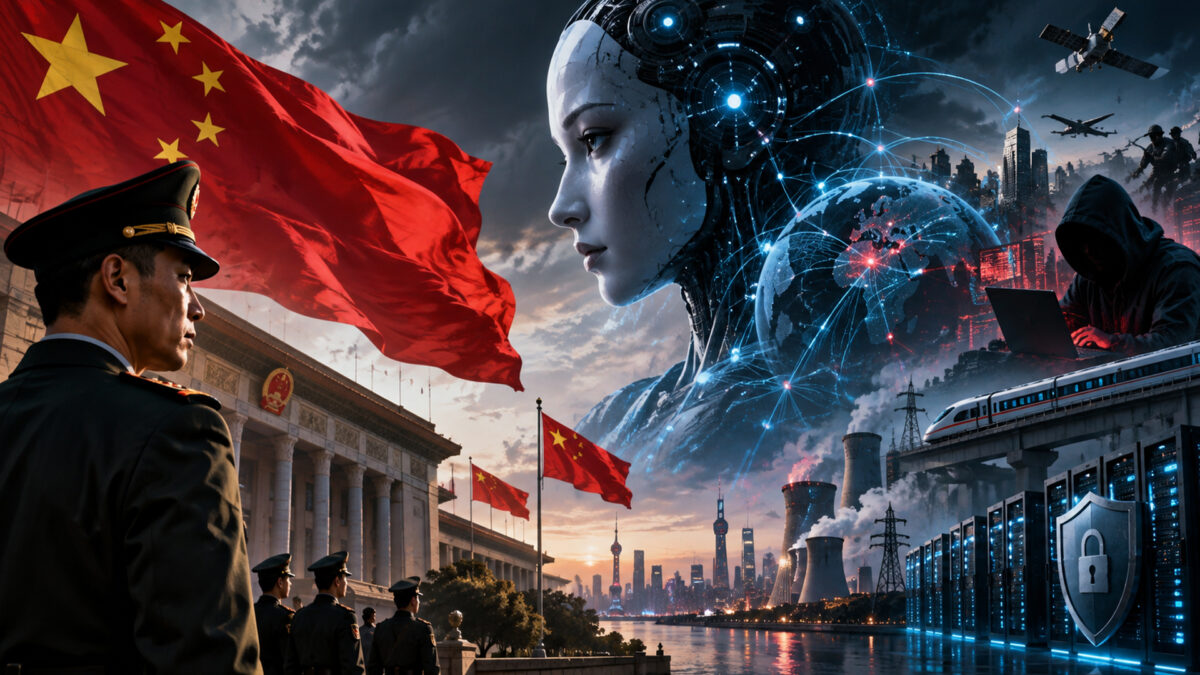
China’s top intelligence official has issued a strong warning about the national security risks posed by artificial intelligence, saying the rapidly developing technology could become a powerful tool for cyberattacks, disinformation and what he described as “cognitive warfare”.
Chen Yixin, China’s Minister of State Security, outlined the concerns in an article published in China Cyberspace, a journal linked to the country’s internet regulator. His comments represent one of Beijing’s clearest warnings yet about the dangers posed by advanced AI.
Chen said artificial intelligence has become a new arena for strategic competition between major powers. He warned that hostile groups could exploit generative AI to create and spread political rumours, manipulate public opinion and encourage social divisions on a much larger scale.
The concern goes beyond ordinary misinformation. Chen specifically pointed to AI-generated images, videos and audio, along with automated online accounts that can flood social media with misleading content.
Such tools could make it easier to create convincing deepfakes of political leaders or public figures. A fabricated speech or video, if widely circulated before it can be disproved, could create confusion and potentially trigger a political or social crisis.
Chen described these activities as a form of public opinion and cognitive warfare. He said they could directly affect China’s political, institutional and ideological security.
The warning comes as artificial intelligence becomes increasingly central to the global competition between China and the United States.
China has made AI a strategic priority and is investing heavily in advanced models, chips and computing infrastructure. At the same time, Beijing is trying to reduce its dependence on foreign technology, particularly advanced semiconductors needed to train powerful AI systems.
Chen said China must strengthen its ability to control key technologies and protect its technological independence.
Cybersecurity is another major concern highlighted by the intelligence chief.
Chen warned that advances in AI could lower the technical expertise and financial resources needed to launch sophisticated cyberattacks. Powerful AI systems could potentially help attackers identify weaknesses, write malicious code and target computer networks much faster.
That could put critical infrastructure at greater risk. Energy systems, financial networks, communications infrastructure and government databases could all become potential targets.
Chen specifically referred to advanced AI models developed by US companies, including systems from Anthropic and OpenAI. He warned that increasingly capable models could create serious risks for China’s critical information infrastructure.
The Chinese security ministry is also worried about sensitive information being collected and analysed with the help of AI.
Chen said foreign intelligence agencies could use automated web crawlers, data-mining systems and AI-powered profiling tools to gather information on national databases, business secrets and citizens’ personal information.
The concern reflects a broader issue surrounding the rapid growth of AI: the same technology that can improve productivity and research can also make surveillance, intelligence gathering and cyber operations more powerful.
AI is also changing the nature of modern warfare, according to Chen.
He warned that countries able to use AI for faster sensing, analysis and targeting could gain a major advantage on the battlefield. This has made AI warfare and military AI increasingly important parts of the competition between major powers.
The warning comes at a sensitive moment in US-China relations.
Washington and Beijing are expected to discuss AI governance and other issues as the two countries attempt to manage growing technological competition. US technology leaders have also been debating whether the development of increasingly powerful AI systems should be slowed or subjected to tighter safeguards.
Anthropic CEO Dario Amodei has recently called for a slower pace of development for advanced AI models. OpenAI CEO Sam Altman and other technology figures have also raised concerns about the risks associated with increasingly powerful systems.
Amodei has argued that maintaining a technological lead over China is important for US security. China, however, has rejected what it sees as attempts to use concerns about AI safety to restrict its technological development.
Chinese Foreign Ministry spokesperson Guo Jiakun said that “fearmongering, confrontation and vicious competition” would harm efforts to establish global AI governance.
Beijing has instead called for greater international cooperation on AI rules. Chen urged stronger safeguards and a more robust system of global AI governance while arguing that China must protect its own technological and security interests.
The contrast highlights the complicated position China occupies in the global AI debate. Beijing wants to become a leader in artificial intelligence while also warning about the technology’s potential dangers.
China’s leadership has increasingly linked AI with national development, economic competitiveness and military strength. At the same time, officials are becoming more vocal about the risks created by advanced AI systems.
The latest warning therefore reflects more than concern about deepfakes or online misinformation. It shows that Beijing increasingly sees artificial intelligence as both an economic opportunity and a national security challenge.
The biggest fear is that AI could make existing threats faster, cheaper and harder to detect. A single sophisticated system could potentially generate large volumes of false information, analyse huge amounts of sensitive data or assist cyberattacks at a scale that would have been difficult to achieve manually.
As China and the US compete for leadership in artificial intelligence, the technology is moving beyond the world of chatbots and productivity tools.
It is becoming part of the wider contest over cybersecurity, military power, information control and technological independence.