
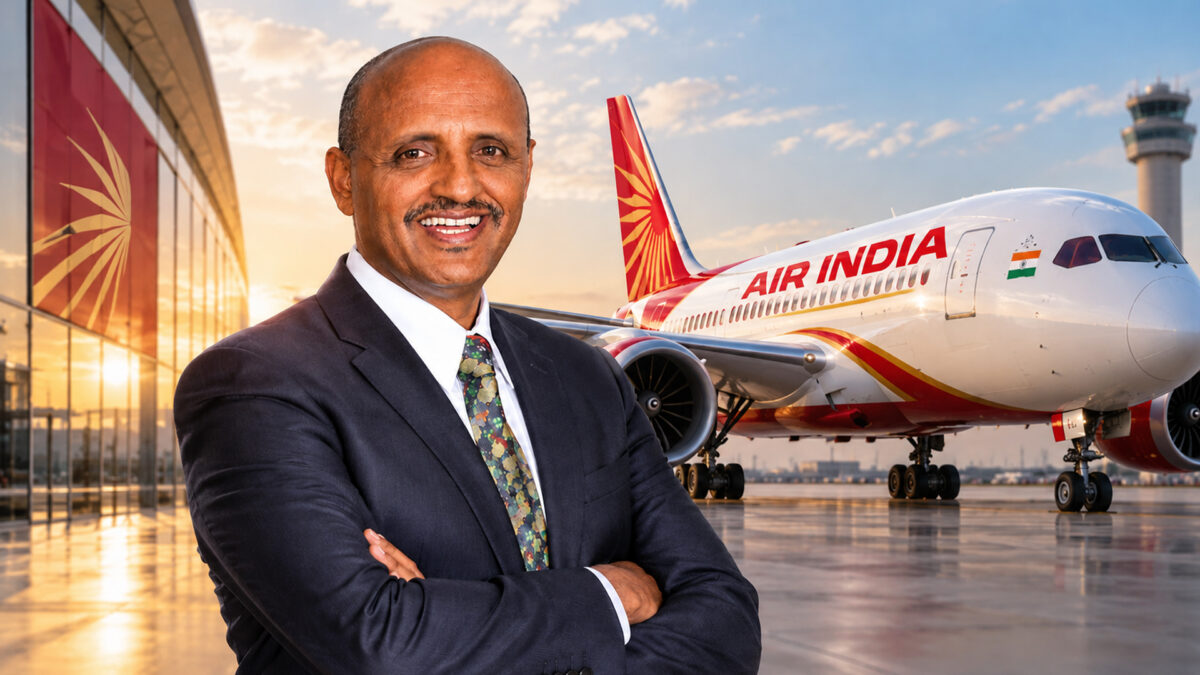
Tewolde Gebremariam has taken charge as the new chief executive officer and managing director of Air India, stepping into the top job at a critical point in the Tata Group-owned airline’s transformation.
The former Ethiopian Airlines chief succeeds Campbell Wilson, who led Air India through its return to the Tata Group, the merger with Vistara, fleet expansion and a major brand overhaul. Gebremariam now inherits an airline with ambitious growth plans but also mounting financial losses, operational challenges and heightened safety scrutiny.
His immediate focus is expected to be on making Air India’s everyday operations more reliable while strengthening safety and restoring passenger confidence. The new CEO has sought employee support as he begins the task of rebuilding the airline, with operational disruptions and service consistency likely to remain key priorities.
Safety is expected to be at the heart of his agenda. The June 2025 Air India Boeing 787 crash in Ahmedabad, which killed 260 people, brought intense scrutiny of the airline’s safety systems and operating procedures. Regulatory concerns and compliance issues have added to the pressure on the management to strengthen oversight and accountability.
Gebremariam brings nearly four decades of aviation experience to Air India. He joined Ethiopian Airlines in 1985 and eventually became its group CEO, a position he held for more than a decade. Under his leadership, the airline expanded its fleet, international network, passenger traffic and infrastructure, establishing itself as one of Africa’s leading carriers.
That experience will be closely watched as he takes on Air India’s much larger and more complex turnaround. The airline has placed orders for more than 500 aircraft and is seeking to build a stronger global network. Managing this expansion without worsening financial pressure will be one of his biggest challenges.
Air India’s financial performance remains a major concern. The Air India Group reported losses of more than $2 billion in the financial year ended March 2026. The airline has remained loss-making since the Tata Group took control in 2022, increasing pressure to improve revenues while keeping costs under control.
Several external factors have made the situation more difficult. Higher fuel costs, geopolitical tensions and restrictions on international airspace have affected flight operations and forced airlines to take longer routes. Air India has also reviewed parts of its international network and adjusted services in response to changing market conditions.
The airline is simultaneously undertaking a major fleet modernisation programme. Air India has begun introducing new aircraft while refurbishing older planes, but supply-chain constraints involving aircraft components, seats and other equipment have slowed some upgrades.
The success of the turnaround will be judged by more immediate issues. Punctual flights, smoother baggage handling, better communication during disruptions, cleaner aircraft and consistent service will be crucial in rebuilding Air India’s reputation.
The airline is also facing stronger competition as India’s aviation market expands. IndiGo remains a dominant domestic player, while international airlines continue to compete for India’s growing long-haul travel market. Air India’s ability to combine its extensive international ambitions with dependable operations will be crucial to its future position.
For Gebremariam, the challenge is to balance growth with stability. The airline cannot afford to lose sight of operational discipline while pursuing its ambitious fleet and network expansion.
His experience at Ethiopian Airlines gives him a strong background in building and managing a major carrier. But Air India presents a different set of challenges, from its financial losses and ageing aircraft to safety concerns and the expectations surrounding the Tata Group’s aviation ambitions.
The new CEO will also need to strengthen coordination across Air India’s wider group operations following the Vistara integration. Aligning employees, systems and service standards across the expanded airline will be important as the carrier seeks to create a more consistent experience for passengers.
The coming months will therefore be an important test of Gebremariam’s leadership. Investors, employees and passengers will be looking for visible improvements in reliability, safety and service, while the management will have to keep the airline’s long-term growth plans on track.
For Air India, the priority now is turning years of transformation plans into measurable results. Under its new CEO, the airline faces the difficult task of becoming not just a larger carrier, but a safer, more reliable and financially sustainable one.