
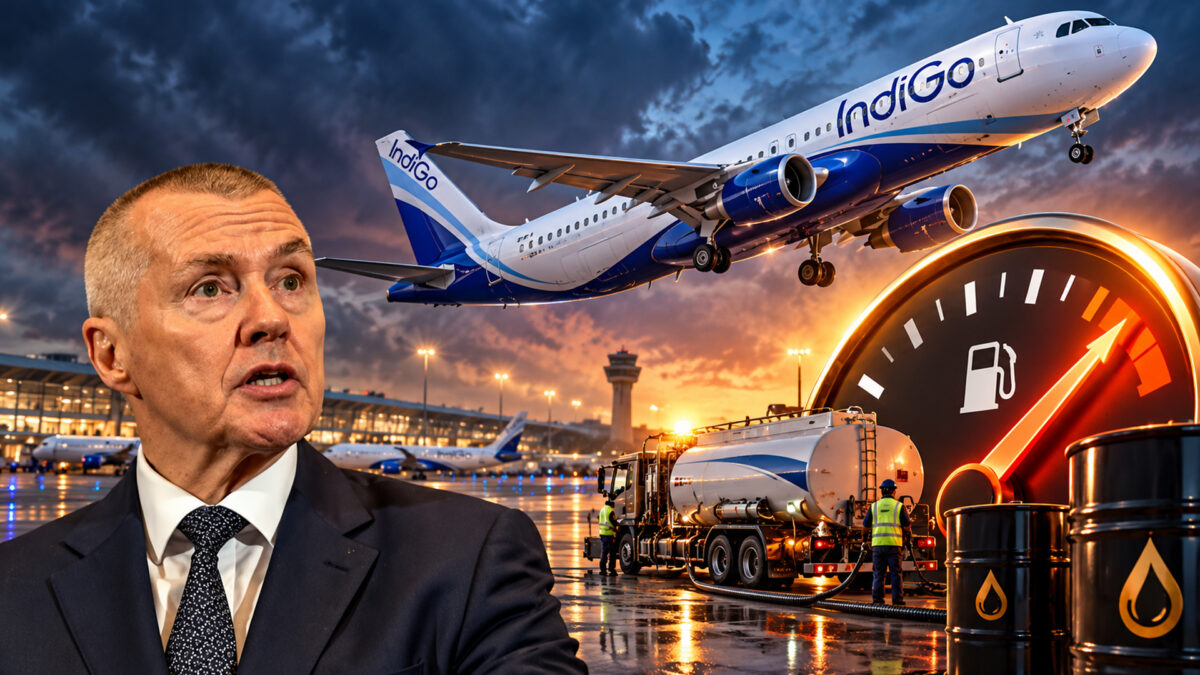
Airfares in India could remain under pressure as airlines struggle with record-high jet fuel prices, IndiGo chief executive Willie Walsh has warned. The airline is absorbing as much of the increase as possible, but rising operating costs may leave it with little choice but to pass some of the burden on to passengers.
Walsh made the remarks during his first in-person interaction with the media since taking charge as IndiGo CEO in August. Speaking in New Delhi on Monday, November 2, he described a difficult environment for airlines, with aviation turbine fuel (ATF), airport charges and taxes weighing on finances.
Fuel accounts for around 40 per cent of IndiGo’s operating costs, compared with roughly 32 per cent for the global airline industry. Walsh said jet fuel prices were at record levels and could remain elevated in the near term, even though crude oil prices were not at historic highs.
He pointed to the unusually wide gap between crude oil and refined jet fuel prices. This difference, known as the crack spread, has increased sharply. According to Walsh, its average level between 2000 and 2025 was about 22 per cent, but it has now climbed to around 65 per cent.
The increase reflects disruption to global refining capacity, particularly in Europe and the Middle East, restricting aviation fuel supplies. Walsh said crude oil production was beginning to recover, but jet fuel output had not risen at the same pace. This imbalance has kept fuel unusually expensive.
The pressure is visible in IndiGo’s financial results. Its fuel bill rose 67.2 per cent year-on-year to Rs 9,966.8 crore in the July-September quarter. Parent company InterGlobe Aviation reported a consolidated net loss of Rs 1,879.1 crore, lower than a year earlier. Revenue increased 26 per cent to Rs 23,364 crore.
Walsh said IndiGo had limited room for further significant cost reductions because it already operated with an efficient cost base. The airline has adjusted capacity and fares to soften the impact, but these steps have not fully offset higher fuel expenses.
Higher fares have affected demand. IndiGo carried 27.5 million passengers in the September quarter, down 4.7 per cent from a year earlier. Walsh said its average seat factor fell by around two percentage points. However, bookings for the December quarter remained robust and the outlook was positive.
He expects the impact of higher ticket prices on passenger demand to be temporary. Airlines, he said, must balance affordable fares with financial stability. IndiGo is absorbing a significant share of the higher fuel bill, but cannot shield passengers from every increase indefinitely.
Walsh also called for lower taxes and airport charges, arguing that these costs make India an expensive market for airlines. He said airports should offer more competitive pricing because they effectively function as monopolies. Lower levies, he added, would help the aviation market grow and support investment.
Fuel hedging is another issue under review. IndiGo has traditionally avoided locking in fuel prices through financial contracts. Walsh said the airline’s board had discussed the policy and that a comprehensive review would be undertaken. He stressed that hedging was about managing risk, not betting on future prices. No decision has been taken.
The airline is also dealing with operational challenges caused by geopolitical developments. Walsh said the continued closure of Pakistani airspace remained a concern for Indian carriers. IndiGo has reduced some services to Saudi Arabia amid the situation in West Asia, with passenger and crew safety remaining its priority.
Despite the immediate pressures, Walsh said IndiGo’s long-term growth plans were unchanged. The airline expects its first Airbus A350 wide-body aircraft in the second half of 2028, supporting expansion of long-haul international services and its premium offering. It is also assessing opportunities at Navi Mumbai International Airport.
IndiGo is also expanding its longer-range narrow-body network, with four A321XLR aircraft in operation and plans to increase the number to seven by March 2027 for international routes.
Walsh said IndiGo continued to see significant opportunities in India and would focus on maintaining a competitive cost base. The airline currently operates more than 2,100 flights a day and has a fleet of over 400 aircraft.
For passengers, the immediate concern is whether higher fuel expenses will translate into more expensive tickets. Walsh’s comments suggest further fare increases remain possible if costs stay elevated. The airline hopes refining supply will improve and fuel premiums will ease, but there is no clear indication of when relief will arrive. Until then, carriers must balance ticket prices, passenger demand and financial performance.