
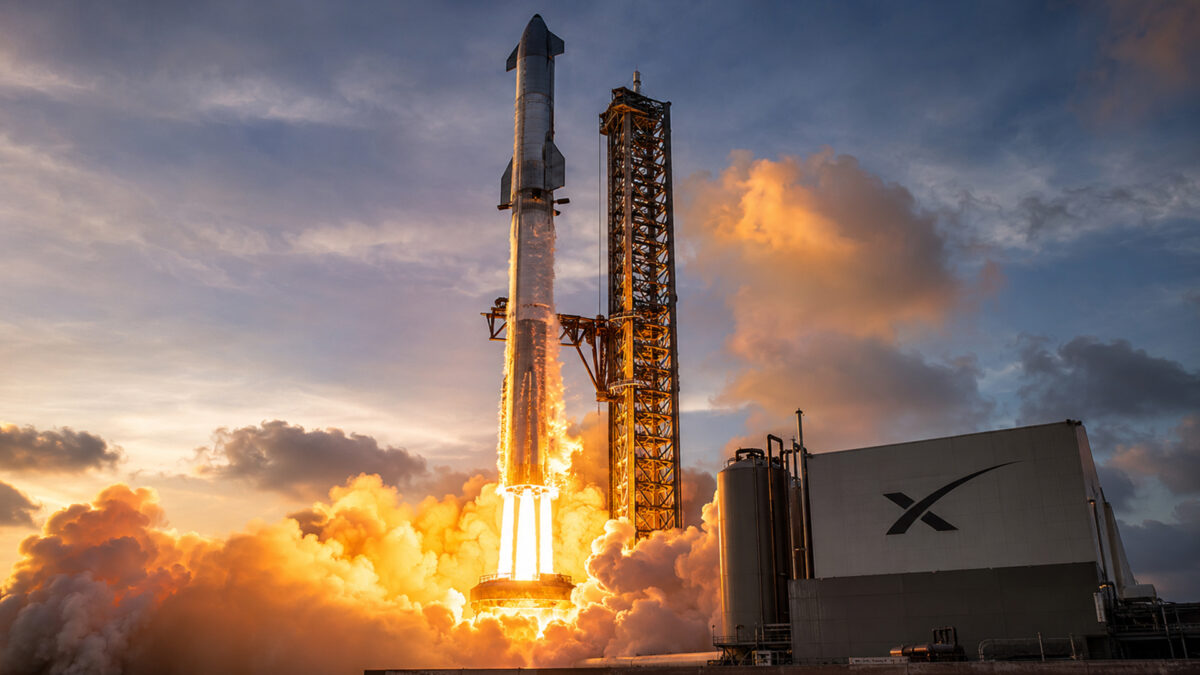
SpaceX has moved a step closer to achieving fully reusable spaceflight after its 13th Starship test flight successfully completed several key mission objectives, including deploying next-generation Starlink satellites and making a controlled splashdown. Encouraged by the mission’s outcome, the company is now preparing for an even bigger milestone, attempting to catch the Starship spacecraft with the launch tower’s mechanical arms on its next test flight.
The latest mission marked one of the strongest performances in the Starship programme so far, giving engineers valuable data on the rocket’s systems, heat shield and overall flight performance. While some technical challenges remain, the successful test has strengthened confidence that SpaceX is making steady progress towards building a fully reusable launch system for future Moon and Mars missions.
Starship lifted off from SpaceX’s Starbase facility in Texas atop the Super Heavy booster, powered by 33 Raptor engines. After a smooth launch and stage separation, the upper-stage spacecraft continued into space, carrying 20 next-generation Starlink satellites. These satellites are designed to enhance SpaceX’s satellite internet network with greater capacity and faster connectivity.
Although the satellites were intentionally placed on a suborbital trajectory and burned up during re-entry, the mission allowed engineers to collect crucial performance data. The flight also successfully demonstrated an in-space restart of a Raptor engine, an important capability needed for future orbital operations, satellite deployments and deep-space missions.
One of the biggest achievements came during Starship’s return to Earth. The spacecraft survived atmospheric re-entry and completed a controlled splashdown in the Indian Ocean while remaining largely intact. Engineers were able to inspect the vehicle after landing, providing a rare opportunity to study the condition of its heat shield and thermal protection system following the intense heat of re-entry.
The intact splashdown is considered a major engineering milestone because it offers valuable insight into the performance of Starship’s more than 18,000 heat-shield tiles. Improving these tiles is critical to making the spacecraft reusable with minimal repairs between flights.
The mission was not entirely flawless. The Super Heavy booster failed to complete its planned landing after some engines did not restart during the final descent, causing it to fall into the Gulf of Mexico. Even so, SpaceX said the booster showed encouraging progress and generated important data that will help improve future recovery attempts.
Following the successful mission, SpaceX founder Elon Musk said the company is considering an ambitious new objective for the next Starship flight. If post-flight inspections reveal no major issues, SpaceX plans to attempt a “tower catch” of the Starship spacecraft using the giant mechanical arms at the launch site.
The company has already demonstrated this technique with the Super Heavy booster, but catching the Starship upper stage would be far more challenging because it returns from space at much higher speeds and temperatures. A successful catch would eliminate the need for ocean landings and significantly speed up rocket reuse.
Starship is central to SpaceX’s long-term vision of dramatically reducing the cost of space travel. The fully reusable rocket is expected to launch larger batches of Starlink satellites, support NASA’s Artemis programme to return astronauts to the Moon, and eventually carry humans and cargo to Mars.
NASA is relying on a modified version of Starship as the lunar lander for future Artemis missions. Before those missions can take place, however, SpaceX must continue demonstrating safe launches, controlled re-entries, orbital refuelling and reliable recoveries.
With Flight 13 delivering successful satellite deployment, an in-space engine relight and an intact splashdown, SpaceX has checked off several major milestones. The company now hopes the next mission will bring it even closer to routine, rapid rocket reusability with its first-ever tower catch of the Starship spacecraft itself.