
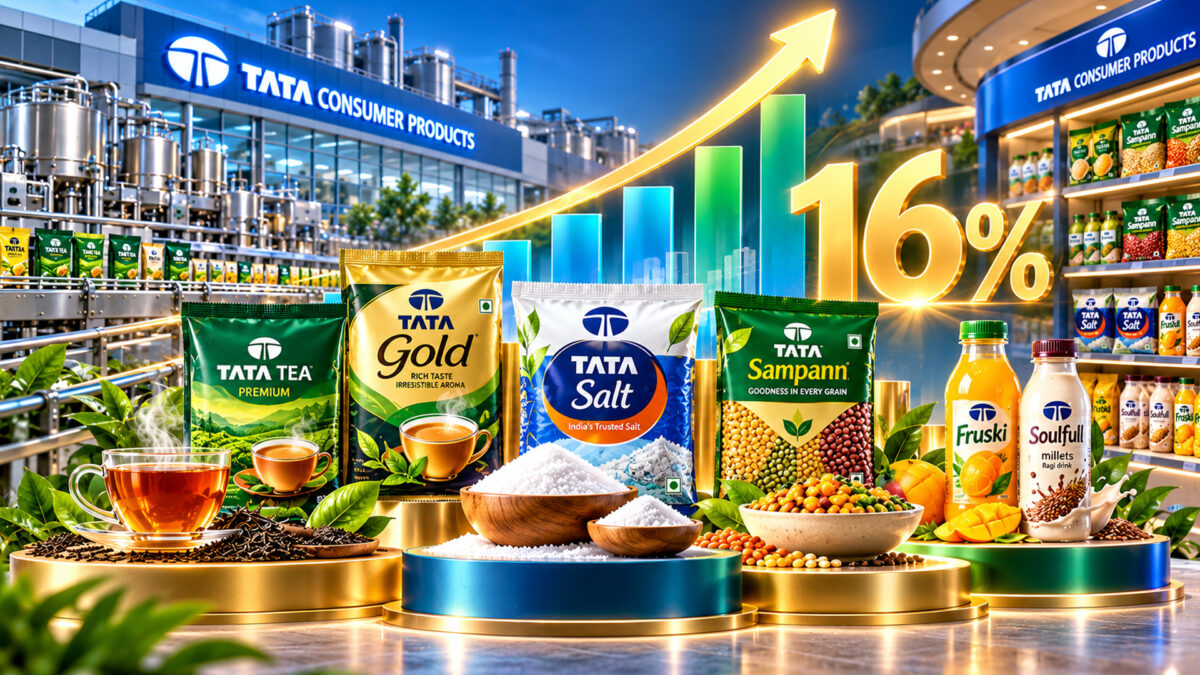
Tata Consumer Products shares surged more than 6% on Tuesday, October 27, after the company reported a 16.2% year-on-year rise in consolidated net profit for the September quarter of FY27. Strong revenue growth, healthy sales volumes and an encouraging performance from its newer product categories lifted investor sentiment, even as brokerages flagged concerns over rising commodity costs and pressure on domestic margins.
The stock rose to ₹994.85 on the National Stock Exchange during early trade, against its previous close of ₹936.50. The rally came after the Tata Group’s fast-moving consumer goods (FMCG) company announced its quarterly results on Monday, October 26. Analysts largely retained positive ratings on the stock, although several reduced their target prices to reflect near-term challenges.
Tata Consumer reported consolidated net profit attributable to shareholders of ₹469.3 crore, compared with ₹404.46 crore in the corresponding quarter last year. Revenue from operations increased 14% to ₹5,661 crore from ₹4,966 crore, exceeding market expectations of approximately ₹5,583 crore.
The results indicate that the company continues to expand its business despite inflationary pressures affecting key raw materials such as tea and salt. However, sustaining profitability and delivering the expected improvement in margins will remain important factors for investors.
Tata Consumer’s India business remained a key driver of growth during the quarter. Revenue from the India business increased 17% year-on-year to approximately ₹3,666 crore, while underlying volume growth in its branded business reached 11%.
Volume growth is particularly important for FMCG companies because it indicates that consumers are purchasing more products, rather than sales rising solely because of price increases.
The company’s established brands continued to contribute to performance. Salt revenue rose 15%, supported by volume growth and pricing measures. Its Tata Sampann portfolio, which includes pulses, spices and other packaged food products, recorded a 57% increase in revenue.
The ready-to-drink beverage business also performed strongly, with revenue rising 47%. These categories are becoming increasingly important as Tata Consumer expands beyond its traditional tea and salt businesses.
Overall, the company’s growth businesses recorded approximately 40% growth and accounted for around 38% of its India business. The portfolio includes Capital Foods, Organic India, Tata Sampann and other newer product categories.
The expansion of these businesses could help diversify revenue and reduce dependence on traditional product segments over time.
The company’s consolidated earnings before interest, taxes, depreciation and amortisation (EBITDA) rose to approximately ₹783 crore, an increase of 16.6% from the year-ago period. The EBITDA margin improved to 13.8% from 13.5%.
Although the improvement was encouraging, profitability remains sensitive to changes in input costs. Tea prices and other commodity expenses have put pressure on the India business, while subdued tea consumption has limited growth in the category.
Management has maintained its FY27 guidance for EBITDA margin expansion of 50–70 basis points, equivalent to 0.5–0.7 percentage points. Price increases implemented across selected categories are expected to support margins as their full benefits flow through in the coming quarters.
Investors will watch whether the company can balance higher prices with continued demand. If consumers reduce purchases in response to price increases, the expected margin recovery could take longer.
Brokerages remained broadly positive following the quarterly results, citing the company’s volume growth, expansion in newer categories and potential for margin recovery. However, their target price revisions reflect caution over commodity inflation and uncertainty surrounding the pace of improvement in domestic profitability.
Jefferies retained its Buy rating on Tata Consumer Products but reduced its target price to ₹1,250 from ₹1,450. The brokerage highlighted the company’s 11% underlying volume growth in its India branded business and the contribution of newer categories.
Jefferies also identified the expansion of quick-commerce platforms as a potential growth driver. Faster delivery services can help consumer brands reach urban customers more frequently, particularly in categories such as packaged foods, beverages and household essentials.
Citi maintained its Buy rating while cutting its target price to ₹1,225 from ₹1,400. The brokerage expects margins to recover gradually as pricing measures take effect and international and non-branded businesses continue to contribute.
Goldman Sachs also retained its Buy rating, lowering its target price to ₹1,325 from ₹1,440. It pointed to strong volume growth and improving operating performance despite a challenging cost environment.
JM Financial maintained its Add rating but reduced its target price to ₹1,065 from ₹1,225, citing margin uncertainty and broader valuation pressures in the FMCG sector.
The differing target prices underline that brokerages remain optimistic about the company’s longer-term prospects but have varying expectations about how quickly earnings and margins can improve.
Tata Consumer’s international operations recorded 7% revenue growth, although performance was weaker after adjusting for currency movements. Conditions in overseas tea markets remained challenging, including subdued consumption in the United Kingdom.
Tata Starbucks delivered stronger results, with revenue increasing 15%. The joint venture operated 505 stores across 81 Indian cities at the end of the quarter, reflecting its continuing expansion in the organised coffee market.
Capital Foods and Organic India together reported 15% revenue growth. Export shipping disruptions affected their performance, but domestic revenue from the businesses increased 24%.
These operations provide additional growth opportunities as Tata Consumer builds a broader portfolio of packaged foods, beverages and wellness products.
Tata Consumer’s latest results have strengthened confidence in its revenue growth and business diversification. Nevertheless, the next few quarters will be crucial in determining whether price increases and a stronger product mix can deliver sustainable margin improvement.
The stock’s sharp rally reflects positive investor sentiment, but brokerage target prices remain estimates rather than guaranteed outcomes. Investors will need to assess valuations, commodity prices, demand trends and execution before making decisions.