
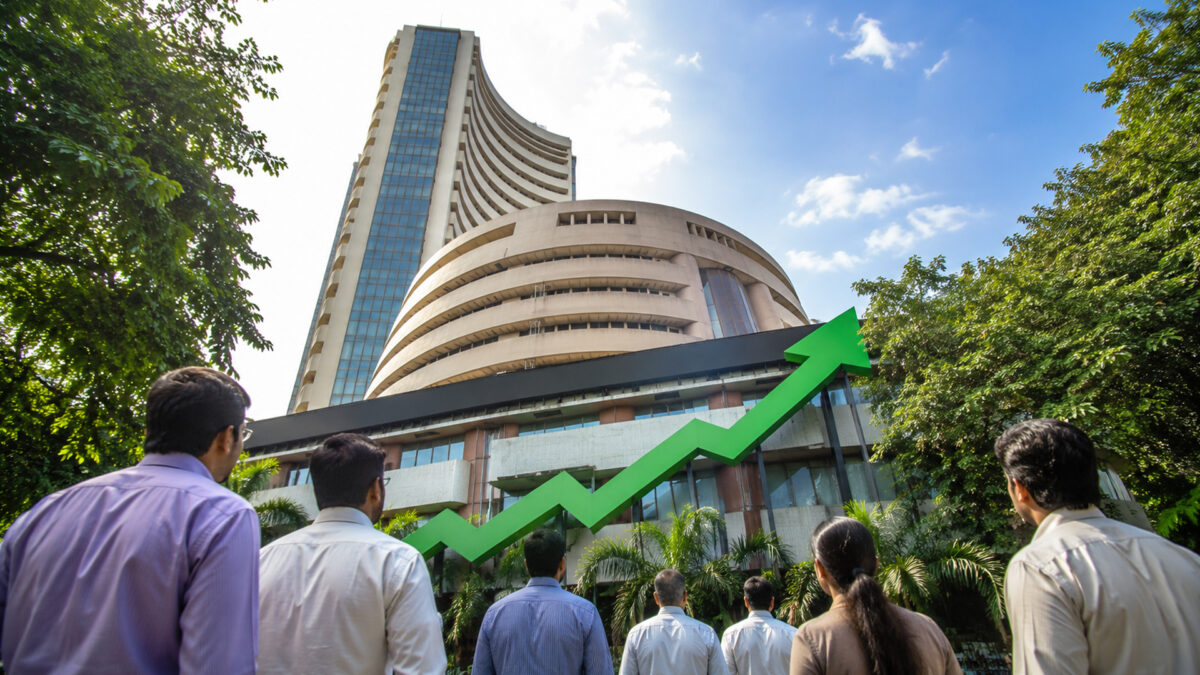
Stock market staged a recovery on Thursday, November 19, after opening on a weak note, as buying interest in automobile and banking shares helped benchmark indices regain ground. Earlier today, the 30-share BSE Sensex had advanced nearly 150 points to 82,180, while the NSE Nifty 50 gained close to 50 points to move above 25,250. The recovery followed an early decline in which the Sensex dropped 206.12 points to 81,837.27 and the Nifty slipped 78.10 points to 25,145.70.
The turnaround reflected renewed buying in select heavyweight stocks, particularly in the automobile sector. Maruti Suzuki emerged as the strongest performer among Sensex constituents, rising more than 5 per cent. Mahindra & Mahindra followed with gains of around 4 per cent. Hindustan Unilever, Bajaj Finserv, Bharat Electronics, IndiGo, Tata Steel, State Bank of India, Sun Pharmaceutical Industries, Bharti Airtel and Power Grid also traded higher, advancing by up to 2 per cent.
However, the recovery was not broad-based across all sectors. Information technology stocks remained under pressure, with Infosys, Tech Mahindra, HCL Technologies and Tata Consultancy Services among the major losers on the benchmark indices. These stocks declined by as much as 3 per cent, reflecting concerns over the outlook for technology spending and the impact of interest rate expectations in the United States.
The sectoral performance highlighted the difference in investor sentiment. The Nifty Auto index surged more than 3 per cent, emerging as the leading sectoral performer. Nifty Consumer Durables and Nifty PSU Bank also recorded gains of around 2 per cent each. In contrast, the Nifty IT index declined more than 2 per cent, making it the weakest among the major sectoral indices.
Market breadth improved as the session progressed. On the National Stock Exchange, 1,712 stocks were advancing, compared with 1,547 declining stocks, while 96 remained unchanged. The positive breadth indicated that buying interest was gradually spreading beyond a handful of heavyweight shares.
The recovery followed a difficult session on Wednesday, when investors booked profits after the strong rally seen in the Indian equity market during November. The Sensex had fallen 500.38 points, or 0.61 per cent, to close at 82,031.81, while the Nifty declined 159.45 points, or 0.63 per cent, to settle at 25,227.95. Metal stocks faced particularly strong selling pressure, contributing to the decline.
Despite the recent volatility, market analysts believe the broader upward trend remains intact. VK Vijayakumar, Chief Investment Strategist at Geojit Investments, described the previous session’s correction as an overdue adjustment following a rapid market advance. He noted that profit booking after a sharp rally was not necessarily a sign of a weakening market and could help establish a healthier foundation for the next phase of growth.
One of the important factors supporting this optimism is the return of foreign institutional investors (FIIs). According to market commentary, foreign institutional inflows had reached a record Rs 94,299 crore during November up to the reporting period. FIIs also purchased equities worth Rs 5,866.78 crore on Wednesday, according to exchange data.
Analysts believe sustained foreign investment, combined with improving corporate earnings, could provide further support to domestic equities. The stronger rupee has also contributed to the positive outlook. The Indian currency appreciated from a low of Rs 96.96 against the US dollar to around Rs 93.44, easing some concerns over currency-related pressures and improving the investment environment.
Another emerging trend is the gradual adjustment in stock valuations. According to Vijayakumar, large-cap stocks that were relatively undervalued have started catching up, while valuations in parts of the broader market are becoming more reasonable. This shift could create opportunities for investors who are looking beyond short-term market movements.
However, technical indicators suggest that the market may continue to experience fluctuations before establishing a clear direction. Anand James, Chief Market Strategist at Geojit Investments, pointed to 25,054 as an important downside level for the Nifty. He expects the index to witness movements on either side of 25,140 in the near term.
A sustained recovery above 25,400 would be important for strengthening bullish sentiment. However, failure to reclaim this level could expose the market to further weakness, with potential downside targets at 24,840 and 24,800.
Global developments are also likely to influence the direction of Indian equities. Asian markets remained largely weak on Thursday, with South Korea’s Kospi, Shanghai’s SSE Composite and Hong Kong’s Hang Seng trading lower, while Japan’s Nikkei 225 moved higher. On Wall Street, the Dow Jones Industrial Average declined 1.11 per cent on Wednesday, while the S&P 500 fell 0.23 per cent. The Nasdaq Composite, however, ended 0.42 per cent higher.
Concerns surrounding the US Federal Reserve’s monetary policy added another layer of uncertainty. Minutes from the Fed’s October meeting reinforced expectations that further interest rate increases could be necessary to contain inflation. The possibility of higher borrowing costs in the world’s largest economy has weighed on investor appetite for riskier assets, including equities in emerging markets.
Crude oil prices also remained in focus. Brent crude traded around $91.91 per barrel during early trade, with analysts suggesting that softer oil prices could offer some support to Indian markets. As a major oil importer, India remains vulnerable to higher crude prices, which can increase inflationary pressures and widen the country’s import bill.