
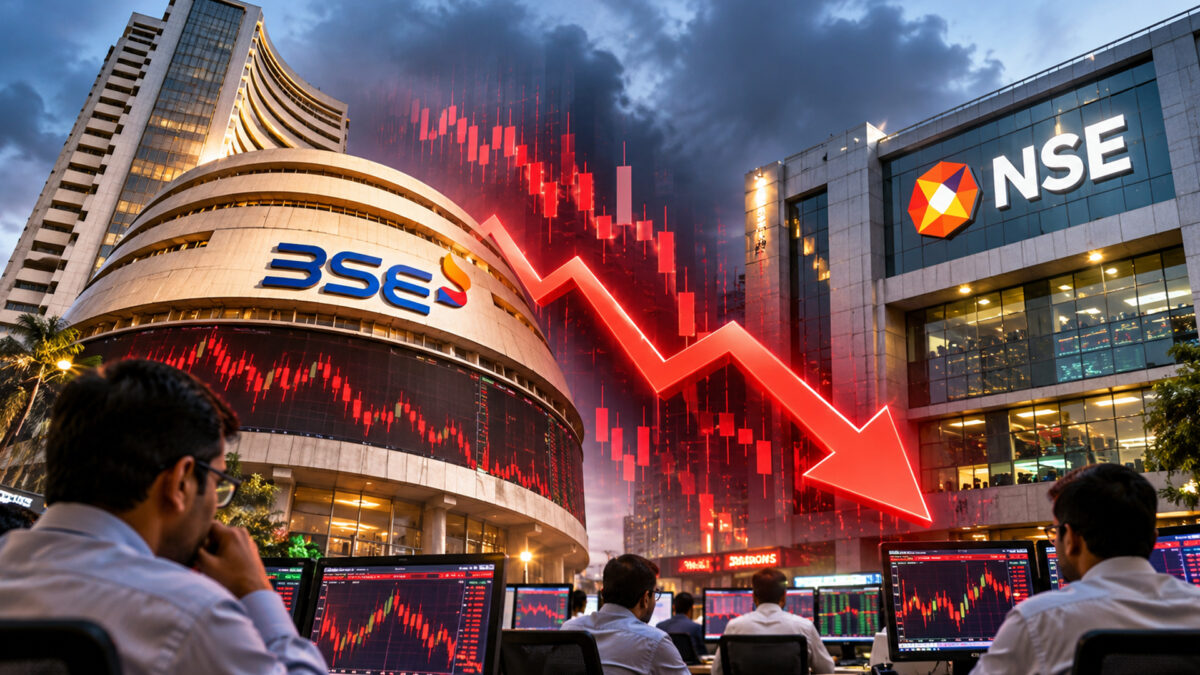
Indian equity markets ended Wednesday’s trading session on a weak note, with the Sensex falling nearly 500 points and the Nifty slipping below 25,250. Heavy selling in consumer durables, metal, automobile and information technology stocks weighed on investor sentiment, while profit-booking following the recent rally added to the pressure. The decline came after both benchmark indices had witnessed a recovery in recent sessions, encouraging investors to book profits at higher levels.
Titan Company was the biggest loser among Sensex constituents, tumbling 4.82%. Eternal fell 2.51%, while Bajaj Finance declined 2.45%. Tata Consultancy Services (TCS) shed 2.13%, and Infosys lost 1.86%. Asian Paints, Mahindra & Mahindra and Tata Steel were among the other stocks that ended in the red.
On the Nifty50, Titan Company, Hindalco Industries and HDFC Life Insurance were among the biggest laggards. The weakness in these stocks reflected selling across multiple sectors, with investors reducing exposure to several heavyweight companies.
The decline was not uniform, however. State Bank of India (SBI) emerged as the biggest Sensex gainer, advancing 2.34%. ITC climbed 1.60%, while UltraTech Cement added 0.87%. Sun Pharmaceutical Industries and Power Grid Corporation also managed to finish the session higher, providing limited support to the benchmark index.
Sectoral indices reflected the cautious mood. The Nifty Consumer Durables index recorded the steepest decline, falling 3.08%. The Nifty Metal index dropped 2.46%, while the Nifty Auto and Nifty IT indices declined 1.35% and 1.24%, respectively. The weakness in these segments indicated that investors were booking profits across both cyclical and technology-related stocks.
Broader markets also remained under pressure. The Nifty MidCap 100 declined 1.22%, while the Nifty SmallCap 100 slipped around 0.35%. The relatively sharper fall in mid-cap stocks suggested that investors were becoming more cautious about higher-risk segments of the equity market. Meanwhile, the India VIX, which measures expected market volatility, edged up 0.04% to 15.53.
The benchmark indices began the session with losses and struggled to recover throughout the day. The Sensex opened around 140 points lower, while the Nifty started approximately 30 points below its previous close. Selling gathered momentum as the session progressed, leaving both indices firmly in negative territory by the closing bell.
Profit-booking after the recent market recovery was one of the key reasons behind Wednesday’s decline. Benchmark indices had advanced to nine-month highs, prompting investors to lock in gains in stocks that had witnessed substantial appreciation. With valuations remaining elevated in certain segments, the latest correction reflected a degree of caution among market participants.
Global developments also remained central to investment decisions. Continuing tensions between the United States and Iran have raised concerns about potential disruptions to energy supplies and international shipping routes. The Strait of Hormuz, a critical passage for global oil and gas transportation, remains particularly important in this context. Any prolonged disruption could affect crude supplies, increase transportation costs and add pressure to economies dependent on energy imports.
Crude oil prices continued to attract attention amid these geopolitical concerns. Brent crude was hovering near $93 a barrel, while West Texas Intermediate (WTI) was trading around $85. At the same time, an increase in US crude and gasoline inventories raised questions about near-term demand. The conflicting signals from supply data and geopolitical developments have kept energy markets volatile.
For India, movements in crude oil prices are particularly important because the country depends heavily on imported energy. A sustained rise in oil prices could increase the import bill, put pressure on the rupee and complicate inflation management. Higher energy costs could also affect corporate margins, particularly in sectors with significant fuel and transportation expenses.
Investors are additionally monitoring the US Federal Reserve’s interest-rate outlook. Uncertainty over the timing of future rate cuts, movements in US Treasury yields and dollar strength could influence foreign investment flows into emerging markets. Any shift in global liquidity conditions is likely to remain an important factor for Indian equities.
Despite the latest correction, market participants have not entirely abandoned their positive longer-term outlook. Domestic consumption, corporate earnings and investment in infrastructure and manufacturing continue to provide support to the Indian economy. However, the near-term direction of equities is expected to depend on earnings performance, global developments and institutional investment activity.
Investors are likely to remain selective, focusing on companies with consistent earnings growth, manageable debt and reasonable valuations. Banking, pharmaceuticals, information technology, capital goods and manufacturing stocks will remain among the sectors in focus as markets assess opportunities following the recent volatility.
The immediate attention will be on whether the Nifty can regain the 25,250 level and whether the Sensex finds support after Wednesday’s decline. Developments in crude oil prices, US-Iran tensions and foreign portfolio investment flows are likely to influence trading sentiment in the coming sessions.