
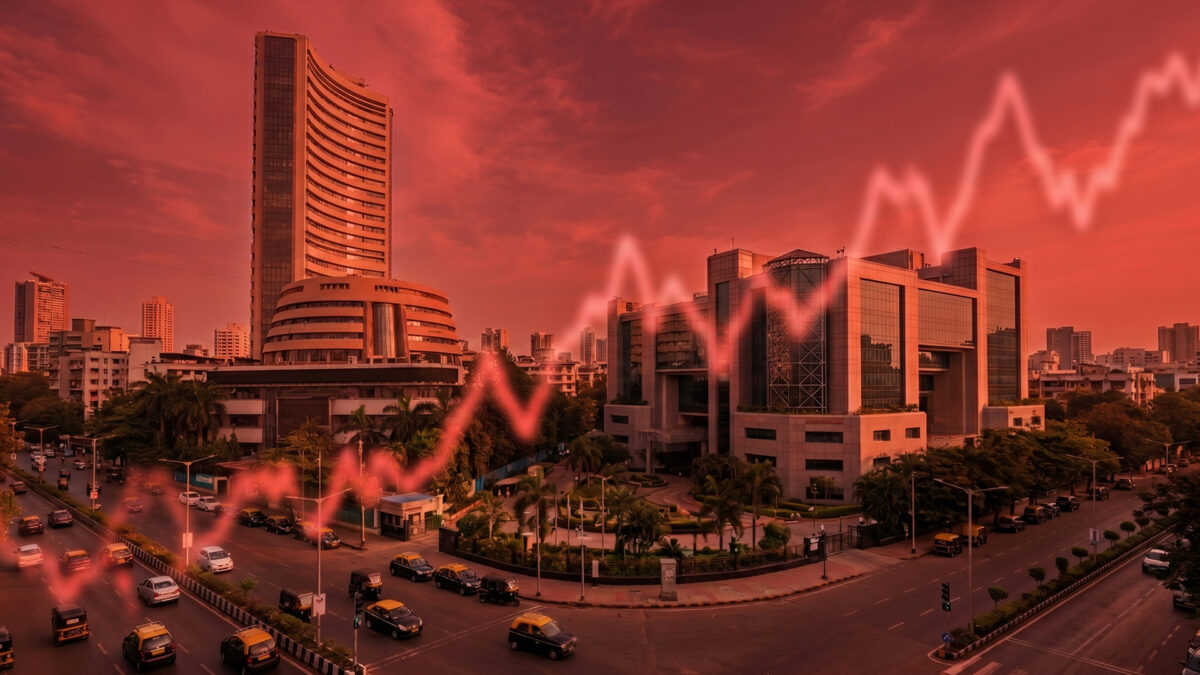
Indian benchmark indices extended their decline on Tuesday, with the Sensex falling more than 350 points and the Nifty 50 testing the crucial 24,200 level as rising crude oil prices and renewed geopolitical tensions in West Asia weighed on investor sentiment. The sell-off came as hopes of a fresh US-Iran agreement faded, pushing Brent crude above $91 a barrel.
The decline marked another weak session for the Indian stock market, with the Sensex heading for its third consecutive session of losses and the Nifty extending its losing run to six sessions. Investors remained cautious as higher oil prices threatened to increase inflationary pressure and widen India’s import bill.
Among major stocks, Titan Company, Tata Consumer Products, Bajaj Finance and Shriram Finance were among the stronger performers, helping limit the broader decline. Defensive sectors such as pharmaceuticals and selected consumer stocks also attracted buying interest.
On the other side, State Bank of India, Eternal, ITC and Dr Reddy’s Laboratories were among the prominent laggards in early trade. IT stocks were particularly weak, with the Nifty IT index falling around 1.4 per cent, making it the worst-performing major sectoral index. Colgate-Palmolive also declined nearly 3 per cent after brokerages raised concerns over margins following an analyst meeting.
The sectoral picture was mixed rather than uniformly negative. Auto, pharma, healthcare, consumer durables, oil and gas, mid-cap and chemical stocks showed pockets of strength, while banking, IT, realty, FMCG, financial services and metal stocks came under selling pressure.
The immediate trigger for the market weakness was the sharp rise in crude oil prices. Brent crude was trading around $91.46 a barrel, up 0.63 per cent, after Iran indicated a potentially more aggressive military posture and US President Donald Trump ruled out an extension of the temporary ceasefire arrangement.
The development has raised concerns about possible disruptions to global energy supplies. For India, which imports most of its crude oil requirement, sustained high oil prices can have a significant impact on the economy and financial markets.
Higher crude prices increase the cost of imports and can put pressure on the rupee. They can also raise transportation and production costs for companies, potentially affecting profit margins. If elevated oil prices persist, they could make the inflation outlook more challenging and limit the room for monetary easing.
The rupee opened weaker at ₹95.68 against the US dollar, compared with Monday’s close of ₹95.61. Persistent dollar demand and expensive crude contributed to the currency’s weakness. A weaker rupee can further increase the domestic cost of imported oil, adding to the concerns facing investors.
Foreign institutional investor selling has also emerged as a concern for Dalal Street. FIIs sold equities worth ₹2,535.10 crore on Monday, their highest selling in three weeks. Continued foreign outflows can put additional pressure on large-cap stocks and keep the broader market volatile.
At the same time, the US 10-year Treasury yield climbed to 4.73 per cent. Higher US bond yields can make American fixed-income assets more attractive to global investors and reduce the relative appeal of emerging markets such as India.
The domestic market was also tracking a cautious global environment. Asian markets were mixed to lower, while US equities ended Monday’s session in negative territory. Wall Street futures were also pointing towards a weaker opening.
The Nasdaq Composite fell 0.6 per cent on Monday, adding to concerns around technology stocks. The weakness was reflected in India, where the Nifty IT index led sectoral losses.
Technology companies with significant exposure to the US market remain sensitive to global growth expectations, currency movements and changes in US financial conditions. The combination of geopolitical uncertainty and elevated bond yields has therefore created additional pressure on IT stocks.
Apart from the broader market decline, several stocks remained in focus because of company-specific developments. Paytm saw a large block transaction, with 1.92 crore shares, representing around 3 per cent of its equity, changing hands at ₹1,535 per share. The transaction was valued at nearly ₹2,950 crore.
Groww also witnessed significant block activity, with about 1.2 per cent of its equity changing hands in two block deals. Investors were closely watching the stock for further movement following the transactions.
Bharti Airtel, Paytm, SpiceJet, ONGC and ZEE were among other stocks in focus because of company-specific developments. Indo-MIM, meanwhile, bucked the broader market trend and jumped around 10 per cent after reporting a 32 per cent rise in June-quarter profit. Highway Infrastructure also gained after securing an ₹80.17-crore contract from the National Highways Authority of India.
The immediate direction of the market will depend heavily on crude oil prices, developments in the Middle East, foreign fund flows and global bond yields. With the earnings season largely behind investors, global developments are playing a bigger role in determining market sentiment.