
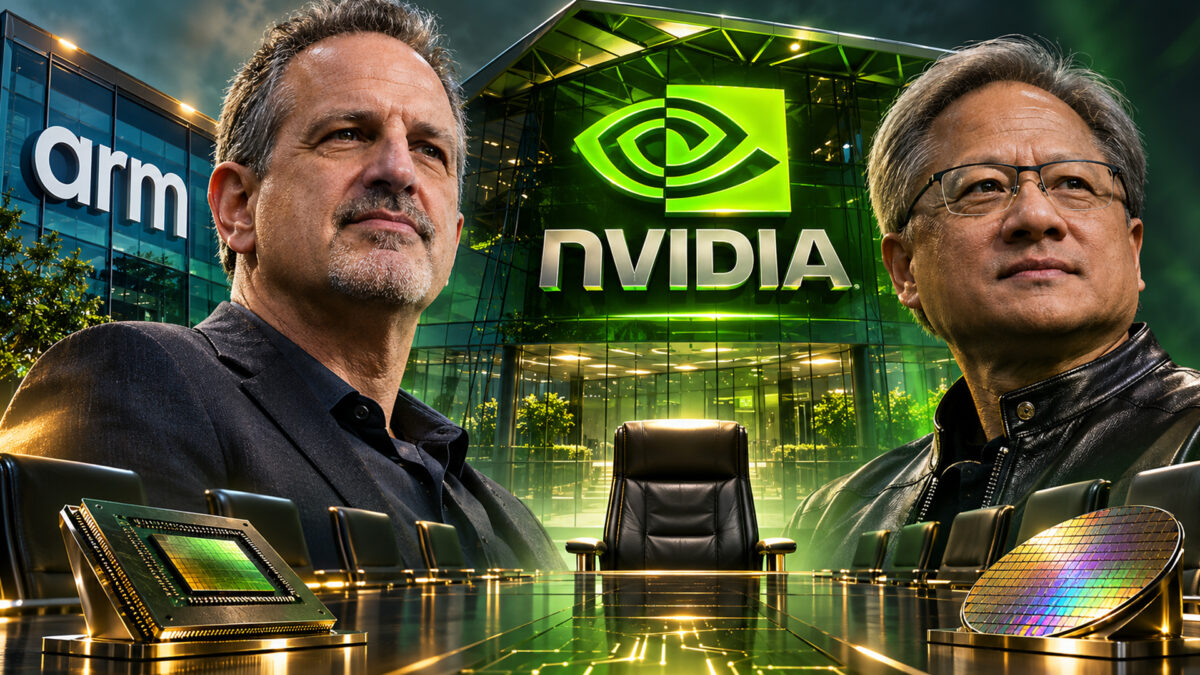
Nvidia is reportedly considering Arm chief executive Rene Haas as a possible successor to Jensen Huang, as the American chipmaker begins looking at leadership options following a major change at the top. Haas, who previously spent seven years at Nvidia, has emerged as a potential candidate because of his experience in the semiconductor industry and familiarity with the company’s operations.
According to reports, Nvidia has approached Haas about the possibility of taking over the leadership of the company. The development has drawn attention across the global technology industry, given Nvidia’s central role in the artificial intelligence boom and Huang’s long association with the business.
However, the succession process is still at an early stage. Nvidia’s board has indicated that it has not formally approached potential candidates and is yet to appoint an executive search firm to oversee the process. There is also no confirmation that Haas has agreed to consider the position.
Haas’ name has gained prominence because he understands Nvidia’s business from the inside and has since built considerable leadership experience at Arm. His background could make him a strong contender if the company decides to look beyond its existing management team.
Haas has an established history with Nvidia. He worked at the company for seven years, eventually becoming vice-president and general manager of its computing products business. His experience gave him an understanding of Nvidia’s technology, product development and business strategy.
He left Nvidia in 2013 and joined Arm, where he took on increasingly senior responsibilities. In February 2022, he became the company’s chief executive, succeeding Simon Segars.
Since taking charge, Haas has overseen an important phase in Arm’s growth. One of his biggest achievements was guiding the company through its Nasdaq listing in September 2023. The public offering attracted significant investor interest and marked a major milestone for the British semiconductor designer.
Arm develops processor architectures and licenses its technology to companies that manufacture chips. Its designs power a large proportion of smartphones worldwide and are increasingly being adopted in personal computers, cloud computing and artificial intelligence infrastructure.
His experience managing Arm through a major business transition, combined with his earlier association with Nvidia, makes Haas an interesting candidate for the role.
However, taking charge of Nvidia would be a considerably different challenge. The company has grown into one of the world’s most valuable technology businesses, with its graphics processing units (GPUs) forming the backbone of several leading artificial intelligence systems.
The succession discussions follow Huang’s sudden departure from the company’s top position on November 12. Huang, who co-founded Nvidia, has been closely associated with its growth for more than three decades.
Under his leadership, Nvidia transformed from a graphics chip manufacturer into a global leader in AI computing. Its GPUs are now widely used by technology companies, research institutions and governments to develop and operate advanced artificial intelligence models.
His departure has therefore raised questions about how Nvidia will maintain its growth momentum and technological leadership without the executive who shaped much of its strategy.
The company has appointed chief financial officer Colette Kress as interim chief executive while it considers its next steps. Kress is familiar with Nvidia’s financial operations and business strategy, making her an important part of the transition.
Nvidia has also appointed Harvey C. Jones as its first board chairman. Jones has been associated with the company’s board since 1993 and brings decades of experience in the technology sector.
The board is expected to assess candidates based on their understanding of the semiconductor industry, experience in managing large businesses and ability to lead Nvidia through its next phase of expansion.
Haas is not the only executive whose name has surfaced in discussions about Nvidia’s future leadership.
Kress is among the potential internal contenders because of her long association with the company and understanding of its financial and operational structure.
Ian Buck, another veteran Nvidia executive, has also attracted attention. He has played an important role in the development of CUDA, Nvidia’s software platform that allows developers to use its GPUs for a wide range of computing applications. CUDA has become one of the company’s biggest competitive advantages in the AI market.
Several external executives have also been mentioned in industry discussions. These include AMD chief executive Lisa Su, Micron CEO Sanjay Mehrotra, Marvell CEO Matt Murphy and Apple’s hardware engineering chief Johny Srouji.
Former Apple CEO Tim Cook has also been mentioned as a possible candidate after US President Donald Trump raised his name.
However, there is no confirmation that these executives are formally being considered or have been approached by Nvidia.
The possibility of Huang’s departure has also triggered reactions among Nvidia employees. Reports suggest that an internal discussion calling for the board to consider employees’ views attracted more than 1,600 comments, with several workers expressing support for Huang’s return.
Billionaire entrepreneur Elon Musk also indicated support for a petition seeking Huang’s reinstatement. The response highlights the strong connection Huang has built with employees and the wider technology community.
The company must also navigate growing geopolitical tensions, particularly restrictions on advanced semiconductor exports to China and increasing regulatory scrutiny of the technology sector.
Investors are closely watching the developments. Nvidia shares fell around 2% on November 13, while Arm shares declined approximately 5%, reflecting market sensitivity to the reported succession discussions.
Nvidia’s upcoming third-quarter fiscal 2027 results, scheduled for November 17, will provide another important update on its business performance.