
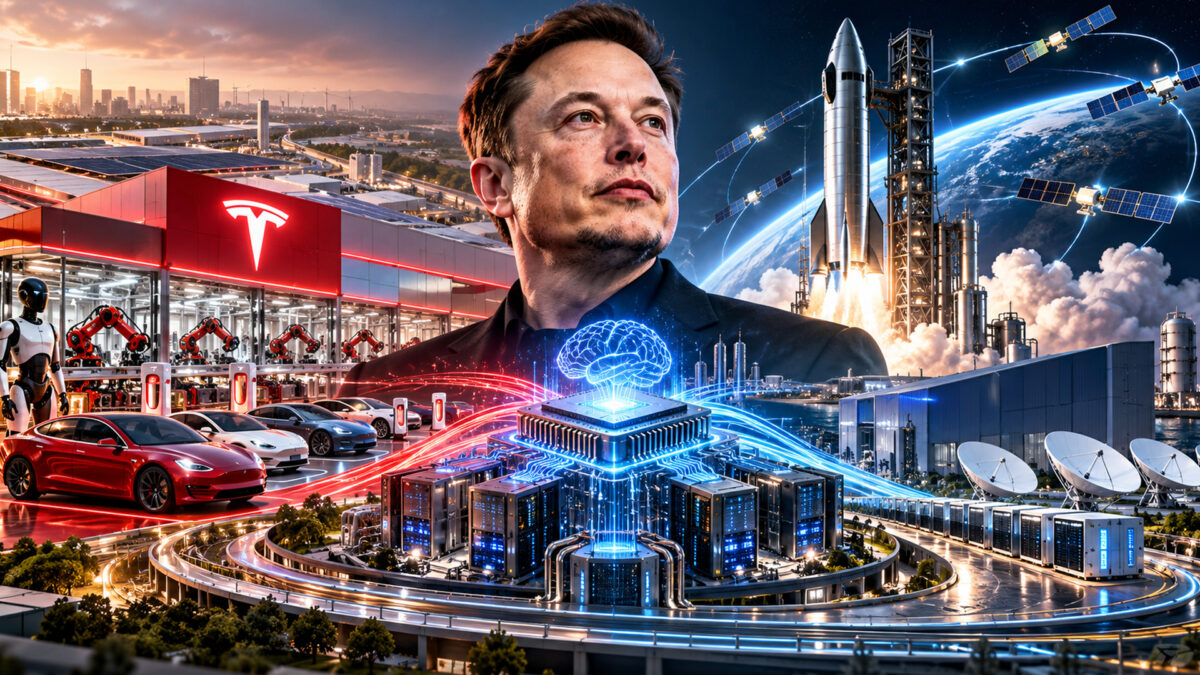
Elon Musk has confirmed that Tesla and SpaceX have formed special committees to explore a possible merger, bringing his electric vehicle and space technology businesses closer to a potential historic corporate deal. Musk has described the idea as a good one, but stressed that any agreement will depend on the committees’ assessment and shareholder approval.
The announcement came on October 20, during SpaceX’s third-quarter earnings call, where the company also reported a sharp rise in revenue and its first profit as a public company. The proposed merger could bring electric vehicles, rocket launches, satellite internet and artificial intelligence (AI) operations under a single corporate structure.
“I think it would be a good idea, but it’s really up to the special committees of both companies,” Musk said, according to Reuters, adding that he could not participate in their discussions because of his conflicting interests.
Tesla-SpaceX merger talks gather momentum
The potential merger could represent a major step towards consolidating Musk’s business empire. Tesla focuses on electric vehicles, battery technology, energy storage and autonomous driving, while SpaceX operates rockets and the Starlink satellite internet network and is expanding its AI computing business.
The two companies have increasingly overlapping ambitions, particularly in artificial intelligence, robotics and advanced computing infrastructure. Combining their operations could allow them to share resources, coordinate investments and develop technologies that support multiple businesses.
However, no final agreement has been announced. The independent committees must examine whether a merger would benefit shareholders, while any proposed transaction would also face regulatory scrutiny.
A combined business could be valued at more than $3.5 trillion, according to estimates cited in media reports. Such a deal would rank among the largest corporate combinations, although its eventual valuation and structure would depend on the terms agreed by both companies.
SpaceX revenue jumps 161% in third quarter
The merger discussions coincided with a strong financial performance from SpaceX. The company reported revenue of $14.58 billion for the three months ended September 30, 2026, up 161% from a year earlier.
SpaceX recorded net income of $4.4 billion, compared with a loss of $1.1 billion in the same quarter last year. Its adjusted earnings before interest, taxes, depreciation and amortisation (EBITDA) also increased sharply, reflecting growth across its businesses.
Artificial intelligence was the biggest contributor to the revenue surge. SpaceX’s AI business generated approximately $7.56 billion, nearly ten times its revenue a year earlier. Much of this income came from renting computing capacity at data centres to AI developers, rather than from selling its own AI models.
SpaceX has been investing heavily in computing infrastructure to meet demand from companies developing advanced AI systems. The business has become increasingly important to its financial outlook, even as the company continues spending on rockets and satellite technology.
Chief financial officer Bret Johnsen said SpaceX expected annual recurring revenue of around $100 billion by the end of 2026. The company is planning capital expenditure of $35 billion to $40 billion in the fourth quarter, underscoring the scale of its expansion plans.
Starlink remains a key growth driver
SpaceX’s satellite internet service, Starlink, continued to expand, reaching 13.6 million subscribers during the third quarter. The service provides broadband connectivity in markets where traditional internet infrastructure may be limited or difficult to deploy.
Starlink is an important part of SpaceX’s business because it generates recurring revenue from consumer, enterprise and government customers. Its satellite network also supports the company’s broader ambitions in communications and space infrastructure.
However, expansion into new markets with lower-priced plans has put pressure on average revenue per subscriber. This could become a challenge as SpaceX seeks to grow its customer base while maintaining profitability.
The company is also developing Starship, its next-generation reusable rocket system. The vehicle is expected to support future space missions, expand Starlink deployments and potentially enable ambitious plans for computing infrastructure in orbit. Starship, however, has yet to enter regular commercial service, and its development continues to involve significant costs and technical risks.
What a merger could mean for Tesla
For Tesla, a merger could provide closer links to SpaceX’s satellite network and computing capabilities while supporting its ambitions in autonomous driving and robotics. Tesla is investing in self-driving technology, robotaxis and its Optimus humanoid robot programme, all of which depend on advances in software, AI and computing power.
Supporters of a merger may argue that combining the businesses could improve coordination and give Musk greater flexibility to direct capital towards shared technological priorities.
However, investors will also need to consider the risks. Tesla and SpaceX operate in different industries, face different regulatory requirements and have distinct capital needs. A combined company would have to balance spending on electric vehicles, rocket development, satellite communications and AI infrastructure.
Governance is another important issue. Since Musk leads both businesses, the independent committees will need to evaluate the proposal carefully. Shareholders must ultimately decide whether the potential benefits justify the financial and operational risks.
No deal has been finalised
For now, the discussions remain exploratory. The next steps will involve the committees’ assessments, possible negotiations over the terms and a decision on whether to put a formal proposal before shareholders.
The strong SpaceX earnings report gives Musk additional momentum as he pursues his wider technology ambitions. Yet the proposed merger is not guaranteed, and regulatory approvals could add further complexity.
If the deal moves forward, it could reshape the relationship between electric mobility, space technology and artificial intelligence. Until then, investors will be watching for clearer details on the proposed structure, valuation and expected benefits.