
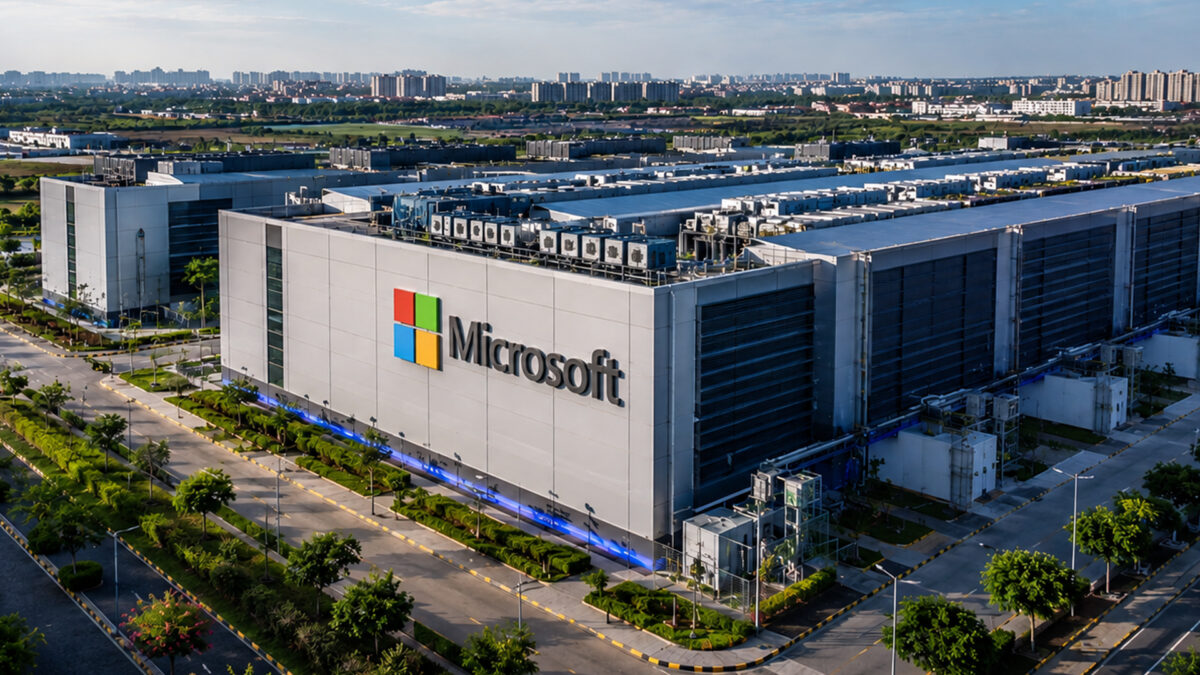
Microsoft has opened its largest data centre region in India in Hyderabad, strengthening its cloud infrastructure as demand for artificial intelligence (AI) services accelerates across the country.
The launch of the India South Central region takes Microsoft’s total number of cloud regions in India to four, joining existing facilities in Pune, Chennai and Mumbai. The company said the new infrastructure will give businesses more options to run cloud services and AI workloads within the country.
The move comes as global technology companies compete aggressively to build India’s digital and AI infrastructure. With more than one billion internet users and a large pool of technology talent, India is increasingly becoming an important market for cloud computing and artificial intelligence.
Microsoft’s Hyderabad facility has already attracted several major customers. Adani Group, Bajaj Finserv, HDFC Bank and PB Pay are among the early users of the new data centre region, highlighting growing enterprise demand for cloud and AI capabilities.
For Microsoft, the expansion is about more than simply adding another data centre. The company is positioning its infrastructure closer to the businesses, developers and organisations that are increasingly using AI for everyday operations.
Puneet Chandok, President of Microsoft India and South Asia, said trusted infrastructure needs to be located close to where data is generated and decisions are made. The Hyderabad region is expected to provide that foundation for customers looking to scale their cloud and AI workloads.
The new data centre is part of Microsoft’s much larger investment programme in India. In December 2025, the company announced plans to invest $17.5 billion between 2026 and 2029 in cloud and AI infrastructure, skilling and operations in the country. This followed an earlier $3 billion investment announced in January 2025.
Together, these commitments underline the growing importance of India in Microsoft’s global cloud and artificial intelligence strategy. Microsoft had said the latest investment would support the expansion of hyperscale infrastructure, sovereign-ready solutions and AI skilling initiatives.
The company expects its investment to help businesses, startups, developers and public-sector organisations access the computing capacity needed to adopt AI at scale.
Microsoft’s Azure cloud business has also recorded double-digit revenue growth in India for the past two years, according to the company. The strong demand for Azure services, along with growing adoption of AI tools such as Copilot, has encouraged the company to expand its infrastructure further.
Microsoft’s move also adds momentum to Hyderabad’s emergence as a major data centre hub in India.
Amazon Web Services, Microsoft and Oracle are among the global technology companies expanding their presence in the city through owned infrastructure and partnerships. AWS launched its Hyderabad region in 2022, while Oracle has also announced plans to build data centre capacity in the city.
The growth is being driven by several factors, including rising cloud adoption, enterprise digitalisation, AI workloads and Hyderabad’s established technology ecosystem.
But rapid data centre expansion also brings infrastructure challenges. Large facilities require substantial electricity, reliable networks, cooling systems and connectivity. Industry experts have pointed to the need for stronger power infrastructure and improved connectivity, particularly as data centre campuses expand into peripheral areas.
Knight Frank India executive director Joseph Thilak said India’s data centre industry is moving into a more mature phase, supported by sustained cloud adoption, AI-led computing demand and enterprise digitalisation.
Microsoft’s expansion comes at a time when its biggest technology rivals are also increasing investments in India’s AI infrastructure.
Alphabet’s Google and Amazon are expanding their data centre capacity as they look to capture a larger share of India’s growing AI market. The competition is not limited to cloud storage or traditional computing anymore. Increasingly, companies are building infrastructure capable of supporting AI models, enterprise applications and high-performance workloads.
Microsoft also operates two data centres in India with Reliance Industries’ Jio, further expanding its infrastructure footprint in the country.
For Indian businesses, the expansion could mean greater access to cloud computing capacity, potentially lower latency and more options for running sensitive workloads within the country.
That is becoming increasingly important as banks, financial companies, manufacturers, startups and public-sector organisations experiment with generative AI and other advanced technologies.
The Hyderabad launch therefore marks another significant step in India’s transformation into an AI and cloud computing market. Microsoft is betting that demand will continue to rise as companies move beyond experimentation and begin deploying AI across core business functions.