
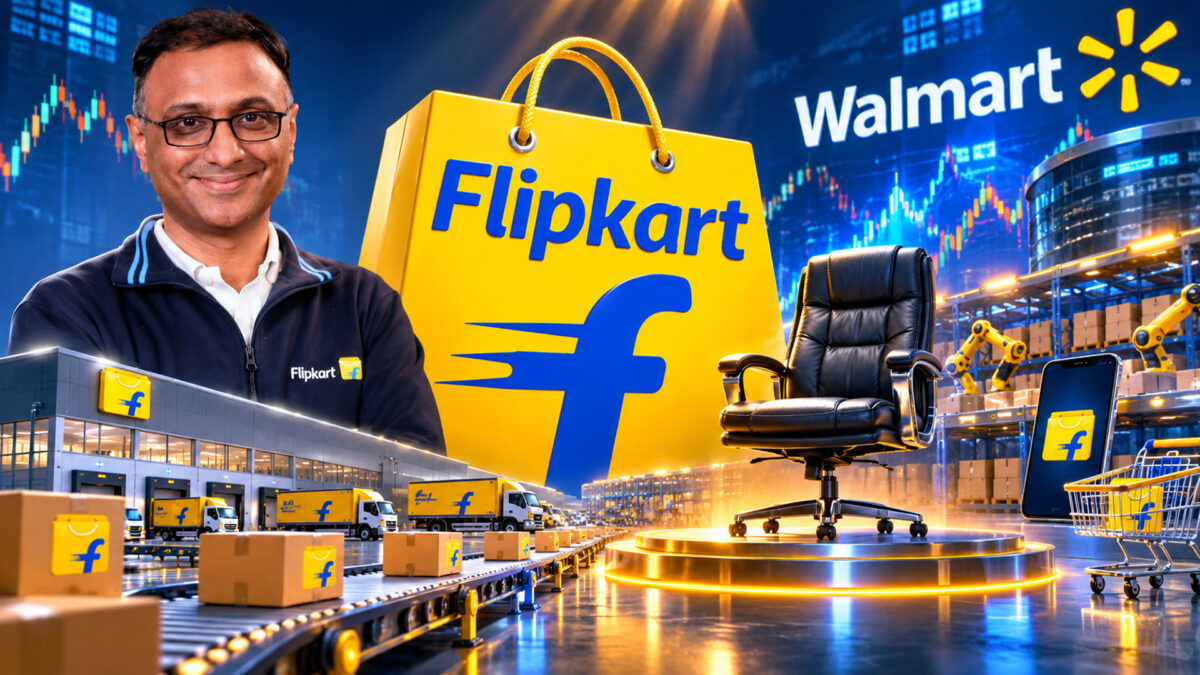
Kalyan Krishnamurthy is set to step down as chief executive officer of Flipkart, bringing an end to more than 11 years of association with the Walmart-owned e-commerce company. His departure marks a major leadership change at one of India’s largest online retail businesses, which is preparing for its next phase amid growing competition, delayed initial public offering (IPO) plans and increasing pressure to improve profitability.
Flipkart announced his departure on November 25, saying that Krishnamurthy was concluding his tenure after more than 11 years with the company. The company is expected to announce his successor in the coming weeks. In the interim, Balaji Thiagarajan, Flipkart’s chief product and technology officer, will lead the organisation along with the company’s board.
According to reports, Krishnamurthy’s last working day will be December 4. However, Flipkart’s official announcement did not specify his final date or provide a reason for his departure.
The exit comes at a critical time for Flipkart as its parent company, Walmart, reassesses its priorities for the Indian business. While the e-commerce platform has expanded significantly under Krishnamurthy’s leadership, it now faces questions about its growth strategy, financial performance and readiness for a public listing.
Krishnamurthy joined Flipkart in 2015 after working with investment firm Tiger Global, an early investor in the company. He became CEO in January 2017 and took over as group CEO in 2018, the year Walmart acquired a controlling stake in Flipkart for $16 billion.
His tenure coincided with a significant transformation in India’s online shopping market. Under his leadership, Flipkart strengthened its position against competitors, expanded its marketplace and invested in technology, logistics and services to reach more consumers.
According to the company’s announcement, Flipkart’s business grew more than fivefold during his leadership. Its flagship Big Billion Days sale also developed into one of India’s biggest festive shopping events, attracting millions of customers and sellers every year.
The company expanded its registered user base to more than 500 million and built an extensive seller network. Its group operations now include Myntra, Flipkart Wholesale, Cleartrip and super.money.
Krishnamurthy also oversaw Flipkart’s transition through Walmart’s acquisition and its efforts to strengthen corporate governance and operational capabilities.
In his farewell statement, he described his time at Flipkart as a privilege and said he was proud of both the company’s growth and the way it had built its business. He highlighted ethics, integrity and strong governance as important foundations of its progress. He also thanked employees, sellers and business partners who contributed to the company’s journey.
Walmart International president and CEO Chris Nicholas praised Krishnamurthy’s leadership, acknowledging his contribution to Flipkart and the wider Walmart organisation.
His departure comes as Flipkart’s long-awaited IPO remains uncertain. The company has taken steps towards a potential domestic listing, including shifting its holding company’s domicile from Singapore to India in March 2026.
However, Walmart has reportedly asked the company to prioritise financial performance rather than pursue an immediate public offering. In May, reports indicated that Walmart wanted Flipkart to achieve EBITDA breakeven by the end of the 2026-27 financial year before considering a fresh external fundraising or stock market listing.
This approach has created uncertainty among current and former employees who hold employee stock ownership plans (ESOPs). Many have been waiting for an IPO or another liquidity event to realise the value of their vested shares.
The issue gained further attention in October when around 1,000 former employees of Flipkart and its group companies reportedly approached Walmart and Flipkart’s boards, seeking clarity on the listing timeline and options to cash out their vested stock options.
The company had previously conducted employee stock liquidity programmes, allowing eligible employees to sell a portion of their vested options. However, uncertainty over future opportunities has added to concerns about employee compensation and retention.
Reports have also pointed to several senior-level departures over the past year, highlighting the organisational challenges facing the e-commerce major.
Rising competition and profitability challenges
Flipkart is also operating in an increasingly competitive market. Amazon remains a major rival, while quick-commerce companies and newer digital retail platforms are changing consumer expectations around delivery speed and convenience.
The expansion of quick-commerce services has increased pressure on established e-commerce companies to strengthen their delivery networks, improve customer experience and invest in new business models.
Flipkart has been expanding its quick-commerce offering through Flipkart Minutes while continuing to invest in its core marketplace and fashion business through Myntra.
Its financial performance also remains under scrutiny. For the financial year ended March 2026, Flipkart Group reported an 18 per cent increase in revenue from operations to Rs 1,45,880 crore. However, its consolidated net loss stood at Rs 8,468 crore, compared with Rs 8,646 crore in the previous financial year.
Although the company has narrowed its losses marginally, improving profitability remains a major priority as Walmart prepares the business for its next stage of growth.
Krishnamurthy’s departure leaves Flipkart at an important crossroads. The next CEO will have to balance growth ambitions with financial discipline while strengthening the company’s position against established e-commerce players and emerging quick-commerce rivals.
The leadership transition also raises questions about the company’s IPO timeline, employee stock liquidity and future investment priorities.
Walmart, meanwhile, has reiterated its commitment to Flipkart and its long-term prospects in India. The parent company believes the e-commerce business has a strong market position and significant opportunities to expand its reach.