
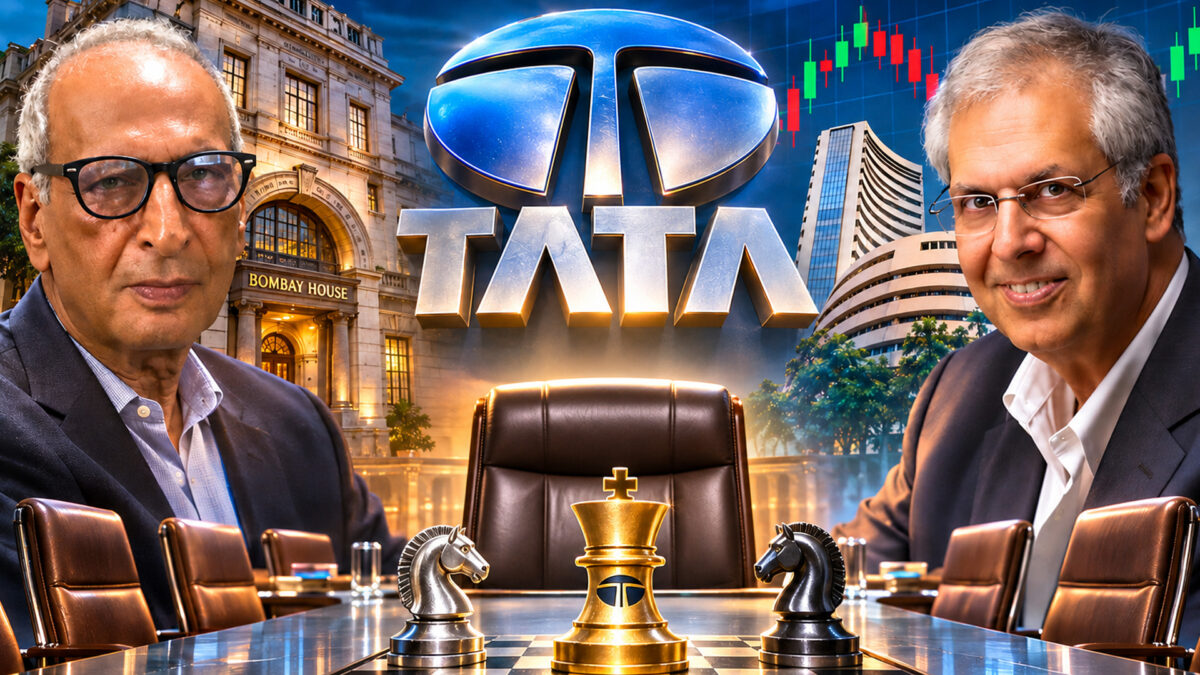
A fresh controversy has emerged within the Tata Group, with Jimmy N Tata, younger brother of the late industrialist Ratan Tata, publicly backing the listing of Tata Sons while raising serious questions about the growing influence of family members in the group’s charitable trusts. Jimmy has accused Tata Trusts chairman Noel Tata of attempting to consolidate family control over Tata Sons through trustee appointments, describing the developments as a potential back-door takeover.
Jimmy‘s intervention marks a significant development in the ongoing differences over the future of Tata Sons, the group’s principal holding company, its proposed stock market listing and the reappointment of N Chandrasekaran as executive chairman. His position also brings another influential member of the Tata family into a dispute that has increasingly become a test of corporate governance and institutional independence.
According to reports, Jimmy communicated his views during a conversation with a fellow trustee of Tata Trusts, who subsequently shared them with other members. He has questioned the induction of multiple members of Noel Tata’s family into the charitable institutions, arguing that such appointments are inconsistent with the intentions of their founders.
Jimmy maintained that the Sir Ratan Tata Trust and Sir Dorabji Tata Trust were established to serve the public and support charitable causes, rather than function as instruments of family ownership. Their founders, who had no children, had dedicated their wealth and properties to public welfare, including poverty alleviation and the preservation of Indian culture.
He argued that trustees are custodians of these public charitable institutions and must protect their original objectives. Allowing several members of one family to occupy positions within the trusts, he suggested, could effectively give them disproportionate influence over Tata Sons without any corresponding ownership contribution.
The issue is particularly significant because Tata Trusts collectively hold approximately 66 per cent of Tata Sons, giving them considerable influence over the group’s holding company. Noel Tata’s son Neville is a trustee of the Sir Dorabji Tata Trust, while his daughters also hold positions in trusts associated with the Tata philanthropic institutions.
Jimmy’s criticism comes amid disagreements over the composition and functioning of the trusts, with questions being raised about the balance between family representation and independent decision-making.
A major part of Jimmy’s intervention concerns the long-standing question of whether Tata Sons should be listed on the stock exchanges. He has strongly supported a public listing, arguing that it would bring greater transparency, statutory accountability and independent scrutiny to the holding company.
He has also called on the Reserve Bank of India (RBI) to enforce strict timelines for the listing and ensure that the regulatory requirement is not avoided through corporate restructuring.
Tata Sons was classified as an upper-layer non-banking financial company (NBFC) by the RBI in 2022. Under the applicable regulatory framework, upper-layer NBFCs are required to list their shares within three years. The deadline for Tata Sons expired in September 2025.
However, Tata Sons has been seeking to move out of the upper-layer NBFC category. The RBI rejected its application to surrender its registration in September 2026, keeping the listing issue alive.
Jimmy has argued that the regulatory position makes a public listing even more important. He has also cautioned against proposals to divide Tata Sons into smaller entities to avoid the RBI’s listing requirements, describing such a move as contrary to the interests of shareholders and the public.
He pointed to the successful public listing of Tata Consultancy Services (TCS) under Ratan Tata’s leadership, arguing that the group had benefited from opening one of its major businesses to public investors.
In contrast, Noel Tata has maintained that listing Tata Sons could fundamentally change the group’s approach to business and philanthropy. Speaking at the Hindustan Times Leadership Summit on November 14, he cautioned that a stock market listing could place greater emphasis on profitability and shareholder expectations at the expense of the Tata Group’s philanthropic commitments.
Jimmy has also thrown his support behind N Chandrasekaran’s proposed reappointment for a third five-year term as Tata Sons chairman, adding another dimension to the differences within Tata Trusts.
He praised Chandrasekaran’s leadership, crediting him with improving the financial performance of several Tata companies, reducing debt and delivering strong earnings and dividend payouts. He also questioned the opposition to extending the chairman’s tenure despite what he described as substantial support for Chandrasekaran within the organisation.
The proposed reappointment has reportedly received a 4-1 majority at the Tata Sons board level and unanimous support through a resolution at Tata Trusts. However, Noel Tata and trustee Darius Khambata have opposed another term for Chandrasekaran.
Jimmy alleged that Noel had attempted to block the reappointment by invoking veto provisions in the amended Articles of Association of Tata Sons, without providing adequate justification.
He also criticised changes introduced to the Articles of Association around 2013-14, arguing that they had altered the relationship between Tata Trusts and the commercial operations of Tata Sons. According to him, the earlier framework maintained a clearer separation between the charitable trusts and the management of the business.
The subsequent amendments, he argued, gave the chairman of Tata Trusts extensive veto powers and the authority to nominate directors, weakening collective decision-making at the board level.
Jimmy further raised concerns about trustee tenure rules, including the treatment of independent members such as Venu Srinivasan and Vijay Singh. He questioned whether the existing arrangements were weakening institutional independence and concentrating authority.
He contrasted the current situation with the earlier practice of appointing respected independent personalities, including Nani Palkhivala, Gautam Sarabhai, Homi Sethna and Homi Bhabha, to the trusts.
Jimmy has called for the government and the Charity Commissioner to intervene to safeguard the original objectives of the Tata charitable institutions. He believes that the trusts must remain committed to their public responsibilities rather than become centres of family influence.
The latest developments come against the backdrop of earlier disagreements within the Tata Group, including the high-profile removal of Cyrus Mistry as Tata Sons chairman in 2016, which triggered a prolonged legal battle.
The Shapoorji Pallonji Group, which holds an 18.37 per cent stake in Tata Sons, has also supported a public listing, as it could unlock the value of its investment.
With Tata Trusts holding the controlling stake, the RBI’s regulatory position and the proposed leadership changes continuing to generate debate, the future structure of Tata Sons has become a central issue for the group.
Jimmy’s intervention has therefore brought renewed attention to questions of transparency, accountability and the role of family members in one of India’s most influential business institutions. The outcome could have far-reaching implications for the governance of Tata Sons and the relationship between its commercial interests and philanthropic legacy.