
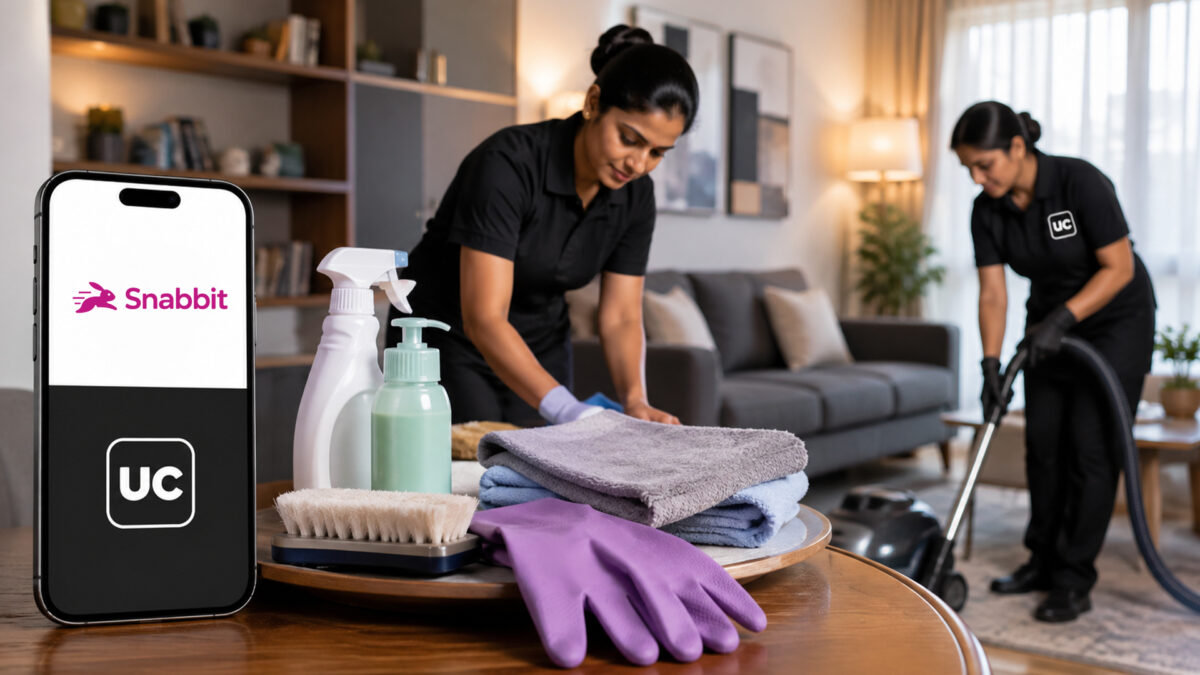
What started as a simple promise, getting someone to clean a house, wash dishes or help with laundry within minutes, is quickly turning into one of India’s most closely watched startup categories.
The country’s instant home services market has reached a new milestone, with Snabbit and Urban Company’s InstaHelp both crossing 100,000 daily orders. Snabbit said it is now completing more than 115,000 jobs a day, while InstaHelp crossed 100,000 delivered orders in a single day on August 2.
The latest numbers show how quickly consumer demand for on-demand home services has grown. They also explain why investors have been putting fresh money into companies such as Snabbit and Pronto, while Urban Company continues to spend aggressively on its InstaHelp vertical.
The scale-up has been particularly striking over the past few months. Urban Company’s InstaHelp completed about 1.9 million orders in July, reclaiming the top spot after briefly trailing Snabbit in June. Snabbit recorded around 1.85 million orders, while Pronto crossed 1.25 million monthly bookings for the first time. Together, the three platforms processed nearly 5 million orders in July.
That monthly race highlights an important change in the market. Instant home services are no longer just an experiment in a handful of neighbourhoods. Startups are building dense networks of service professionals and trying to turn occasional bookings into a regular habit for urban households.
Snabbit has emerged as one of the fastest-growing players. The company, founded in 2024, now operates across 10 cities and more than 150 micromarkets, supported by over 25,000 service professionals. It said it completed 4 million jobs in its core household-services category during the June quarter.
The company is also showing signs that its unit economics are improving. Snabbit said consolidated net order value, after customer discounts, has crossed ₹130, while its burn per job has fallen by more than ₹100 sequentially to below ₹250. It expects net order value to improve another 15-20% in the coming months.
That is important because the biggest question facing the instant home services business is no longer whether customers want the service. The question is whether companies can make the model financially sustainable while continuing to grow.
The funding market suggests investors believe there is a large opportunity. Earlier this year, Snabbit was in talks to raise as much as $70 million after already raising several rounds. Since then, the company has gone on to raise $56 million in a Series D round, taking its total capital raised to $112 million and valuing the startup at about $360 million.
Pronto has followed a similar path. The startup raised $25 million in March and added another $20 million in May, taking its Series B round to $45 million and doubling its valuation to $200 million. The fresh capital is being used largely to expand its workforce, reflecting a major constraint in the business: demand is growing faster than the supply of trained service professionals.
Pronto had earlier reported a sharp increase in bookings, from around 3,000 a day at the beginning of December to more than 26,000 a day by May. It has also been expanding beyond basic cleaning into services such as car washing, gardening and home-cook pilots.
Urban Company, meanwhile, has the advantage of an established consumer base and a much larger operating platform. Its InstaHelp service has expanded rapidly and crossed the 100,000-order daily mark barely five months after crossing 50,000. The company said the milestone reflected rising consumer demand as well as the strength of its operating model.
But rapid growth comes at a price.
The instant home services market remains heavily dependent on discounts, customer incentives and spending on worker acquisition. Earlier reports showed that all three major platforms had experimented with aggressive promotional offers, including limited ₹1 campaigns, to attract customers. These were not their standard prices, but they illustrate how fiercely the companies are competing for users.
Urban Company has also acknowledged that InstaHelp is still a significant investment. The vertical reported a loss of ₹61 crore in the December quarter even as revenue grew. The company has said that reducing loss per order will be critical to reaching sustainable break-even.
For startups, the challenge is similar. A platform can generate thousands of bookings, but profitability depends on keeping service professionals busy enough, while ensuring customers continue to book frequently.
This is where the idea of micromarket density becomes crucial. Instead of spreading workers thinly across an entire city, companies are concentrating supply and demand in specific neighbourhoods. Higher utilisation means professionals spend less time travelling between jobs and more time earning, improving the economics of every booking.
Snabbit has said its mature micromarkets are approaching profitability, while Pronto has reported utilisation above 60% in older clusters. The companies believe greater density will gradually reduce the cost of servicing each customer.
Still, changing consumer behaviour may be the hardest part. For many households, instant house help remains a backup option when their regular domestic worker is unavailable. Turning that occasional need into a high-frequency habit will determine whether the business can support the valuations and funding now flowing into the sector.
The latest numbers suggest the opportunity is real. Nearly 5 million monthly orders across InstaHelp, Snabbit and Pronto show that Indian consumers are increasingly willing to pay for convenience in household chores.
The next phase, however, will be less about simply chasing bookings. Investors will want to see better unit economics, customer retention, worker utilisation and lower cash burn.
That makes the competition between Urban Company, Snabbit and Pronto more than a race for market share. It is a test of whether instant home services can evolve from a heavily funded startup idea into a sustainable consumer business.
For now, the momentum is unmistakable. Millions of households are trying a service that promises to solve an everyday problem in minutes. The companies that can turn that convenience into a habit, without spending too much to make it happen, are likely to shape the next big chapter of India’s startup economy.