
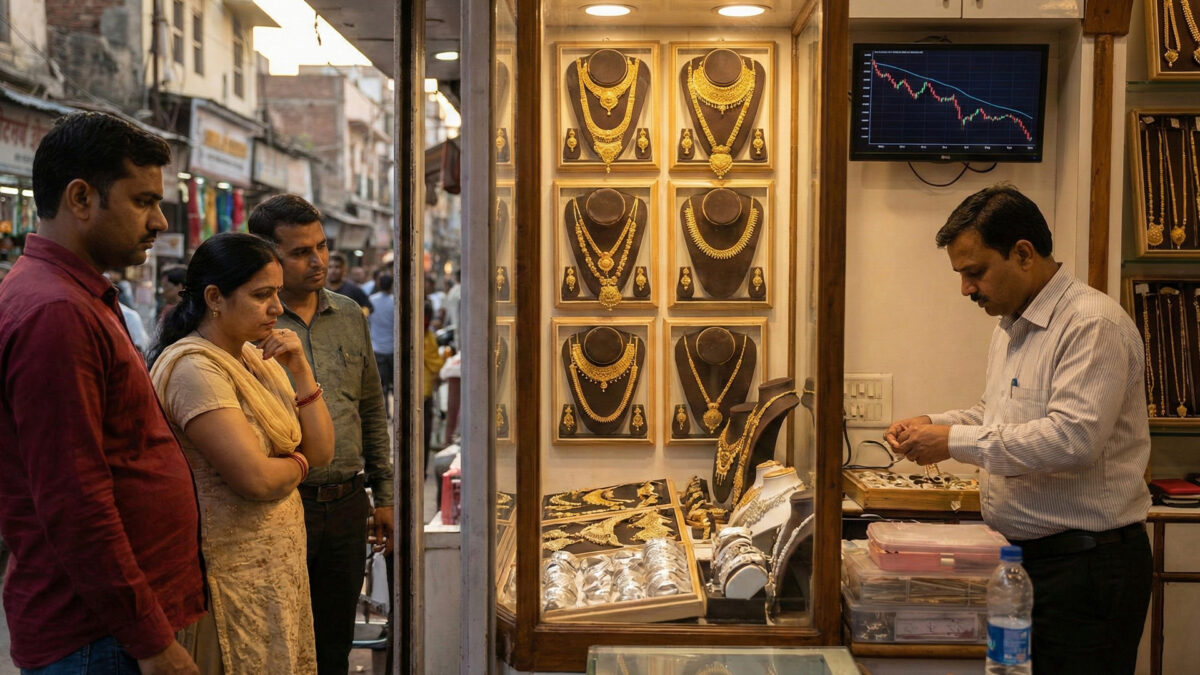
Gold and silver prices declined in domestic futures trading on Wednesday, October 14, as investors continued to assess global economic developments and the outlook for interest rates. While gold recorded a modest fall, silver futures came under greater pressure. Retail gold prices remained elevated across major Indian cities, keeping precious metals in focus as consumers prepare for the festive season.
MCX Gold futures for December 4 delivery stood at ₹1,48,086 per 10 grams, down nearly 0.25% during the session. MCX Silver futures for December 4 delivery declined 0.70% to ₹2,19,001 per kilogram around noon.
The movements came even as gold continued to attract interest from investors seeking protection against economic uncertainty. Market participants are closely tracking expectations of US Federal Reserve rate cuts, currency movements and geopolitical developments, all of which can influence demand for precious metals.
In the retail market, 24-carat gold was priced at ₹1,48,320 per 10 grams, while 22-carat gold stood at ₹1,35,960 per 10 grams, according to Indian Bullion Association data reported on Wednesday. Silver of 999 purity was quoted at ₹2,17,940 per kilogram.
Retail prices vary by city and may differ from futures prices because of differences in market conditions and pricing methods. Consumers should also account for applicable taxes, GST and jewellery-making charges when calculating the final purchase cost.
Mumbai recorded a 24-carat gold price of ₹1,48,060 per 10 grams, while 22-carat gold was priced at ₹1,35,722. Silver of 999 purity stood at ₹2,17,550 per kilogram.
In New Delhi, 24-carat gold was quoted at ₹1,47,800 per 10 grams and 22-carat gold at ₹1,35,483. Silver prices stood at ₹2,17,170 per kilogram.
Bengaluru reported 24-carat gold at ₹1,48,110 per 10 grams and 22-carat gold at ₹1,35,768. Silver was priced at ₹2,17,620 per kilogram.
In Kolkata, 24-carat gold stood at ₹1,47,800 per 10 grams, while 22-carat gold was quoted at ₹1,36,693. Silver prices were recorded at ₹2,17,160 per kilogram.
Hyderabad reported a 24-carat gold rate of ₹1,49,560 per 10 grams, while 22-carat gold stood at ₹1,35,483. Silver was priced at ₹2,25,870 per kilogram. In Chennai, 24-carat gold was quoted at ₹1,48,450 per 10 grams and 22-carat gold at ₹1,36,079, with silver at ₹2,18,330 per kilogram.
The variations highlight the importance of checking local bullion prices before making a purchase. Jewellery buyers should also distinguish between 24-carat and 22-carat gold. While 24-carat gold is considered nearly pure and is widely used as a benchmark for investment products, 22-carat gold contains other metals that improve its durability, making it suitable for jewellery.
Global developments continue to shape the outlook for gold and silver. Expectations of lower US interest rates can support gold prices because the metal does not offer interest income. When returns on interest-bearing assets decline, gold can become more attractive to investors. However, a stronger US dollar and rising bond yields can weigh on demand by making gold more expensive for holders of other currencies.
Safe-haven buying has remained an important source of support for gold amid economic uncertainty. According to market commentary cited in recent reports, expectations of Federal Reserve rate cuts, elevated US debt levels and institutional buying have helped sustain investor interest. Hopes for progress towards peace in the Russia-Ukraine conflict have also remained part of the broader market picture.
Silver, meanwhile, is influenced by both investment demand and industrial consumption. Its use in manufacturing and other industrial applications makes it sensitive to changes in economic activity, while currency movements and investor sentiment can add to short-term volatility. These factors can cause silver prices to fluctuate more sharply than gold.
For consumers planning festive purchases, the latest decline in futures prices does not necessarily mean an equivalent reduction in jewellery costs. Retail rates, purity, jeweller margins and additional charges all influence the final bill. Comparing prices across established jewellers and checking hallmarking details can help buyers make informed decisions.
With precious metal prices continuing to respond to global economic signals, investors and consumers will be watching currency movements, interest-rate expectations and local demand for further clues on the direction of gold and silver prices.