
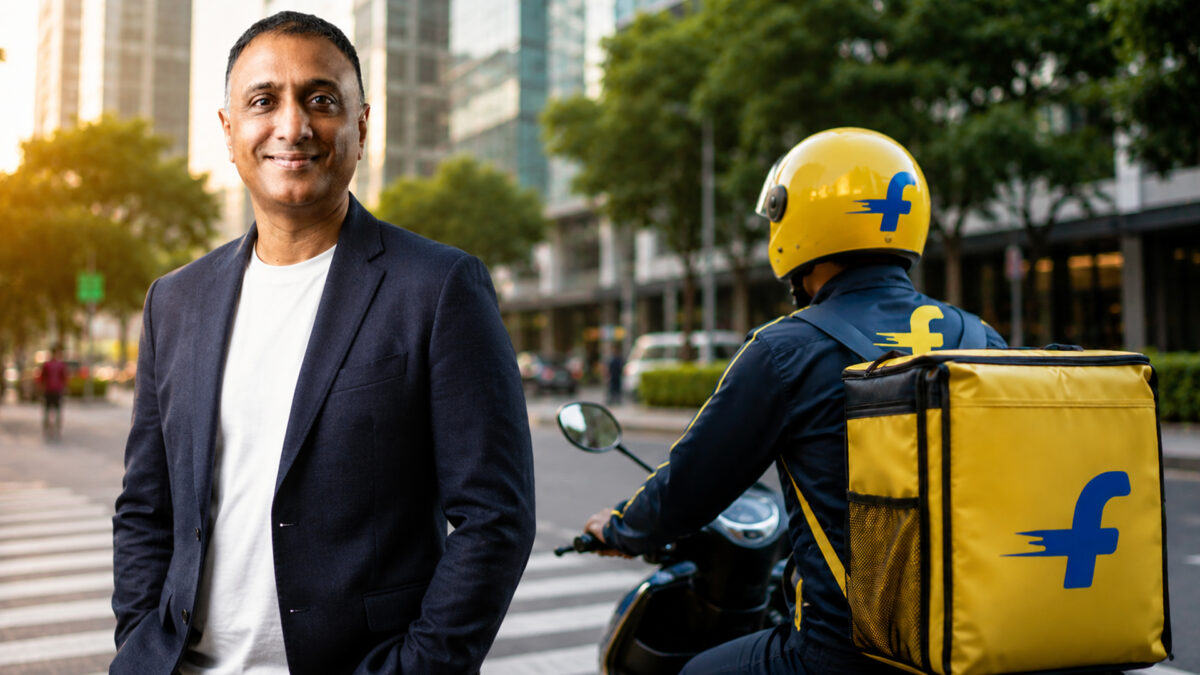
Flipkart is set to enter India’s highly competitive online food delivery market, taking on established players Swiggy and Zomato in a move that could reshape the country’s rapidly growing digital commerce landscape. The Walmart-owned e-commerce company plans to launch its food delivery service in the coming weeks, beginning with a pilot in Bengaluru before expanding to other cities.
Confirming the development, Flipkart Group CEO Kalyan Krishnamurthy said the company is ready to roll out the new service after months of preparation. The announcement marks another major step in Flipkart’s strategy to expand beyond its traditional e-commerce business and strengthen its presence in high-growth consumer services.
Speaking about the company’s plans, Krishnamurthy said entering a market later than competitors should not be seen as a disadvantage. According to him, companies that focus on delivering a better customer experience and creating real value can still succeed, even in sectors dominated by established players.
“Just because somebody enters a market late doesn’t mean they can’t build a strong business,” he said, expressing confidence that Flipkart can carve out its own space in the food delivery market.
The company is expected to leverage its existing logistics infrastructure, particularly the network built for Flipkart Minutes, its quick commerce platform. With thousands of delivery personnel, dark stores and fulfilment centres already operating across multiple cities, Flipkart believes it has a strong operational base to support restaurant deliveries.
The move comes at a time when India’s food delivery industry is largely controlled by Swiggy and Zomato, which together account for most online food orders. Both companies have spent years building extensive restaurant partnerships, delivery fleets and loyal customer bases. Even so, Flipkart believes there is room for another strong player in the market.
Industry experts say Flipkart’s biggest advantage lies in its massive customer base and well-established digital ecosystem. Millions of users already shop on the platform for electronics, fashion, groceries and household essentials. Adding food delivery could encourage customers to use a single app for multiple daily needs, making the platform even more integral to their lives.
Reports suggest the food delivery service will first be tested in Bengaluru. A pilot launch will allow the company to fine-tune delivery operations, strengthen restaurant partnerships and gather customer feedback before expanding to other metropolitan markets.
Krishnamurthy also shared his broader view on the rapid growth of quick commerce in India. He described quick commerce as simply another retail category rather than a separate business altogether, adding that Flipkart is focused on building a sustainable business rather than chasing growth at any cost.
His comments come as companies across India’s digital economy continue to invest heavily in faster deliveries and expanded services. Consumers today increasingly expect groceries, medicines, electronics and even restaurant meals to arrive at their doorstep within minutes, prompting major platforms to diversify their offerings.
For restaurant owners, Flipkart’s entry could open another important sales channel. More competition among food delivery platforms may also improve commission structures, offer better business terms and reduce dependence on a limited number of aggregators.
Consumers, meanwhile, are likely to benefit from increased competition. Industry observers expect attractive launch offers, discounts, loyalty programmes and faster delivery options as Flipkart attempts to win customers from existing players. Rival platforms may also introduce new incentives and service improvements to retain market share.
However, analysts caution that success in the online food delivery business will depend on more than competitive pricing. Efficient delivery operations, reliable service, strong restaurant relationships and consistent customer experience will be critical in a business where profitability has historically been difficult to achieve.
Flipkart’s entry also reflects the broader convergence of e-commerce, quick commerce and food delivery, with major technology companies increasingly trying to become one-stop platforms for consumers’ everyday needs.
Backed by Walmart’s financial strength and supported by one of India’s largest logistics networks, Flipkart believes it is well positioned to compete in the next phase of the country’s digital commerce evolution.
Whether the company can break the long-standing dominance of Swiggy and Zomato remains to be seen. But with Group CEO Kalyan Krishnamurthy publicly confirming the launch and expressing confidence in Flipkart’s strategy, the battle for India’s online food delivery market is about to become significantly more competitive.