Categories
Leaders

Robinhood CEO’s AI venture Harmonic hits $1.45 billion

Harmonic, the AI startup co-founded by Robinhood CEO Vlad Tenev, has closed a fresh $120 million funding round, lifting its valuation to $1.45 billion. The raise underscores Tenev’s growing influence as a tech leader betting on a new direction for artificial intelligence,  one built on mathematical rigour, transparency and verifiable reasoning.

Founded in 2023, Harmonic is attempting to solve a leadership-level challenge facing the AI industry: trust. While most AI models risk “hallucinating,” Harmonic’s flagship system, Aristotle, reasons using formal logic and expresses outputs in a provable programming language. This makes its decision-making traceable, a quality that leaders in high-stakes fields like finance, aerospace and software reliability have been demanding.

Though still pre-revenue, Harmonic’s rapid valuation growth shows that investors view this approach as the future of responsible AI leadership. The new capital will boost computing power, accelerate model development and strengthen its push to build AI that organisations can depend on for mission-critical decisions.

Tenev’s involvement also reflects a shift among global technology leaders,  moving from building apps to building the foundations of the next era of intelligence, where safety, logic and accountability matter as much as raw capability.

Also Read: IMF shifts India to crawl-like regime

Categories
Leaders

Ola founder Bhavish Aggarwal bets on home batteries

Ola Electric Mobility Ltd., once one of India’s most hyped electric vehicle (EV) companies, is now grappling with declining sales and investor hesitation. Its market share in electric scooters fell sharply to 11.5% in October, down from 30% last year, while cash reserves dropped from ₹480 crore in March to just ₹160 crore by September. The company is also facing a challenging fundraising environment, as investors remain cautious about joining its ₹1,500‑crore capital-raising plan.

In a bid to revive fortunes, founder Bhavish Aggarwal is betting big on a new business vertical, Ola Shakti. The initiative offers lithium‑ion battery packs for homes and small businesses, using the same proprietary 4680 “Bharat” battery cells developed for Ola scooters. Aggarwal expects the home‑battery venture to generate around ₹100 crore in revenue in the quarter beginning March, potentially reaching ₹1,000 crore by March 2027, almost a third of Ola’s projected annual revenue.

While the move could diversify Ola’s income, experts warn that home battery storage is a highly competitive segment dominated by low-cost lead-acid systems. Making a lithium-ion battery business profitable also requires large-scale production, with analysts suggesting Ola would need to reach roughly 10 GWh to break even.

Despite these challenges, Aggarwal remains optimistic that leveraging technology developed for scooters could provide a strategic edge. However, analysts caution that the home-battery push alone may not be enough; a revival of Ola’s core EV business is critical for long-term success. The company’s ability to balance innovation, production scale, and investor confidence will determine whether Bhavish Aggarwal’s bold bet on Ola Shakti can turn around the struggling EV maker.

Also Read: Premier Energies sees 32% upside, Nuvama turns bullish

Categories
Leaders

Google and Accel partner to boost India’s AI startups

Google and global venture capital firm Accel have come together to support a new wave of early-stage AI startups in India. Their partnership is designed to help young founders who are still at the idea or prototype stage but have the passion and potential to build meaningful AI products.

Under this initiative, selected startups can receive up to $2 million in funding, shared between Google’s AI Futures Fund and Accel’s Atoms programme. For many first-time entrepreneurs, this kind of early backing can be the difference between a dream that stays on paper and a product that reaches the market.

But the help goes far beyond money. Young founders often struggle with access to powerful computing resources, which are essential for training and testing AI models. To bridge this gap, Google will offer $350,000 worth of compute credits, along with access to its newest AI technologies, including Gemini and DeepMind models. This gives small teams the same high-end tools used by global AI companies.

The selected startups will also receive close mentorship from Google engineers, product leaders and Accel’s investment team. This support will help founders refine their ideas, build stronger products and learn how to take them to market. For many entrepreneurs, this kind of guidance can be more valuable than the funding itself.

This partnership comes at a time when India’s AI ecosystem is rapidly expanding. Google for Startups recently launched a hands-on programme called “Prompt to Prototype” to help early-stage founders learn to build with AI. More than 150 young companies also participated in Google’s AI Day for Startups, showing the excitement and hunger among India’s new generation of builders.

Global tech giants are also paying attention. Nvidia has joined India’s Deep Tech Alliance, and companies like OpenAI, Anthropic and Perplexity are strengthening their presence in the country. They see India not just as a big market, but as a place where talented engineers and creative problem-solvers can build world-class AI products.

Through this collaboration, Google and Accel hope to inspire India’s youngest AI minds to think big, experiment boldly and build solutions that can impact millions, both in India and around the world.

Also Read: AdaniConneX buys Trade Castle Tech Park for ₹231 crore

Categories
Leaders

Lakshmi Mittal leaves UK as tax fears rise

Steel tycoon Lakshmi Mittal, one of Britain’s richest residents for decades, has quietly begun moving his financial base out of the United Kingdom, a shift that reflects growing anxiety among the country’s wealthiest families as the Labour government prepares a major tax overhaul.

According to people familiar with his plans, Mittal is relocating his tax residency to Switzerland and is expected to spend more time in Dubai, a city that has increasingly become a haven for global billionaires. While the UK has long been his primary home, the changing tax climate appears to have accelerated his decision to look elsewhere.

The Labour government’s proposal to tighten tax rules for the super-rich,  including a potential exit tax and stricter treatment of global assets has unsettled several high-net-worth individuals. For many, the biggest worry is not the immediate wealth tax but the broader reach of inheritance tax, which can apply to worldwide assets if an individual is deemed UK-domiciled.

For families with complex international holdings, this has raised difficult questions about how much control the government may eventually have over future wealth transfers. Advisors say the Mittals, like many other affluent families, have been assessing the long-term implications of these changes for years, but the new political climate appears to have tipped the scales.

Mittal’s departure is especially symbolic. He has been more than just a wealthy resident,  he built ArcelorMittal, the world’s largest steel company, while living in London, and once owned some of the city’s most expensive homes. His long association with the UK made him a fixture in business circles, and he has even been a donor to the Labour Party in the past.

His exit now raises broader questions: Will others follow? Can the UK maintain its appeal for global entrepreneurs if tax rules become less favourable? Economists warn that a high-profile billionaire leaving the country could send the wrong signal at a time when Britain is trying to attract investment and rebuild post-pandemic growth.

For Mittal, however, the decision appears practical rather than political. Switzerland and Dubai both offer predictable, inheritance-tax-free environments, a financial stability that contrasts sharply with the uncertainty now defining Britain’s tax landscape.

Also Read: 14,000 Amazon employees laid off, engineers bear brunt

Categories
Leaders

US court orders Byju Raveendran to pay $1 billion

A US bankruptcy court in Delaware has ordered Byju’s founder, Byju Raveendran, to pay over $1 billion after ruling that he failed to comply with repeated court orders in a case involving alleged diversion of funds from the company’s US unit, Byju’s Alpha.

The court passed a default judgment, a strict legal action taken when a party does not cooperate with the judicial process, saying Raveendran repeatedly ignored instructions to submit financial documents, bank statements and details of large money transfers.

The dispute centres on two major fund movements: about $533 million transferred out of Byju’s Alpha in 2022 and another $540.6 million linked to a hedge fund investment in 2023. Lenders and the US entity alleged these transfers were made without proper explanation and may have been routed to other companies or accounts abroad. The judge criticised what he described as Raveendran’s “extensive and repeated pattern of delay and obstruction,” noting that the unusually large financial penalty was justified given the lack of cooperation.

As part of the order, Raveendran must also provide a full and accurate accounting of where the funds were sent, including tracing money that may have been moved to Singapore or to firms linked to Byju’s parent company, Think & Learn Pvt Ltd. Earlier, the court had also fined him $10,000 per day for civil contempt after he failed to comply with discovery requirements.

Raveendran has denied all allegations of personal misuse of funds. His legal team said the money was used by the parent company for business activities and not for his personal benefit. They claim they were not given adequate opportunity to present evidence and have announced plans to file counter-claims in the US accusing certain lenders of “racketeering and obstruction of justice,” while seeking at least $2.5 billion in damages.

The ruling comes at a time when Byju’s is already dealing with multiple challenges, including a funding crunch, layoffs, mounting debt, and governance concerns raised by investors. Once valued as India’s most successful ed-tech startup, the company now faces one of its most serious legal and financial crises, with the court order likely to have far-reaching implications for its future operations and credibility.

Also Read: Kotak Bank approves 5‑for‑1 stock split, first since 2010

Categories
Leaders

Samsung restores Co-CEO structure, appoints TM Roh

Samsung Electronics has reshaped its top leadership by appointing TM Roh, the head of its mobile division, as the company’s new co-CEO. The move marks Samsung’s return to its traditional dual-CEO structure, with one leader overseeing the Device Experience (DX) business and the other heading the semiconductor division.

TM Roh, best known for strengthening Samsung’s global smartphone portfolio and expanding its premium Galaxy lineup, will now lead the DX division, which includes smartphones, TVs, and home appliances. He has been acting head of the consumer business since April this year, following the sudden death of former co-CEO Han Jong-Hee in March.

Industry analysts described Roh’s elevation as a “safe and predictable” decision, signalling Samsung’s intent to consolidate its position in both mobile devices and memory chips, two areas that continue to drive the company’s global growth. The memory-chip business is benefiting from rising AI-related demand, making strong leadership alignment across both major divisions crucial.

Samsung also announced leadership changes in its Business Support Office, a coordinating unit responsible for managing cross-company strategy and operations.

Despite the restructuring, Samsung’s stock saw a 4% decline on Thursday, largely influenced by global market concerns linked to high AI valuations and uncertainty around U.S. interest rates.

With TM Roh officially stepping into the co-CEO role, Samsung aims to reinforce stability at the top and sharpen its focus on innovation across its consumer technology ecosystem.

Also Read: Reliance halts Russian oil for Jamnagar export refinery

Categories
Leaders

AI scientist LeCun leaves Meta for new startup

Yann LeCun, one of the world’s leading artificial intelligence researchers, has confirmed that he is leaving Meta to start his own AI company. LeCun, often called the “godfather of AI,” has spent 12 years at Meta, first as the founding director of FAIR (Facebook AI Research) and later as the company’s Chief AI Scientist.

 LeCun said that his new startup will focus on Advanced Machine Intelligence (AMI,  a type of AI designed to truly understand the world, remember information over long periods, reason through complex situations, and plan multi-step actions. Unlike most current AI systems, which excel at predicting text or generating content, LeCun wants machines that can think and learn in a more human-like, problem-solving way.

Although LeCun is leaving his full-time role at Meta, he emphasized that Meta will remain a partner in his new venture. Some of his company’s research may align with Meta’s commercial projects, while other work will remain purely experimental and exploratory.

LeCun has often criticized the current hype around large language models, saying they are powerful but limited. He believes real breakthroughs in AI will come from models that combine learning with reasoning and understanding.

LeCun thanked Meta executives, including Mark Zuckerberg, Andrew Bosworth, Chris Cox, and Mike Schroepfer, for their support and collaboration over the years.

His departure comes at a time when Meta is reorganizing its AI efforts under a new division called Superintelligence Labs, now led by Alexandr Wang.

Also Read: Made-in-india Wobble One smartphone launches at ₹22,000

Categories
Leaders

Meta revenue chief Hegeman leaves to start own venture

John Hegeman, Chief Revenue Officer at Meta, has announced his departure after 17 years to pursue his own entrepreneurial venture. Hegeman, who has been central to Meta’s advertising and revenue strategies, described leaving as a mix of excitement and reflection, noting that building something new had long been a personal goal.

During his tenure, Hegeman oversaw key areas including Meta’s core ad platforms, the feed, Stories, notifications, and other business operations. His leadership helped establish Meta’s advertising system as one of the most profitable in tech and supported the company’s global growth.

Following his exit, Andrew Bocking, a senior executive, will take over Hegeman’s responsibilities in advertising and business messaging. Simultaneously, Meta is reorganizing its AI teams, assigning leadership to oversee key initiatives and long-term innovation projects.

Hegeman’s departure comes amid heightened scrutiny of Meta’s growing investment in AI. While the company continues to report strong revenue, rising costs in AI infrastructure have prompted strategic adjustments.

Although details of his startup remain private, Hegeman’s experience at Meta positions him well for a potentially impactful venture. His exit reflects a broader trend of seasoned tech executives leaving established firms to pursue entrepreneurial ambitions, signaling shifts in leadership as the industry continues to evolve.

Also Read:  Amazon founder, Bezos , returns to lead $6.2 billion AI startup

Categories
Leaders

Amazon founder, Bezos , returns to lead $6.2 billion AI startup

Jeff Bezos, the Amazon founder who stepped down as CEO in 2021, is back in the driver’s seat,  this time in the world of artificial intelligence. He will be co‑CEO of a new startup called Project Prometheus, which has already raised a whopping $6.2 billion, with some of the money coming from Bezos himself.

The company is not just another tech startup. Its goal is to use AI to improve engineering, manufacturing, and industries like cars, computers, and even spacecraft. The team includes about 100 top researchers from leading AI labs like OpenAI, DeepMind, and Meta. Bezos will share leadership with Vik Bajaj, a physicist and chemist formerly with Google’s innovation lab, Google X.

This is Bezos’s first formal executive role since leaving Amazon, although he has remained busy with his space venture, Blue Origin.

Not everyone is impressed, though. Elon Musk reacted on social media, calling Bezos a “copycat” and adding a playful cat emoji. The comment reflects the ongoing rivalry between the two billionaires, especially as both are now heavily involved in AI.

Project Prometheus represents a bold move by Bezos to enter the AI space in a serious, hands-on role and the tech world is watching closely to see what he builds next.

Also Read: India’s October trade deficit hits $41.68 billion

Categories
Leaders

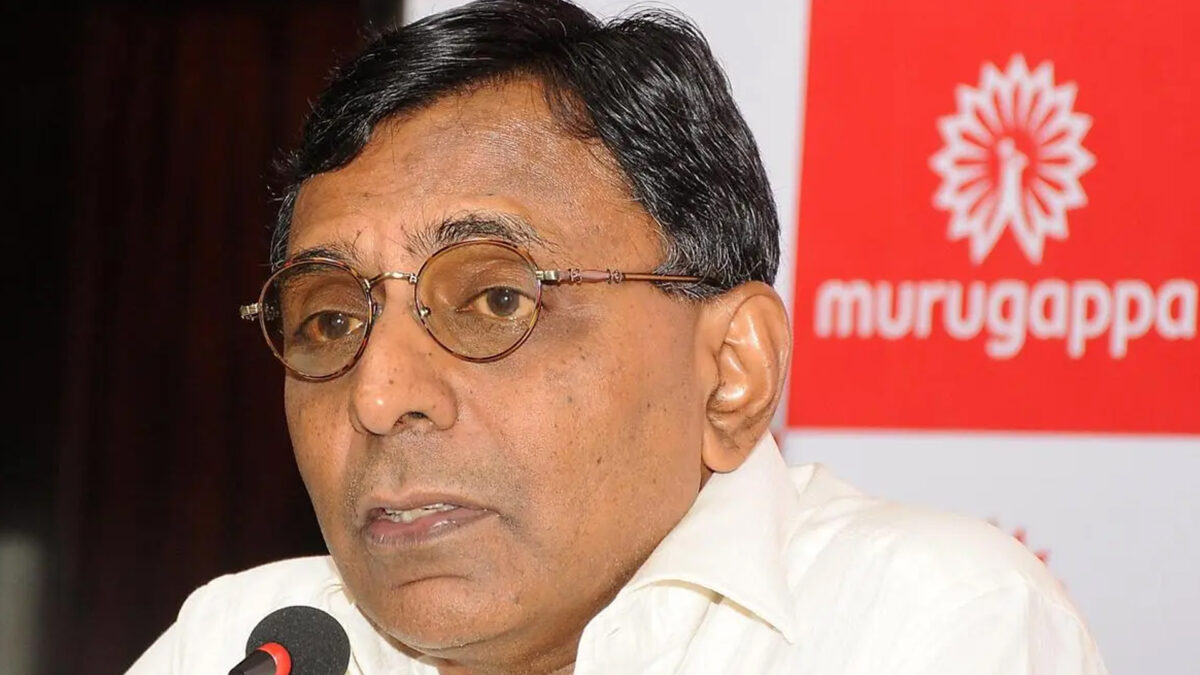
Murugappa Group’s former chairman, passes away at 72

Arunachalam Vellayan, the respected former Chairman of the Murugappa Group, passed away on Monday at the age of 72 after a long illness. Known for his calm leadership and thoughtful guidance, he helped shape one of India’s most enduring business families.

He is survived by his wife Lalitha, their sons Arun and Narayanan, and grandchildren, leaving behind a close-knit family that was dear to him.

Under his leadership, the Murugappa Group expanded across fertilizers, sugar, engineering, and financial services, with Vellayan guiding companies like Coromandel International and EID Parry Ltd. Beyond business, he was a mentor to many and played key roles in industry associations, helping Indian businesses grow responsibly.

An alumnus of The Doon School and Shri Ram College of Commerce, he also studied in the UK and received honorary doctorates for his contributions to industry.

Those who knew him remember not just his business acumen, but his generosity, humility, and commitment to nurturing talent. His passing leaves a significant void, but his legacy of vision, leadership, and care will continue to inspire.

Also Read: Ira Bindra of Reliance among top global CHROs